Showing posts with label hidden goal. Show all posts

Wednesday, February 20, 2013

Games I Grew Up On: Careers

One of the earlier board games with both choice and hidden goals that I played was a game called Careers.  The goal of the game is to get the right amount of Fame, Money, and Happiness that you wrote on your "Secret Formula" at the beginning of the game by going around the board traveling down various career paths such as Farming, Sea, Hollywood, etc.  Certain careers' squares were more geared towards one stat (Hollywood got you a lot of fame), so choosing the right career was an interesting and important choice in the game.  Most of these career paths have minimum requirements to enter (e.g. you need to have a certain degree by going through the College career path) and reward you for going through them multiple times.  Sometimes you would get Opportunity or Experience cards - akin to Monopoly's Chance and Community Chest cards - that let you either move a specific amount, bypass career requirements, or immediately go to a certain career.

As with most older board games, a lot of the game is determined by luck (if you don't land exactly at the start of a career path you want, you can't start going down that path), so I think it would be an interesting idea to revamp this game with a little less die rolling and a little more decision making.  The simplest way is my favorite method of replacing a die roll: a deck of cards numbered 1-6, every player has a hand of 3 cards or so and gets to decide which card to use to move forward, and then draws a new card.  It still has some elements of randomness that dice have, but it lets the player strategize a little more.  It would also be interesting to have some way to affect the other players.  I don't really remember there being any Opportunity or Experience cards that you could use on other players for example, but that might be interesting.

This definitely was an interesting game to play growing up that was one step more advanced than The Game of Life.  They are essentially the same game, but this has more interesting choices (if the die lets you have your way).  It was also an interesting way to teach young minds about potential career paths, the importance of going to college, and how it's okay to want no fame or money, but lots of happiness.

Friday, September 21, 2012

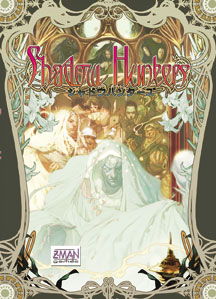
Review: Shadow Hunters

A war is being waged between Shadows and their hunters with some innocent bystanders caught in the middle.  In Shadow Hunters, players are randomly given characters from one of these three teams, which they keep secret.  Each team has their own goal, Shadows win by killing all the Hunters, Hunters win by killing all the Shadows, and Neutrals each have their own goal based on which character they have.

On their turn, players roll the dice to see which area they move to.  Based on the area they land on, players may draw a green, white, or black card or hurt/heal another player.  After that, the player may attack another player in an adjacent area.

Green cards (Hermit cards) are used to try to figure out who is what.  They each have instructions like, "Shadows and Hunters take on damage", so if a player is given this card and they are a Shadow or Hunter, they must move their health token up one space.  Otherwise they say, "This has no effect."  Using a combination of these cards and who attacks whom, players can start to determine who is on their side and who isn't.

White cards are usually defensive or healing items whereas Black cards are offensive items.  Characters also have special abilities that they can use once per game (except for some Neutrals whose special abilities are automatically used at specific times).

Gameplay is fairly simple, but filled with opportunities for strategies, deception, and teamwork.  However, setting up the game is a fairly complicated procedure and takes a lot more time than it should for how simple the game plays.  The game is for 4-8 players (more is better) and takes roughly 45 minutes to play.

Monday, September 17, 2012

Review: The Resistance

The Resistance has missions they must accomplish, but unbeknownst to them there are spies among their organization who are out to foil their plans.  Each side (spies and resistance) has 5 chances to achieve their own goals, the side that achieves their goal 3 times out of those 5 chances wins the game.

At the beginning of the game, players are given a card that determines whether they are part of the resistance, one of the spies, or the mission leader (the mission leader will also get a spy/resistance role card after he reveals he is a mission leader).  Just like in the beginning of Mafia, all players close their eyes and all the spies reveal themselves to each other so they know who they are working with.

The mission leader chooses a set number of players (based on which mission number they are on) to go on a mission.  All the players then vote on whether they approve of the team or not.  If the team is denied, the current mission leader passes that responsibility (and its card) to the player on their left and players repeat this process until a team is approved.

Once a team is approved, each team member gets a mission fail and mission success card.  They pass one of their choice to the  mission leader and the others go in a discard pile.  Resistance members MUST pass a success to the  mission leader, spies can choose either one.  Once all cards are distributed, the mission leader reveals them.  In 4 out of 5 of the missions, a single fail card revealed will be a success for the spies, otherwise the resistance wins.  The other mission requires to fail cards to fail the mission.  This cycle continues until one side has 3 victories.

This game is a very quick 30 minute game for 5-10 people (best with 7 players).  This game plays like a mix between Mastermind and Mafia.  There are relatively clear strategies/methods to figure out who is on which side, but just as many methods of deceiving each other.  I'm not sure how well this game would hold up if you played with the same group of friends repeatedly, but I guess that's a general problem with games of this sort, like Bang and Mafia.