Sorry, I'm not talking about hoarding, although I guess collecting goes wrong there, too. I'm talking about collectibles in video games and how they can ruin certain types of games (or at least certain sections). As I'm sure you're aware by this point, I love collecting things in games. I love scouring every corner of a world to find all the hidden widgets and whatsits (especially if there's a tracker or some way to know if I've missed any), but I've come to the realization that collectibles lying on the ground can completely ruin any dramatic tension a game may have built up, not to mention any sense of sanity in the playable character.
Say your girlfriend just got kidnapped and you've chased the bad guys into some building. Being a video game, chances are pretty good that you could just stand at the entrance indefinitely and the bad guys will never leave the building or try to find some other way to ferret away your girlfriend because you were just standing there. Personally, I appreciate this bit of video game logic since it lets me move the story forward at my choice. But it definitely kills the mood of the game if it's an intense moment and I stop because there might be some hidden goody in an adjacent room and I have to stop chasing them to go find it.
This happened a bunch during Last of Us where I'd meet someone and they'd say, "Come follow me to safety" and they'd just walk off. Logically and cinematically, I should immediately follow them to make sure I'm safe. But I know I can comically just ignore them to wander into all the rooms they should have already cleaned out of useful items to see if I can find anything since the story won't trigger until I reach a certain place and I know enemies won't be coming from anywhere until that point. The problem I'm talking about is mostly with collectibles in games like Uncharted, Last of Us, and Remember Me. The fairly linear, cinematic type games where the pacing is very important to the overall experience.
I think collectibles can be done in those games, but it should only be in the sections where you have no immediate goal to rush somewhere. So, if the collectibles were only found in some kind of rest area, usually found right after a particularly intense part of the game, then it wouldn't really break the pacing much. If they were consistent about it, then it would also help me to not constantly be breaking the action to scour all the corners of a room to see if I missed anything. I could play the action sequences like action sequences and the collection sections like a crazy OCD packrat - essentially how I treat collecting in any open world game. I am either running around in collection mode or I'm moving the story along, but I get to choose when to do both. Of course, this is all because I can't stop myself from needing to collect everything and hating the feeling that I missed something, so as usual, maybe it's more a personal problem than a game design problem...
Showing posts with label psychology. Show all posts
Showing posts with label psychology. Show all posts
Friday, September 27, 2013

Monday, September 23, 2013
Super Luigi U: The Timer Complex
Super Luigi U is a lot like every other side scrolling 2D Mario game. You need to get from the beginning to the end of a level, there are special coins to collect, and hidden goodies along the way. It's even more like Super Mario Bros. U than the rest because it's a redesigned version of the same game. I haven't actually played the original one yet, so I'm not sure how redesigned the levels are, but there are three consistent changes throughout the game: No Mario (hooray!), Nabbit (nearly invincible playable character when playing with 2 or more players), and only 100 seconds to complete each level.
While the first two changes have their own fairly large impact to the game, the 100 seconds per level fairly drastically changes things for the better, with one side effect. With only 100 seconds to play in each level, there isn't a lot of time to explore and test every pipe for secrets, so the secret coins have to be more cleverly hidden, but still be quick to reach. Most of the time they'll be in a slightly harder to reach path or behind a hidden wall. Some of them, I'm not entirely sure how you're supposed to get them without a sacrificial leap from a cooperative player (but I'm sure there are ways because all coins should be reachable with just Luigi alone). 100 seconds on the clock also means that at most, each level is only going to take a little over 1.5 minutes, which means that it's very easy to complete a given world within 30 minutes if you're not going for coins and not completing every level. It also means that replaying a level over and over again to get those coins isn't as punishing. With 100 seconds, there are no need for checkpoints, so you can't accidentally activate a checkpoint right after missing a Star Coin (thus having to play another level or beat the current one and play it again).
The side effect of the 100 seconds is that other Mario games have trained you to panic and rush when you hear the "Hurry up!" music that plays when a level's timer reaches 100 seconds. Well, in Super Luigi U, every level starts with that noise and they certainly take advantage of the psychology by making a few levels here and there where you specifically have to slow down and wait right at the beginning. Many a death was caused by the previous training from Mario games.
It's interesting to see how drastically a Mario game can change when the timer is so short. It never really felt like I had to rush (unless I had stopped to explore too long), but it actually puts on the pressure of the clock that I haven't felt in nearly any other Mario game. I generally hate time limits, but I think Super Luigi U finally made the timer in a Mario game actually purposeful.
While the first two changes have their own fairly large impact to the game, the 100 seconds per level fairly drastically changes things for the better, with one side effect. With only 100 seconds to play in each level, there isn't a lot of time to explore and test every pipe for secrets, so the secret coins have to be more cleverly hidden, but still be quick to reach. Most of the time they'll be in a slightly harder to reach path or behind a hidden wall. Some of them, I'm not entirely sure how you're supposed to get them without a sacrificial leap from a cooperative player (but I'm sure there are ways because all coins should be reachable with just Luigi alone). 100 seconds on the clock also means that at most, each level is only going to take a little over 1.5 minutes, which means that it's very easy to complete a given world within 30 minutes if you're not going for coins and not completing every level. It also means that replaying a level over and over again to get those coins isn't as punishing. With 100 seconds, there are no need for checkpoints, so you can't accidentally activate a checkpoint right after missing a Star Coin (thus having to play another level or beat the current one and play it again).
The side effect of the 100 seconds is that other Mario games have trained you to panic and rush when you hear the "Hurry up!" music that plays when a level's timer reaches 100 seconds. Well, in Super Luigi U, every level starts with that noise and they certainly take advantage of the psychology by making a few levels here and there where you specifically have to slow down and wait right at the beginning. Many a death was caused by the previous training from Mario games.
It's interesting to see how drastically a Mario game can change when the timer is so short. It never really felt like I had to rush (unless I had stopped to explore too long), but it actually puts on the pressure of the clock that I haven't felt in nearly any other Mario game. I generally hate time limits, but I think Super Luigi U finally made the timer in a Mario game actually purposeful.
Friday, August 23, 2013
Choosing Random vs. Random Choice
A game design issue that I've been working and struggling with at my job lately is the difference between choosing to take a gamble that involves some random chance in it vs. having some outcome of the game be randomly selected for you. The end result is going to be the same regardless of which way the game is designed, but it feels incredibly different from a player's point of view because in one case they get to choose to take a risk and in the other case, they have no choice and whether the end result is good or not, it doesn't feel as satisfying.
I'll give an example to make this a little clearer. In the game I'm currently working on, there's a lot of hidden information. So what information each player gets is very important and what they do with that information is the real crux of the game. In the original design, one player moved pawns around and each turn, had a random chance of seeing what the other player did at those spots. Having multiple pawns on the same spot would increase that random chance. So, the "interesting" choice they had was how to allot their resources and hope for the best. It turns out (unsurprisingly now that I look back at it) that this is really not fun to play.
The new design is to instead give the first player a bunch of false information along with information about what the other player is doing. They can't tell the difference between false and real information, so the choice is still seemingly random, but the player gets to choose which information they think is real. Eventually, the player should have enough information to start figuring out what the other player is doing and deduce their strategy and come up with a good counter strategy. This makes it so the interesting choice is how to deal with the information you have and not how to hopefully get the right information.
A similar example of random choice is battle in the game of Risk. You do get to choose where to attack, but the outcome is pretty much completely random, so even if your strategy is amazing or you have 99 times as many units as the other player, you can still lose because the dice hate you. It's still important for the defender to have some method of surviving an attack, but at some point, the better strategy should be rewarded over the luckier player. Of course, this is why the combat in my first board game took a long time to play because I eliminated random die rolling and had straight up math (attack vs. defense), which taught me a whole other lesson. Still a balance I have yet to completely figure out.
Monday, August 12, 2013
Dealing With Virtual Loss
I don't seem to deal well with losing characters in video games, even when it's fairly inevitable. In any game with minions (Overlord, Pikmin, Little King's Story, etc.) or in games with permanent party member deaths (Fire Emblem, X-Com, etc.) I find myself constantly reloading and replaying sections whenever any of my group dies. In some cases, like X-Com, this means I'm essentially cheating because I'm not really accepting the fate of my teammates, don't have to lose money in getting more teammates, and don't have to retrain new troops. In other cases, it's just really frustrating (any of the bosses in Pikmin games since it's inevitable that some Pikmin will die).
My theory about why I can't handle loss is twofold: all other video games have taught me that dying means I failed at the game and also, I seem to get attached to things too easily. Even with a troop of completely non-unique followers, I still can't stand to lose them, let alone if they're given names or have unique traits (like the super hilarious and awesome helmets the minions in Overlord would wear). What really makes this hard is when there are statistics being kept of how many I've lost or the memorial to them. There's no real game design problem with this, this is entirely a personal problem of mine. So far, the only way I've been able to handle the loss is if I get sick of repeating the same thing over and over again.
All this is probably the same reason I don't like reading/watching/playing things where characters die, but at least when its the story that kills them off I had no control over it, so it can't be my fault. I wonder if that's why I care so much...I feel like I got them killed...man, I'd never survive a zombie apocalypse, if I didn't get outright killed, I'd be consumed with guilt for anyone I couldn't save.
Monday, July 22, 2013
Random Consequences In Game
As my final single player Xbox games in my game backlog, I'm finishing up Infinite Undiscovery. I only paid $10 for this, so I'm not too miffed that it starts out as a very generic JRPG and the game only gets more frustrating as it goes on. One odd game design decision that's bugging me the most is a very strange choice to punish players for trying to play the game. The game is an action RPG with large areas filled with wild monsters to fight. Fighting those monsters makes your characters stronger. Most of your characters' abilities are powered by the moon. At a certain point in the game, the moon starts raining lunar rays on the world while you're exploring. Exposure to this lunar rain makes your characters more powerful until they have too much power to control and turn into monsters. You have a few ways to combat this, so it wouldn't be so bad except for one thing: the lunar rain occurs at random times for random intervals.
So it may be that you can fight monsters for awhile before having to run from the lunar rain. Or it may never stop raining because a random chance has decreed it. Unfortunately, if you find yourself underpowered in a section, the only way to get better is to fight monsters. So there's a random chance that doing what you need to will be impossible without having to lose and fight your own teammates. This bizarre problem that has repeatedly made me just run blindly through areas is made worse by the fact that you can't seem to tell your teammates to run blindly like you do. You can set them to a non-aggressive mode where they won't attack, but at they'll inevitably get hit a few times when running past monsters and will then stop to heal themselves, only to end up getting killed because they decided to stop.
So, I guess the takeaway from this is if you're going to have some (potentially) interesting pressure put on the player, make sure it doesn't conflict with the main gameplay element of the game making them not want to play the main gameplay element (and thus the game itself). Or at least make sure that their method of avoiding that main gameplay element doesn't have annoying detriments of its own.
So it may be that you can fight monsters for awhile before having to run from the lunar rain. Or it may never stop raining because a random chance has decreed it. Unfortunately, if you find yourself underpowered in a section, the only way to get better is to fight monsters. So there's a random chance that doing what you need to will be impossible without having to lose and fight your own teammates. This bizarre problem that has repeatedly made me just run blindly through areas is made worse by the fact that you can't seem to tell your teammates to run blindly like you do. You can set them to a non-aggressive mode where they won't attack, but at they'll inevitably get hit a few times when running past monsters and will then stop to heal themselves, only to end up getting killed because they decided to stop.
So, I guess the takeaway from this is if you're going to have some (potentially) interesting pressure put on the player, make sure it doesn't conflict with the main gameplay element of the game making them not want to play the main gameplay element (and thus the game itself). Or at least make sure that their method of avoiding that main gameplay element doesn't have annoying detriments of its own.
Friday, June 21, 2013
Tension Cycles in Games
I've spent a lot of my free time this past week working on clearing up my backlog of half finished games, games that for some reason or another I stopped part way through. One of those games were Dead Space. While playing, I noticed that I was super tense and on the edge of my seat the entire time. This wasn't due to being excited or scared (although Dead Space is really good at building a terrifying atmosphere), but the game just builds a state of tension without really letting up. You learn often and repeatedly that there isn't really any safe places. Right when you think backtracking through previously cleared rooms or entering a room with a save station in it will be safe, the game tricks you. This makes it much harder to play for long periods of time (the human body is not meant to be in a state of tension for so long. Ultimately, for a game that is built for a joyride/intense experience, the moments of tension and excitement should be the punctuation marks between moments of safety/lulls so they can be more meaningful.
One game that did this cycle really well was Left 4 Dead. The AI of the game was designed to come in waves when those lulls were getting too long and to let up when things were getting too tense. There was also a little leeway on both ends to keep it from being predictable and there were also safe houses to go to (the whole point of most of the levels) where it was guaranteed to be safe once inside. This was nice because during the tense moments, if you were near the safe house, you knew you could try to make a break for it if/when things got too bad. If you weren't near a safe house, you knew you just had to survive long enough for things to calm down a little. This same thought also tended to make me do brave/stupid/risky things since I knew I'd have a chance to try to recover if I could just last a little bit longer. If the game is super tense the entire time, it's only going to make the player more careful and deliberate instead of giving them those fun moments where they can be bold.
One game that did this cycle really well was Left 4 Dead. The AI of the game was designed to come in waves when those lulls were getting too long and to let up when things were getting too tense. There was also a little leeway on both ends to keep it from being predictable and there were also safe houses to go to (the whole point of most of the levels) where it was guaranteed to be safe once inside. This was nice because during the tense moments, if you were near the safe house, you knew you could try to make a break for it if/when things got too bad. If you weren't near a safe house, you knew you just had to survive long enough for things to calm down a little. This same thought also tended to make me do brave/stupid/risky things since I knew I'd have a chance to try to recover if I could just last a little bit longer. If the game is super tense the entire time, it's only going to make the player more careful and deliberate instead of giving them those fun moments where they can be bold.
Friday, June 7, 2013
Gaming Pet Peeve: Poor User Input Responsiveness
I've noticed a common trend in a lot of the games I've played and been frustrated by recently. In many games, a button prompt will appear when you can interact with some object in the world. This is good and basic user interface design. Where it goes wrong is when the display appears, but pressing the button does nothing. Even if that prompt appears for a split second, if the user has been spamming the button, the button should do something when that prompt is visible. This is especially annoying if the interaction button is the same as, say, the jump button. So instead of interacting with something you end up jumping over it and since you were holding forward, you went past it. If that object happened to be on a cliff edge...well...that sucks.
This is one of those game design things to cater to the impatient gamer. I've opened tons of chests before already in this game, I know what button to push, so the prompt is an indicator that I'm in the right spot to interact with the chest. If the prompt appears and pressing the button doesn't open the chest, the prompt has failed its job. The simplest way to do this is for the prompt visibility radius to be smaller than the actual interaction radius. That way if the user is spamming the button, they'll interact with the chest before the prompt appears rather than the other way around.
This is one of those game design things to cater to the impatient gamer. I've opened tons of chests before already in this game, I know what button to push, so the prompt is an indicator that I'm in the right spot to interact with the chest. If the prompt appears and pressing the button doesn't open the chest, the prompt has failed its job. The simplest way to do this is for the prompt visibility radius to be smaller than the actual interaction radius. That way if the user is spamming the button, they'll interact with the chest before the prompt appears rather than the other way around.
Monday, June 3, 2013
Compulsion Review System
Back in the early 2000's, there was a game review website Old Man Murray that was all about snarky reviews on games that got strong reviews elsewhere - sort of like Zero Punctuation. One of the very novel things that came out of it was the Crate Review System, where a game would be judged by how long it took to get to the first crate because after that point, "the designer has run out of ideas" according to the article. This review system is a joke (but still something interesting to think about when playing games), but I've just developed my own review system that works along similar lines. I'm now going to start judging games based on how long I play until my need to finish a game overrides my need to do everything in a game. I call it, the Compulsion Review System.
In a perfectly designed game, I should still be having fun when I finish completing all the side quests/gathering all the collectibles so that I can finish the game and have both compulsions happy at the end. When doing all the side things in a games starts being work and stops being fun or when parts of the game start frustrating me enough that my need to finish the game gets stronger, the game has over stayed its welcome. Now, my need to gotta catch 'em all is pretty darn strong, so I don't know the conversion rate between happy Erics and happy *insert name here*s. Meaning, this review system doesn't work that well for me to tell other people how good a game is. That is, unless the game is so bad that the compulsion is overridden near the beginning of the game. That means that the collecting is so boring, the mechanics are so broken, or the difficulty level is so high that I just don't care anymore.
It's also possible for the need to finish the game compulsion to get ignored, but that takes a truly terrible game. Either that or I just got distracted by a game I had been looking forward to for a long time. But even then, the game will be sitting on my shelf mocking me for having not beaten it, so that's an extremely rare thing. And this is how you use your own personal crazy to work for you instead of against you. The more you know....
Wednesday, March 27, 2013
Games I Grew Up On: Dragon Warrior
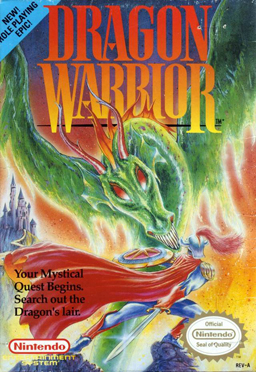
This game is also where I've gotten the fantasy name I use for my main character, Erdrick - the original Dragon Warrior. Yeah, basically it's just my name with a slight fantasy spelling to it, but I've never been good at naming. Most of my Pokemon are named after the first attribute I see in them or what animal they resemble. This is especially since that's pretty much their name anyway (e.g. Zubat = Batty).
There are enough game design issues with the game, that I don't think I could play through it again nowadays (I would not look forward to spending hours walking up and down those three squares fighting werewolves to try to kill a metal slime before it runs away). However, there are designers out there that still have the right touch, as evidenced by the time I sunk 100 hours into Dragon Quest IX without realizing it (you get an accolade for playing the game that long and I was utterly surprised when I got it).
Monday, March 25, 2013
Random Loot Drops
I've started to get really annoyed lately with the random loot drop model of rewarding players in games like Borderlands, Darksiders 2, and Diablo. This reward model feels exactly like a slot machine to me except instead of pulling a lever, I'm killing a monster or opening a chest somewhere. It means that instead of any skill I have being rewarded, it's a random die roll determining if that activity I just partook in was a waste of my time or not. Not to mention that if you do get that natural 6/20/100/whatever that gets you the most awesome loot, then that pretty much solidifies that the loot you get for the next hour if not the rest of the game is a complete waste of time. It also makes gold in a game completely pointless since killing enemies potentially gives you better equipment and experience, whereas gold could potentially buy you yet another random chance at something better than what you have. In a game where rewards are determined based on hidden items, important kills (i.e. bosses), and expensive items, players are rewarded for their hard work, skill, and ability to work towards a goal.
One way to mitigate the ill effects of the random loot drop reward system is to still put in those hidden chests, those bosses that reward you with guaranteed superior items, or expensive items that you can't find randomly, but the random loot drop still isn't adding anything worthwhile to the game. This whole system is kind of like how rolling character stats in older games based on D&D worked. You roll to determine your starting stats and then tweak them how you see fit. The problem is, I'll just sit there re-rolling until I get the best numbers, which not just wastes my time pointlessly, but I can't use my stats to help roleplay my characters since they are all the same (e.g. I won't have a dumb fighter, or a wizard incapable of hand to hand combat). But I've already talked about this, so getting back to the topic at hand, another problem with the random loot drop is that moment when you do get that totally amazing item with super high stats, but it's for a different play style than yours. So, the chances of another super rare and awesome item are rare and since it's not your play style, you either have to change how you play the game, which can be difficult to do, or it's just a waste of a great item, which is really depressing. Who knows, maybe years from now I'll start liking this model again...
One way to mitigate the ill effects of the random loot drop reward system is to still put in those hidden chests, those bosses that reward you with guaranteed superior items, or expensive items that you can't find randomly, but the random loot drop still isn't adding anything worthwhile to the game. This whole system is kind of like how rolling character stats in older games based on D&D worked. You roll to determine your starting stats and then tweak them how you see fit. The problem is, I'll just sit there re-rolling until I get the best numbers, which not just wastes my time pointlessly, but I can't use my stats to help roleplay my characters since they are all the same (e.g. I won't have a dumb fighter, or a wizard incapable of hand to hand combat). But I've already talked about this, so getting back to the topic at hand, another problem with the random loot drop is that moment when you do get that totally amazing item with super high stats, but it's for a different play style than yours. So, the chances of another super rare and awesome item are rare and since it's not your play style, you either have to change how you play the game, which can be difficult to do, or it's just a waste of a great item, which is really depressing. Who knows, maybe years from now I'll start liking this model again...
Friday, March 8, 2013
The Pink Starburst Effect
Growing up, my family would help out at/attend a high school summer camp from my church called Survival Camp. There were many activities to do during free time that week, but one of my favorites was Starburst Poker. Obviously, since it was a church thing, outright gambling wasn't going to be allowed. There was a daily Snack Shack setup where kids could buy candy, though, and since they're all individually wrapped, it was easy to use Starbursts as chips to bet with. Starburst Poker has an interesting side effect that you'd never see in real poker that I have dubbed the Pink Starburst Effect (PSE for short). In regular Poker, chips or money are all worth the same amount to players across the board. The blue chip for me has the same value as the blue chip for you. However, in Starburst Poker, since we all can eat our winnings and people have different taste, different colors have different value to everyone. With most people, the pink Starburst is the most valuable one (hence the name), but that wasn't always the case. For me, yellow, red, and orange were all valued at 0 (throwaway money) and the pinks meant I had something awesome. I'm not good at bluffing, so I don't even try.
I never really thought of using this effect as a game mechanic intentionally until the last couple times of playing Suspicion. Early on in playtesting, I used little white tokens for people to easily tally how many points they had. In the later iterations, I changed it so you steal points from each other and I noticed a funny side effect with using those tokens. If people didn't have a game incentive/feud helping them decide who to take points from, they would pick based on shapes to help them create whatever it was they would make using the shapes when they weren't playing. For example, one of my friends like to create a battleship, so if he needs that road piece for the cannon and you've got one, then you better watch out!
In the final version of Suspicion, the tokens aren't going to be shapes, so that game mechanic won't be in the final version, but it's definitely given me an idea for another game. I would like to see if actually turning that into a mechanic ruins the fun of it. Stealing a particular shape from someone for fun is entertaining and harmless. But if the game makes you search for particular shapes, is the enjoyment PSE going to be altered? One day I hope to find out.
Subscribe to:
Posts (Atom)