Just like almost all the other Gameboy games I played growing up, Batman the Video Game was hard, but fairly simple game. Much like Super Mario Land, you can only move to the right, there are hidden blocks, enemies and bottomless pits that will kill you fairly quickly, and the occasional flying stage. Unlike Super Mario Land (and unlike Batman in pretty much every iteration ever), you use a gun to break blocks and kill enemies. Similar to Contra, there are power ups that change which gun you are using (the most powerful one shoots Batarangs) as well as powerups for being able to shoot more bullets, be protected by a circle of Batarangs, speed up said Batarangs, and get extra lives.
I think the "plot" of the game is trying to follow the movie? It starts with you confronting Jack in the Axis Chemical Factory. Then you go through a museum. Then the batwing levels (which were pretty brutally difficult shoot 'em ups). Then into the cathedral to face the Joker once and for all. I guess it was short just like Super Mario Land, too. It's also pretty entertaining because the life counter is in hexadecimal and how the first and last boss fights are pretty much identical. If you have 30 minutes to kill, you can watch the entire game here. I remember really hating that auto scrolling level at the end...
Showing posts with label nintendo. Show all posts
Wednesday, October 9, 2013
Monday, September 23, 2013
Super Luigi U: The Timer Complex
Super Luigi U is a lot like every other side scrolling 2D Mario game. You need to get from the beginning to the end of a level, there are special coins to collect, and hidden goodies along the way. It's even more like Super Mario Bros. U than the rest because it's a redesigned version of the same game. I haven't actually played the original one yet, so I'm not sure how redesigned the levels are, but there are three consistent changes throughout the game: No Mario (hooray!), Nabbit (nearly invincible playable character when playing with 2 or more players), and only 100 seconds to complete each level.
While the first two changes have their own fairly large impact to the game, the 100 seconds per level fairly drastically changes things for the better, with one side effect. With only 100 seconds to play in each level, there isn't a lot of time to explore and test every pipe for secrets, so the secret coins have to be more cleverly hidden, but still be quick to reach. Most of the time they'll be in a slightly harder to reach path or behind a hidden wall. Some of them, I'm not entirely sure how you're supposed to get them without a sacrificial leap from a cooperative player (but I'm sure there are ways because all coins should be reachable with just Luigi alone). 100 seconds on the clock also means that at most, each level is only going to take a little over 1.5 minutes, which means that it's very easy to complete a given world within 30 minutes if you're not going for coins and not completing every level. It also means that replaying a level over and over again to get those coins isn't as punishing. With 100 seconds, there are no need for checkpoints, so you can't accidentally activate a checkpoint right after missing a Star Coin (thus having to play another level or beat the current one and play it again).
The side effect of the 100 seconds is that other Mario games have trained you to panic and rush when you hear the "Hurry up!" music that plays when a level's timer reaches 100 seconds. Well, in Super Luigi U, every level starts with that noise and they certainly take advantage of the psychology by making a few levels here and there where you specifically have to slow down and wait right at the beginning. Many a death was caused by the previous training from Mario games.
It's interesting to see how drastically a Mario game can change when the timer is so short. It never really felt like I had to rush (unless I had stopped to explore too long), but it actually puts on the pressure of the clock that I haven't felt in nearly any other Mario game. I generally hate time limits, but I think Super Luigi U finally made the timer in a Mario game actually purposeful.
Labels:
game design,
nintendo,
psychology,
video games
Monday, September 16, 2013
Coming Attractions: Fall 2013 Video Games
- September
- The Wonderful 101
- Out Now!
- Strategic action game about controlling up to 100 super heroes at once much like Pikmin in a Pikmin game or like the armies in Little Kings Story
- I've heard this is very difficult, so I'm probably going to put it on the end of my list for now
- October
- LEGO Marvel Super Heroes
- October 18th
- A TT Games LEGO game with Marvel super heroes
- I have yet to be disappointed by a Lego game and they have only gotten better after each one
- Sonic Lost World
- October 22nd
- A Super Mario Galaxy-style game involving Sonic and his universe
- This looks like it will be pretty fun with even more Gamepad cooperative gameplay like Rayman Legends and Super Luigi U
- Batman: Arkham Origins
- October 25th
- The prequel to the two previous Batman: Arkham games
- Although this is developed by a different company, I still am hoping that this will be a quality adventure with a lot of detail and uniqueness for each of the villains. I hope this game does justice to the other two and isn't just a quick cash grab
- Wii Party U
- October 25th
- A Wii U mini-game party game akin to Mario Party, but with Miis
- Honestly, I'm getting this for two reasons: It comes with a motion plus Wiimote and so far the Wii U has been a really good party system for my house on game nights with Nintendo Land, Super Luigi U, and Rayman Legends
- Assasssin's Creed 4: Black Flag
- October 29th
- The fourth assassin ancestor of Desmond (I think it's the sixth main game in the series?) involving pirates and of course, assassins
- I'm really hoping they utilize the Gamepad in some unique way, but even if it's just a more convenient map, it'll still be worth me purchasing it on the Wii U in my opinion
- November
- Watch Dogs
- November 19th
- Open world hacking game. I don't know too much about the game because the short trailer a saw impressed me enough to convince me that I want it, so I stopped paying attention to anything about it (how I normally treat anything I am already convinced I want to buy)
- Just like AC4, I'm hoping they make good use of the Gamepad and that there are a plethora of ways to hack through any given situation
- The Legend of Zelda: A Link Between Worlds
- November 22nd
- A 3DS Legend of Zelda game that's essentially a successor to Link to the Past, which was my absolute favorite Zelda game ever
- I hope the Overworld and Dark world is as vast and filled with as many little secrets as the SNES game
- Super Mario World 3D
- November 22nd
- A sequel to the 3DS's Mario Land 3D, but adding in multiplayers and different character abilities like in Super Mario Bros. 2 (at least as far as I understand it)
- Whether I end up playing it alone or with friends, Mario Land 3D was one of my favorite recent Mario games, so more games in this style excite me
- Undetermined
- Phoenix Wright: Ace Attorney: Dual Destinies
- The fifth entry in the Phoenix Wright series of defense attorney detective/puzzle gameplay
- I've only recently gone back and started playing the Phoenix Wright games, but they are definitely right up my alley: grand mysteries, awesome plot twists, and puzzle gameplay. Essentially each one is an interactive story that reminds me of the Two Minute Mysteries I used to read as a kid
Labels:
3ds,
coming soon,
nintendo,
video games,
wii u
Monday, August 26, 2013
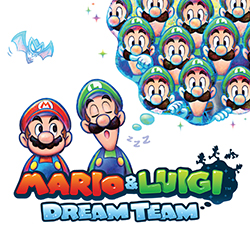
Review: Mario & Luigi: Dream Team
Unlike the Paper Mario series, the Mario & Luigi series seems to still be trying to follow Super Mario RPG in its gameplay and concepts. The latest in the series is Mario & Luigi: Dream Team and is not only focused more heavily on Luigi, which is always awesome, but doesn't portray him as a weak coward like the previous Mario & Luigi and Luigi's Mansions games always portray him. He's actually got quite a bit of courage this time around. I also really appreciated the fact that Bowser ended up being the main bad guy and he and his minions were more competent than they have been in past Mario games.
This is a fairly long game. Even though, I try to do everything in a game, I've always been fairly speedy at beating games and this took me a little less than 50 hours to beat. There's quite a lot to do and nearly all of it is quite enjoyable. Just like in Super Mario RPG, combat is a turn based system where correctly timed button presses can deal extra damage or avoid damage. Unlike Super Mario RPG, it's possible to completely avoid taking damage from enemy attacks and in most cases counterattack the enemy and deal damage to them instead during their attacks. The big difference between this game and other Mario & Luigi games is entering the Dream World through Luigi's dreams. In the overworld, Mario and Luigi are separate characters, Mario controlled with A and Luigi with B. In the Dream World, Dreamy Luigi combines with Mario to form one more powerful character. This is good since the enemies in the Dream World come in hordes of 10-20 at a time. It was actually pretty fun to have a mass of slightly weaker enemies to attack at once vs. the normal 3-5 enemies you normally face in these games.
Alongside the main quest, there are a plethora of side things to do. You can look for and rescue all the Pi'illo people that have been trapped throughout the island, you can find all the beans hidden in the ground throughout the island, you can replay harder versions of boss fights to try to win some coins, you can take on the expert challenges (generally just getting Excellent on attacks and avoiding all damage from enemies), and you can challenge yourself to a high score mode for the special attacks (basically repeat a special attack endlessly until you kill enough enemies or screw up performing the special attack). The item you get for completing all the expert challenges is well worth the time and effort it takes to get it, so I would recommend you try that, but the way the special attack challenges are done makes them not worth attempting. Each challenge requires you to get over 800 points even though some attacks are much slower or more challenging, so getting that score will take you much longer and many failed attempts. I personally did not find those fun in the slightest. Really my only complaint about the game.
Along with a leveling system that has the same choice and risk of Super Mario RPG (you get to pick the stat you're boosting, but you have a spinner deciding what you get), the game also has equipment that not only boosts your stats, but also gives you some interesting benefits, like doubling your defense when you have low health, possibly stunning enemies, or giving you back your Bros. Points (basically magic points, mana points, energy, etc. for using special attacks) if you score Excellent on the attack. By the end of the game I was just about invincible due to my combination of equipment. However, I still had to be fairly good at learning the enemy attacks so I could dodge them. So, I felt powerful, yet still challenged, which I think is how every good RPG should feel at the end.
So all in all, this is a quality game, very much worthy of following Super Mario RPG and trying to keep what that game did alive. I do still miss the hidden coin blocks in the overworld, but I guess I can't have everything...
Monday, August 5, 2013
Console Wars: 1st Year
I'm having issues finding solid data and numbers for the first year of video game console sales. Most of the searches I come across are all along the same ridiculous lines: "Company X is DOOMED!", "Video games are DOOMED!", or "The economy is DOOMED!" I find this hilarious because as far as I can remember (and this is where I wish I had more solid data), very few consoles do well in their first year. I know the 3DS, DS, PS3, and now the Wii U all had pretty miserable first years. In all cases, it was a severe lack of games because developers were trying to figure out how to develop for these systems.
The PS3 had its own super complicated tech to figure out, but if the developers could, it was super powerful. The DS was the first touch based gaming system with a few other bells and whistles that developers seemed to feel needed to all be utilized in every game (I'm so glad I don't have to blow out fires by blowing into the mic or talk at my DS anymore...). The 3DS was mostly the same except for the whole 3D factor. The Wii U has a completely separate screen that game designers need to figure out how to use. Most of those systems were also supposedly overpriced, but I feel like if a game system doesn't have enough games that you like on them, it really doesn't matter what price the system is for. Take for example the OUYA. It's only $100, the price of most collector edition games. All games on the system are "free" as well. However, I have zero interest in the system because not a single game I've heard about on the system sounds appealing to me.
It's especially entertaining to see people say Nintendo as a company is doomed because of lackluster Wii U sales (which is understandable since they only just now started releasing their big slew of games) when there are articles like this that are clearly indicating that the 3DS doing amazing well after a similarly terrible first year. Personally, I'm hoping the Wii U does well enough to get more than the Nintendo loyalists (like myself) to buy it because of all three new systems for the next generation of gaming, I feel like the Wii U has the most potential for new and different gaming experiences. Nintendo just needs to start making more asymmetric multiplayer games like the three minigames in Nintendo Land to show the other developers how it's done.
Labels:
console wars,
microsoft,
nintendo,
ranting,
sony,
video games
Friday, May 31, 2013
Thoughts on the Wii U
Since not all the information is available on the Xbox One or the PS4, I can't fully judge what they have to offer, but from what they have shown, I don't see anything really they're offering that really changes how games will be made. Prettier graphics, more advanced motion controls I don't want that will be foisted upon me, and (so far) no games I have any interest in. This made me feel even better about my purchase of the Wii U because the Wii U actually offers something new and unique to game designers to play with - a secret screen for only one player to see.
So far I have only played Nintendo Land and that for only one evening with a group of friends, so it's still mostly about the potential of the Wii U than anything concrete, but what I have seen so far has amazed me. Three minigames of Nintendo Land, all with a similar premise: one player with the Gamepad containing extra information not available to the other players vs. four other players who really must work as a team to defeat the solo player. In one game, the four are trying to catch the one, in the other two, the one is trying to catch the four. This is precisely what I love about the Wii U's new game possibilities - the ability to have players having different experiences with the same game. Nintendo originally had this same mechanic with the Game Boy Advance connecting with the Gamecube in Zelda Four Swords and Final Fantasy Crystal Chronicles. The downside of those was that you had to have friends who each had not only their own GBA, but also the cable that connects the GBA to the Gamecube. With the Wii U, I can have all the various gadgets needed and my friends merely need to bring their wonderful smiles. Of course, the battery life on the gamepad is pretty poor, but it looks like (hopefully) that won't be an issue much longer.
I look forward to when more games come out and I can see how the Wii U works for single player experiences. This has really been the reason the Wii U hasn't been doing well (and why the 3DS had such a slow start), but with all the announcements of things coming out starting in August (hooray Pikmin 3!), that shouldn't be a problem much longer. We'll see what Sony and Microsoft have to offer at E3 in a couple weeks, but at this point, I feel like they'd have to offer quite a bit to get my interest (especially Microsoft).
Monday, January 14, 2013
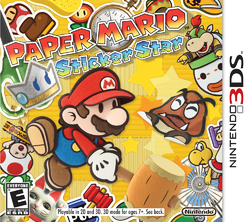
Review: Paper Mario Sticker Star OR How To Oversimplify
Ever since Super Mario RPG first transformed into a spin-off series called Paper Mario, the series has continually evolved while keeping the core combat and RPG systems intact. That is, until Paper Mario Sticker Star. Not only did they reduce the number of stats you have down to just your health, but they also added a combat system where it's possible to not be able to attack.
This game is all about stickers. All of your attacks are each stickers. You have a sticker album where you keep your attacks. When you use an attack sticker it is gone forever and you must collect more. Fortunately, they do seem to be scattered all over the place, so usually you won't run out, but there are definitely times where you'll be forced to use your higher quality and more powerful stickers against a weak enemy because you don't have any other low quality stickers to spend on him. Although this adds a somewhat interesting ammo consumption strategy to all the fights, it also makes the fights a lot more frustrating since you can't always use the best attack against the enemy.
On top of that, the only way to get more than one attack per turn is to successfully get two or three in a row on a slot machine style spinner that costs 3 coins to use each time. And since there are only a few sticker types that hit all enemies and only one of those works on flying enemies, of which there are an abundance in this game, you are forced to get really good at that slot machine, really fast. Especially since, unlike other Mario RPG games (at least in my memory, which is admittedly faulty) even if you successfully time the button press to block incoming attacks, you still take quite a large chunk of damage. In previous games, you could either level up or equip some badge that would reduce how much damage you take, which would make this less of an issue. In this game, however, you're just as likely to get killed by an enemy you meet early on at the end of the game as you are the final boss. And this is precisely why I miss the stats. By the end of the game, I felt no more powerful than I did at the beginning. Fighting a Goomba (the weakest enemy in the game) at the beginning of the game and at the end of the game is the exact same fight.
This lack of stats also makes the boss fights more of a puzzle than a challenge of your combat skills. This sounds like it would be right up my alley, except the solutions to all of these puzzles is to bring very specific stickers into the battle. If you don't have those stickers or use them at the wrong time, combat is just slow and torturous and your little crown friend will berate you for wasting so many stickers on that battle. The only way, without looking at guides, to know which stickers are required is to try the boss fight and die at least once after watching the attacks, patterns, and clues from the background/enemy. So in order to solve the puzzle, you have to fail at least once and that is not the feeling you want to instill in your players. I don't care if losing doesn't cost me anything, it is not fun to be forced to die against a boss in order to succeed. I should only die if I couldn't figure out the patterns/strategy before my health ran out. But if I didn't happen to bring a specific sticker (which generally take up large portions of your sticker album and are thus very costly), there is absolutely nothing I can do, but play through a slow and boring boss fight, hoping I can somehow outlast the other guy.
I am very saddened by where this game series has progressed and would definitely not recommend this game to others. Even though there are still very clever uses of the fact that everything in this world is made of paper, both gameplay and comedic effect, having to go through all that combat with no feeling of progress and fighting puzzle bosses with no way to solve the puzzle the first time except through luck or reading a walkthrough just makes the game very frustrating. I really hope the next Paper Mario brings back some of the RPG elements that made me love the series in the first place.
Monday, August 6, 2012
Lives In Video Games
While playing through various first party games for the Wii, I've discovered a strange trend that I thought we were over. Nintendo still seems to be stuck on giving the players a set of lives which cause a game over when they are all lost. This game design stopped making sense as soon as players gained the ability to save games. Before that point, beating games was an all or nothing thing. It made sense because there was no way to keep your progress partway through the game. However, once players gained the ability to save a game, the game over screen has little to no meaning. It's just a nuisance they have to sit through until they can load their saved game - which is also why the time between death and playing again should be as short as possible, but that's another topic.
It's even more ridiculous in modern day games like Super Mario Bros. Wii, Super Mario Galaxy, and Donkey Kong Country Returns because games are saved after every level or whenever the player chooses, so the game over screen has no power over them. They lose absolutely nothing from the game over. They already have to start a level over either completely or part way because they lost a life. I think they even realize this since in a lot of cases you can either buy extra lives (DKCR) or there are some easily obtainable ones scattered around the world (every Mario game). So what's the point of even having the life system other than nostalgia purposes?
What's even more ridiculous is that with the more recent Mario games, every time you start up the disc, you start with 4-5 lives, no matter what you had when you quit the last session, which means that if you quit before the final world, then you get to start the (generally) hardest part of the game without the stockpile of lives you had worked hard to earn. But Eric, if lives don't matter than why does it matter that they aren't saved along with your progress? Well, most of the time, 1-Ups in the levels of these games are either well hidden or hard to get. So getting them takes skill and the 1-Up is your reward. So every time you quit the game, you lose all the rewards and proof of your hard work. Also, even though the game over screen doesn't affect your progress, it's still a big "YOU SUCK" to the player when it happens, which is why players don't need to see that on the harder levels - they're already going to be frustrated enough without the game reasserting how awful they are.
I can't really think of any other modern games that have this same concept of lives other than Nintendo games. Most games give you a health bar and a single life before the Game Over screen (which makes sense). So other than the fact that it would make coins/bananas and 1-Ups completely pointless, I can't think of a single reason why Nintendo keeps them around.
Subscribe to:
Posts (Atom)