I've recently started listening to podcasts while I'm working. Usually I'll start listening to things when it's either getting too loud in the office to concentrate or if I feel myself starting to zone out or get distracted and I need to refocus on my work. Those seem like times where I totally wouldn't want to listen to a group of guys talking about video games, but it seems that most of the time, that helps me focus more than anything else I've found. One of my favorite podcasts I've been told about lately is the Giant Bombcast. I haven't listened enough to really get to know the guys individually, but it's a long (2-3 hour) podcast about what the guys have been doing lately, what games they've been playing, any recent gaming news and their thoughts on it, and responses to listener e-mails.
It reminds me of the morning show I listen to on the radio where they have a list of things to talk about, but get easily distracted or go into great depth about whatever they feel like, which makes it feel more personal than just a normal news thing, but it never feels like they're trying to force their opinions on anyone (well...maybe on each other), they just share what they feel about the given topic so it never really feels preachy or manipulative. They also seem to enjoy a variety of different games and systems, so it doesn't seem very biased overall. If you've got enough time to listen to podcasts and enjoy gaming, then I would recommend listening to the giant bombcast. It pops up every Tuesday, I think in the late afternoon roughly.
Showing posts with label video games. Show all posts
Showing posts with label video games. Show all posts
Friday, October 11, 2013

Wednesday, October 9, 2013
Games I Grew Up On: Batman The Video Game

I think the "plot" of the game is trying to follow the movie? It starts with you confronting Jack in the Axis Chemical Factory. Then you go through a museum. Then the batwing levels (which were pretty brutally difficult shoot 'em ups). Then into the cathedral to face the Joker once and for all. I guess it was short just like Super Mario Land, too. It's also pretty entertaining because the life counter is in hexadecimal and how the first and last boss fights are pretty much identical. If you have 30 minutes to kill, you can watch the entire game here. I remember really hating that auto scrolling level at the end...
Friday, September 27, 2013
When Collecting Goes Wrong
Sorry, I'm not talking about hoarding, although I guess collecting goes wrong there, too. I'm talking about collectibles in video games and how they can ruin certain types of games (or at least certain sections). As I'm sure you're aware by this point, I love collecting things in games. I love scouring every corner of a world to find all the hidden widgets and whatsits (especially if there's a tracker or some way to know if I've missed any), but I've come to the realization that collectibles lying on the ground can completely ruin any dramatic tension a game may have built up, not to mention any sense of sanity in the playable character.
Say your girlfriend just got kidnapped and you've chased the bad guys into some building. Being a video game, chances are pretty good that you could just stand at the entrance indefinitely and the bad guys will never leave the building or try to find some other way to ferret away your girlfriend because you were just standing there. Personally, I appreciate this bit of video game logic since it lets me move the story forward at my choice. But it definitely kills the mood of the game if it's an intense moment and I stop because there might be some hidden goody in an adjacent room and I have to stop chasing them to go find it.
This happened a bunch during Last of Us where I'd meet someone and they'd say, "Come follow me to safety" and they'd just walk off. Logically and cinematically, I should immediately follow them to make sure I'm safe. But I know I can comically just ignore them to wander into all the rooms they should have already cleaned out of useful items to see if I can find anything since the story won't trigger until I reach a certain place and I know enemies won't be coming from anywhere until that point. The problem I'm talking about is mostly with collectibles in games like Uncharted, Last of Us, and Remember Me. The fairly linear, cinematic type games where the pacing is very important to the overall experience.
I think collectibles can be done in those games, but it should only be in the sections where you have no immediate goal to rush somewhere. So, if the collectibles were only found in some kind of rest area, usually found right after a particularly intense part of the game, then it wouldn't really break the pacing much. If they were consistent about it, then it would also help me to not constantly be breaking the action to scour all the corners of a room to see if I missed anything. I could play the action sequences like action sequences and the collection sections like a crazy OCD packrat - essentially how I treat collecting in any open world game. I am either running around in collection mode or I'm moving the story along, but I get to choose when to do both. Of course, this is all because I can't stop myself from needing to collect everything and hating the feeling that I missed something, so as usual, maybe it's more a personal problem than a game design problem...
Say your girlfriend just got kidnapped and you've chased the bad guys into some building. Being a video game, chances are pretty good that you could just stand at the entrance indefinitely and the bad guys will never leave the building or try to find some other way to ferret away your girlfriend because you were just standing there. Personally, I appreciate this bit of video game logic since it lets me move the story forward at my choice. But it definitely kills the mood of the game if it's an intense moment and I stop because there might be some hidden goody in an adjacent room and I have to stop chasing them to go find it.
This happened a bunch during Last of Us where I'd meet someone and they'd say, "Come follow me to safety" and they'd just walk off. Logically and cinematically, I should immediately follow them to make sure I'm safe. But I know I can comically just ignore them to wander into all the rooms they should have already cleaned out of useful items to see if I can find anything since the story won't trigger until I reach a certain place and I know enemies won't be coming from anywhere until that point. The problem I'm talking about is mostly with collectibles in games like Uncharted, Last of Us, and Remember Me. The fairly linear, cinematic type games where the pacing is very important to the overall experience.
I think collectibles can be done in those games, but it should only be in the sections where you have no immediate goal to rush somewhere. So, if the collectibles were only found in some kind of rest area, usually found right after a particularly intense part of the game, then it wouldn't really break the pacing much. If they were consistent about it, then it would also help me to not constantly be breaking the action to scour all the corners of a room to see if I missed anything. I could play the action sequences like action sequences and the collection sections like a crazy OCD packrat - essentially how I treat collecting in any open world game. I am either running around in collection mode or I'm moving the story along, but I get to choose when to do both. Of course, this is all because I can't stop myself from needing to collect everything and hating the feeling that I missed something, so as usual, maybe it's more a personal problem than a game design problem...
Wednesday, September 25, 2013
Games I Grew Up On: Zelda II - The Adventure of Link
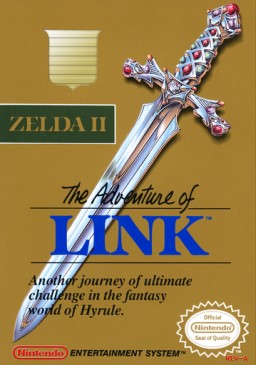
Zelda II was one of those really rare sequels that has so little in common with the original that it's hard to see them as a series. I guess there's still an overworld map, but you don't fight anything there. Instead, if you touch an enemy in the overworld map, you get brought to a side scrolling view where you have to walk to either the left or right edge of the screen to get back to the overworld. The game also had a (in my opinion) really awesome RPG aspect to it where killing monsters garnered XP that would eventually give you more levels to put into your health, your sword, or your magic. All three of these were crucial and by the end of the game, you'll have maxed your level so you can't choose incorrectly, you just determine how hard/easy it is to make it through the game to the end. The map also held a number of secret locations that stored extra hearts, important items, and more monsters that you'd either need a guide to play along with or memorize where they all are because they are visually indistinguishable from the land around them.
I've managed to beat this game once and I had a friend who just celebrated his victory over the game. This is definitely a game where beating it is an accomplishment. This game also just came out for the Wii U virtual console and is also available on the Wii and 3DS virtual consoles, so if you're really itching for some true challenge and exploration, then I would recommend this game. I am Error.
Monday, September 23, 2013
Super Luigi U: The Timer Complex
Super Luigi U is a lot like every other side scrolling 2D Mario game. You need to get from the beginning to the end of a level, there are special coins to collect, and hidden goodies along the way. It's even more like Super Mario Bros. U than the rest because it's a redesigned version of the same game. I haven't actually played the original one yet, so I'm not sure how redesigned the levels are, but there are three consistent changes throughout the game: No Mario (hooray!), Nabbit (nearly invincible playable character when playing with 2 or more players), and only 100 seconds to complete each level.
While the first two changes have their own fairly large impact to the game, the 100 seconds per level fairly drastically changes things for the better, with one side effect. With only 100 seconds to play in each level, there isn't a lot of time to explore and test every pipe for secrets, so the secret coins have to be more cleverly hidden, but still be quick to reach. Most of the time they'll be in a slightly harder to reach path or behind a hidden wall. Some of them, I'm not entirely sure how you're supposed to get them without a sacrificial leap from a cooperative player (but I'm sure there are ways because all coins should be reachable with just Luigi alone). 100 seconds on the clock also means that at most, each level is only going to take a little over 1.5 minutes, which means that it's very easy to complete a given world within 30 minutes if you're not going for coins and not completing every level. It also means that replaying a level over and over again to get those coins isn't as punishing. With 100 seconds, there are no need for checkpoints, so you can't accidentally activate a checkpoint right after missing a Star Coin (thus having to play another level or beat the current one and play it again).
The side effect of the 100 seconds is that other Mario games have trained you to panic and rush when you hear the "Hurry up!" music that plays when a level's timer reaches 100 seconds. Well, in Super Luigi U, every level starts with that noise and they certainly take advantage of the psychology by making a few levels here and there where you specifically have to slow down and wait right at the beginning. Many a death was caused by the previous training from Mario games.
It's interesting to see how drastically a Mario game can change when the timer is so short. It never really felt like I had to rush (unless I had stopped to explore too long), but it actually puts on the pressure of the clock that I haven't felt in nearly any other Mario game. I generally hate time limits, but I think Super Luigi U finally made the timer in a Mario game actually purposeful.
While the first two changes have their own fairly large impact to the game, the 100 seconds per level fairly drastically changes things for the better, with one side effect. With only 100 seconds to play in each level, there isn't a lot of time to explore and test every pipe for secrets, so the secret coins have to be more cleverly hidden, but still be quick to reach. Most of the time they'll be in a slightly harder to reach path or behind a hidden wall. Some of them, I'm not entirely sure how you're supposed to get them without a sacrificial leap from a cooperative player (but I'm sure there are ways because all coins should be reachable with just Luigi alone). 100 seconds on the clock also means that at most, each level is only going to take a little over 1.5 minutes, which means that it's very easy to complete a given world within 30 minutes if you're not going for coins and not completing every level. It also means that replaying a level over and over again to get those coins isn't as punishing. With 100 seconds, there are no need for checkpoints, so you can't accidentally activate a checkpoint right after missing a Star Coin (thus having to play another level or beat the current one and play it again).
The side effect of the 100 seconds is that other Mario games have trained you to panic and rush when you hear the "Hurry up!" music that plays when a level's timer reaches 100 seconds. Well, in Super Luigi U, every level starts with that noise and they certainly take advantage of the psychology by making a few levels here and there where you specifically have to slow down and wait right at the beginning. Many a death was caused by the previous training from Mario games.
It's interesting to see how drastically a Mario game can change when the timer is so short. It never really felt like I had to rush (unless I had stopped to explore too long), but it actually puts on the pressure of the clock that I haven't felt in nearly any other Mario game. I generally hate time limits, but I think Super Luigi U finally made the timer in a Mario game actually purposeful.
Monday, September 16, 2013
Coming Attractions: Fall 2013 Video Games
- September
- The Wonderful 101
- Out Now!
- Strategic action game about controlling up to 100 super heroes at once much like Pikmin in a Pikmin game or like the armies in Little Kings Story
- I've heard this is very difficult, so I'm probably going to put it on the end of my list for now
- October
- LEGO Marvel Super Heroes
- October 18th
- A TT Games LEGO game with Marvel super heroes
- I have yet to be disappointed by a Lego game and they have only gotten better after each one
- Sonic Lost World
- October 22nd
- A Super Mario Galaxy-style game involving Sonic and his universe
- This looks like it will be pretty fun with even more Gamepad cooperative gameplay like Rayman Legends and Super Luigi U
- Batman: Arkham Origins
- October 25th
- The prequel to the two previous Batman: Arkham games
- Although this is developed by a different company, I still am hoping that this will be a quality adventure with a lot of detail and uniqueness for each of the villains. I hope this game does justice to the other two and isn't just a quick cash grab
- Wii Party U
- October 25th
- A Wii U mini-game party game akin to Mario Party, but with Miis
- Honestly, I'm getting this for two reasons: It comes with a motion plus Wiimote and so far the Wii U has been a really good party system for my house on game nights with Nintendo Land, Super Luigi U, and Rayman Legends
- Assasssin's Creed 4: Black Flag
- October 29th
- The fourth assassin ancestor of Desmond (I think it's the sixth main game in the series?) involving pirates and of course, assassins
- I'm really hoping they utilize the Gamepad in some unique way, but even if it's just a more convenient map, it'll still be worth me purchasing it on the Wii U in my opinion
- November
- Watch Dogs
- November 19th
- Open world hacking game. I don't know too much about the game because the short trailer a saw impressed me enough to convince me that I want it, so I stopped paying attention to anything about it (how I normally treat anything I am already convinced I want to buy)
- Just like AC4, I'm hoping they make good use of the Gamepad and that there are a plethora of ways to hack through any given situation
- The Legend of Zelda: A Link Between Worlds
- November 22nd
- A 3DS Legend of Zelda game that's essentially a successor to Link to the Past, which was my absolute favorite Zelda game ever
- I hope the Overworld and Dark world is as vast and filled with as many little secrets as the SNES game
- Super Mario World 3D
- November 22nd
- A sequel to the 3DS's Mario Land 3D, but adding in multiplayers and different character abilities like in Super Mario Bros. 2 (at least as far as I understand it)
- Whether I end up playing it alone or with friends, Mario Land 3D was one of my favorite recent Mario games, so more games in this style excite me
- Undetermined
- Phoenix Wright: Ace Attorney: Dual Destinies
- The fifth entry in the Phoenix Wright series of defense attorney detective/puzzle gameplay
- I've only recently gone back and started playing the Phoenix Wright games, but they are definitely right up my alley: grand mysteries, awesome plot twists, and puzzle gameplay. Essentially each one is an interactive story that reminds me of the Two Minute Mysteries I used to read as a kid
Monday, August 26, 2013
Review: Mario & Luigi: Dream Team
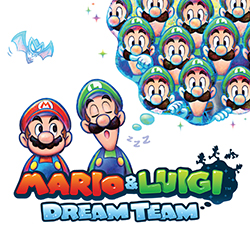
This is a fairly long game. Even though, I try to do everything in a game, I've always been fairly speedy at beating games and this took me a little less than 50 hours to beat. There's quite a lot to do and nearly all of it is quite enjoyable. Just like in Super Mario RPG, combat is a turn based system where correctly timed button presses can deal extra damage or avoid damage. Unlike Super Mario RPG, it's possible to completely avoid taking damage from enemy attacks and in most cases counterattack the enemy and deal damage to them instead during their attacks. The big difference between this game and other Mario & Luigi games is entering the Dream World through Luigi's dreams. In the overworld, Mario and Luigi are separate characters, Mario controlled with A and Luigi with B. In the Dream World, Dreamy Luigi combines with Mario to form one more powerful character. This is good since the enemies in the Dream World come in hordes of 10-20 at a time. It was actually pretty fun to have a mass of slightly weaker enemies to attack at once vs. the normal 3-5 enemies you normally face in these games.
Alongside the main quest, there are a plethora of side things to do. You can look for and rescue all the Pi'illo people that have been trapped throughout the island, you can find all the beans hidden in the ground throughout the island, you can replay harder versions of boss fights to try to win some coins, you can take on the expert challenges (generally just getting Excellent on attacks and avoiding all damage from enemies), and you can challenge yourself to a high score mode for the special attacks (basically repeat a special attack endlessly until you kill enough enemies or screw up performing the special attack). The item you get for completing all the expert challenges is well worth the time and effort it takes to get it, so I would recommend you try that, but the way the special attack challenges are done makes them not worth attempting. Each challenge requires you to get over 800 points even though some attacks are much slower or more challenging, so getting that score will take you much longer and many failed attempts. I personally did not find those fun in the slightest. Really my only complaint about the game.
Along with a leveling system that has the same choice and risk of Super Mario RPG (you get to pick the stat you're boosting, but you have a spinner deciding what you get), the game also has equipment that not only boosts your stats, but also gives you some interesting benefits, like doubling your defense when you have low health, possibly stunning enemies, or giving you back your Bros. Points (basically magic points, mana points, energy, etc. for using special attacks) if you score Excellent on the attack. By the end of the game I was just about invincible due to my combination of equipment. However, I still had to be fairly good at learning the enemy attacks so I could dodge them. So, I felt powerful, yet still challenged, which I think is how every good RPG should feel at the end.
So all in all, this is a quality game, very much worthy of following Super Mario RPG and trying to keep what that game did alive. I do still miss the hidden coin blocks in the overworld, but I guess I can't have everything...
Friday, August 23, 2013
Choosing Random vs. Random Choice
A game design issue that I've been working and struggling with at my job lately is the difference between choosing to take a gamble that involves some random chance in it vs. having some outcome of the game be randomly selected for you. The end result is going to be the same regardless of which way the game is designed, but it feels incredibly different from a player's point of view because in one case they get to choose to take a risk and in the other case, they have no choice and whether the end result is good or not, it doesn't feel as satisfying.
I'll give an example to make this a little clearer. In the game I'm currently working on, there's a lot of hidden information. So what information each player gets is very important and what they do with that information is the real crux of the game. In the original design, one player moved pawns around and each turn, had a random chance of seeing what the other player did at those spots. Having multiple pawns on the same spot would increase that random chance. So, the "interesting" choice they had was how to allot their resources and hope for the best. It turns out (unsurprisingly now that I look back at it) that this is really not fun to play.
The new design is to instead give the first player a bunch of false information along with information about what the other player is doing. They can't tell the difference between false and real information, so the choice is still seemingly random, but the player gets to choose which information they think is real. Eventually, the player should have enough information to start figuring out what the other player is doing and deduce their strategy and come up with a good counter strategy. This makes it so the interesting choice is how to deal with the information you have and not how to hopefully get the right information.
A similar example of random choice is battle in the game of Risk. You do get to choose where to attack, but the outcome is pretty much completely random, so even if your strategy is amazing or you have 99 times as many units as the other player, you can still lose because the dice hate you. It's still important for the defender to have some method of surviving an attack, but at some point, the better strategy should be rewarded over the luckier player. Of course, this is why the combat in my first board game took a long time to play because I eliminated random die rolling and had straight up math (attack vs. defense), which taught me a whole other lesson. Still a balance I have yet to completely figure out.
Wednesday, August 21, 2013
Games I Grew Up On: Drakkhen
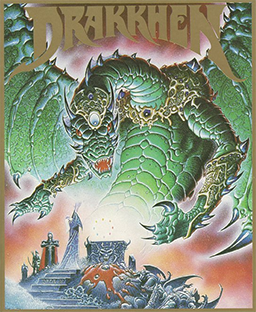
Traveling the overworld was along the XZ planes (no going up, only forward, backward, left, and right) and battles would take place in a brawler style view (you could travel around in all three dimensions in a fixed space). Battle consisted of your characters kind of randomly milling around enemies, occasionally attack enemies whenever they felt like it, with maybe some strategy that I couldn't really figure out.
You could equip your characters with armor and weapons you find (which changed character appearances). Generally, you'll find this equipment in the castles you can explore. Speaking of exploring, the game lets you explore pretty much wherever you want from the get go, so you can very quickly get overwhelmed by the giant black cat heads that shoot laser beams from their eyes or constellations that come down to destroy you. Like I said, a very weird game. It had a much more normal and super awesome sequel, Dragon View, that I was never able to finish because every ROM I found of it would freeze in the same spot. So basically, one series, two games, two games I was never able to beat. Sad day.
Wednesday, August 14, 2013
Games I Grew Up On: Super Mario RPG

The basic premise of the game is Mario and crew trying to save the seven stars of Star Road that grant people's wishes from the evil Smithy and his gang. On the way to victory, there are a ton of mini-games, hidden secrets, and an incredibly difficult optional boss. While wandering around the world in an isometric view, Mario can jump around to climb platforms, hit ? blocks, and jump on enemies. Whenever Mario makes contact with an enemy, the characters enter a turn based battle like most JRPGs of the time. The difference (and the greatest thing this game added to the turn based RPG genre) was the ability to deal extra damage during attacks or dodge/lessen damage from incoming attacks with properly timed button presses. For example, pushing A right before landing a Jump on an enemy will make Mario jump an extra time (and with certain special jump attacks, you can keep doing this until you mistime the button press). This means that not only does the combat have strategy in it (the real purpose behind good turn based combat systems), but it also requires some dexterity to be fully effective.
This RPG spawned the Paper Mario series and the Mario & Luigi handheld RPG series. The Mario & Luigi series seems to be able to hold its own, but the Paper Mario series seems to be declining in quality, but all of them have been lacking some of the magic of the original. I'm not sure what exactly it is, probably the same magic that Square has lost since then. Or it could just be nostalgia won't let me like anything as much as the original...
Monday, August 12, 2013
Dealing With Virtual Loss
I don't seem to deal well with losing characters in video games, even when it's fairly inevitable. In any game with minions (Overlord, Pikmin, Little King's Story, etc.) or in games with permanent party member deaths (Fire Emblem, X-Com, etc.) I find myself constantly reloading and replaying sections whenever any of my group dies. In some cases, like X-Com, this means I'm essentially cheating because I'm not really accepting the fate of my teammates, don't have to lose money in getting more teammates, and don't have to retrain new troops. In other cases, it's just really frustrating (any of the bosses in Pikmin games since it's inevitable that some Pikmin will die).
My theory about why I can't handle loss is twofold: all other video games have taught me that dying means I failed at the game and also, I seem to get attached to things too easily. Even with a troop of completely non-unique followers, I still can't stand to lose them, let alone if they're given names or have unique traits (like the super hilarious and awesome helmets the minions in Overlord would wear). What really makes this hard is when there are statistics being kept of how many I've lost or the memorial to them. There's no real game design problem with this, this is entirely a personal problem of mine. So far, the only way I've been able to handle the loss is if I get sick of repeating the same thing over and over again.
All this is probably the same reason I don't like reading/watching/playing things where characters die, but at least when its the story that kills them off I had no control over it, so it can't be my fault. I wonder if that's why I care so much...I feel like I got them killed...man, I'd never survive a zombie apocalypse, if I didn't get outright killed, I'd be consumed with guilt for anyone I couldn't save.
Friday, August 9, 2013
Review: Tomb Raider

If you've played any Uncharted games, the story will be very familiar, a group of archaeologists are looking for some location of legend, find it, get more than they bargain for, fight another group of people and the supernatural goings-on to try to survive and get back home. To be fair, I'm pretty sure Tomb Raider had this story format first (and Indiana Jones before that), but there are definitely some game and story elements in the game I recognize from Uncharted. It should also be noted, this is my first Tomb Raider game I've ever played.
The game is fairly linear in nature, but each area has a lot of rewards for exploring. The few times the game makes you backtrack to previous areas there have either been major changes to the environment that makes it feel new or you have new abilities/gear that lets you access new areas and new secrets. In each area with collectibles, there are one or two treasure maps that reveal the location of the other collectibles in the area. You can also unlock an ability that lets you mark hidden collectibles on your map when you see them in Survival Instinct (like Batman's Detective Vision and Assassin's Creed's Eagle Vision). You can also unlock a skill that reveals the location of all the treasure maps. This means that if you really must collect everything (like me), you have ways to ensure you don't miss a thing. You'll have more than enough experience and scrap (to upgrade weapons) by the end of the game to have everything fully upgraded, so you aren't forced to play through the game multiple times to collect everything. The combat always made me feel powerful, but still required me to pay attention and be strategic about how I took out the enemies. It's also the first game where I felt like using the bow was the most fun (I only used the shotgun in one fight and used the bow the rest of the game). All in all, if you enjoy a game with collectibles, upgrades, and a movie feel to it (so your spouse/friends can still be entertained watching you play) then I can't recommend this game enough.
Wednesday, August 7, 2013
Games I Grew Up On: Xenophobe

In the game, the players are tasked with trying to find these strange glowing orbs (dropped by killed enemies just like everything else in the game) before the space station you're on blows up. I think if it did blow up, you still teleport off it safely, you just get less points. So each space station is made up of a randomly generated set of rooms, which each contain some pre-determined aliens/barriers/teleport switches and also have constantly respawning enemies. You kill enemies to get items, most just give you points, some give you health, some give you better weapons/grenades, and the glowing orb things end the level. If you kill too many enemies in one room, they stop dropping items when killing them, so you're encouraged to keep wandering around. While playing co-op, you can see the other player if you're both in the same room and if either player finds the orb, both players get warped out of the level (which definitely caused much strife for one of us not waiting for the other to get that awesome item that just dropped before forcing them to leave the level).
The enemies range from little amoebas that jump from the ceiling to the floor, floating laser turrets, little bitey leech guys, big jumpy Xenomorph looking aliens (like on the game cover seen above) that spit acid and basically just charge you a lot, and winged blue giraffe looking things that hang on the ceiling and drop bombs on you. If anything touches you, you get hurt. If you lose all your health, you lose. It's as simple as that. It was definitely a lot of fun at the time, but there's no way this would hold up now. This is especially disappointing since the arcade game it's based off of sounds way more designed and fleshed out. I guess that's probably just due to the technical limitations of the NES. Either that or it was a cash grab...
Monday, August 5, 2013
Console Wars: 1st Year
I'm having issues finding solid data and numbers for the first year of video game console sales. Most of the searches I come across are all along the same ridiculous lines: "Company X is DOOMED!", "Video games are DOOMED!", or "The economy is DOOMED!" I find this hilarious because as far as I can remember (and this is where I wish I had more solid data), very few consoles do well in their first year. I know the 3DS, DS, PS3, and now the Wii U all had pretty miserable first years. In all cases, it was a severe lack of games because developers were trying to figure out how to develop for these systems.
The PS3 had its own super complicated tech to figure out, but if the developers could, it was super powerful. The DS was the first touch based gaming system with a few other bells and whistles that developers seemed to feel needed to all be utilized in every game (I'm so glad I don't have to blow out fires by blowing into the mic or talk at my DS anymore...). The 3DS was mostly the same except for the whole 3D factor. The Wii U has a completely separate screen that game designers need to figure out how to use. Most of those systems were also supposedly overpriced, but I feel like if a game system doesn't have enough games that you like on them, it really doesn't matter what price the system is for. Take for example the OUYA. It's only $100, the price of most collector edition games. All games on the system are "free" as well. However, I have zero interest in the system because not a single game I've heard about on the system sounds appealing to me.
It's especially entertaining to see people say Nintendo as a company is doomed because of lackluster Wii U sales (which is understandable since they only just now started releasing their big slew of games) when there are articles like this that are clearly indicating that the 3DS doing amazing well after a similarly terrible first year. Personally, I'm hoping the Wii U does well enough to get more than the Nintendo loyalists (like myself) to buy it because of all three new systems for the next generation of gaming, I feel like the Wii U has the most potential for new and different gaming experiences. Nintendo just needs to start making more asymmetric multiplayer games like the three minigames in Nintendo Land to show the other developers how it's done.
The PS3 had its own super complicated tech to figure out, but if the developers could, it was super powerful. The DS was the first touch based gaming system with a few other bells and whistles that developers seemed to feel needed to all be utilized in every game (I'm so glad I don't have to blow out fires by blowing into the mic or talk at my DS anymore...). The 3DS was mostly the same except for the whole 3D factor. The Wii U has a completely separate screen that game designers need to figure out how to use. Most of those systems were also supposedly overpriced, but I feel like if a game system doesn't have enough games that you like on them, it really doesn't matter what price the system is for. Take for example the OUYA. It's only $100, the price of most collector edition games. All games on the system are "free" as well. However, I have zero interest in the system because not a single game I've heard about on the system sounds appealing to me.
It's especially entertaining to see people say Nintendo as a company is doomed because of lackluster Wii U sales (which is understandable since they only just now started releasing their big slew of games) when there are articles like this that are clearly indicating that the 3DS doing amazing well after a similarly terrible first year. Personally, I'm hoping the Wii U does well enough to get more than the Nintendo loyalists (like myself) to buy it because of all three new systems for the next generation of gaming, I feel like the Wii U has the most potential for new and different gaming experiences. Nintendo just needs to start making more asymmetric multiplayer games like the three minigames in Nintendo Land to show the other developers how it's done.
Monday, July 29, 2013
Video Game vs. Book Sizes
I forget where this thought came from, but I started thinking about how the various ways video games are released (full releases, expansions, DLC, etc.) are akin to how books are categorized by length (short story, novella, novels, etc.). Some of them are pretty obvious, a full video game release is just like a novel: it can both build a new world, create grand adventures for a set of characters (generally recurring characters in future sequels), and has multiple ups and downs as well as conflicts (albeit one main one). Expansions are like novellas: the are generally smaller adventures with the same characters that have already been setup in the full game/novel, only have time for one real conflict, and don't really have time to do much world building.
DLC, on the other hand, seems to come in two forms. It's either like reading the same book, but with a different font (the main content is no different, but there's at least one minor difference to how that content is experienced). In DLC forms, this is the new weapon/armor/skin. The other type of DLC is more like a short story. It is generally a new small adventure for the characters you know and love in an already established universe. I haven't seen any DLCs that are the other form, where it's a whole new set of characters used to build the world/universe further, except for maybe Bioshock 2's Minerva's Den. I can partly understand this because where a short story only needs to reference things from the world it comes from, DLC has to use the same technology (and generally art assets) made to use the game it's a part of. So the easiest way to make DLC is just to make more of the same thing as the original game.
What I haven't quite figured out is what (if any) equivalent there is to smaller full games (i.e. PSN/XBLA games). Would this be like a magazine article? Just sort of a small way to amuse yourself for a bit of time, but generally no real substance to it? Obviously there are exceptions on both ends of this analogy. Not sure what else it could be. I'm also curious what the visual media (movies, television, etc.) compare to these.
DLC, on the other hand, seems to come in two forms. It's either like reading the same book, but with a different font (the main content is no different, but there's at least one minor difference to how that content is experienced). In DLC forms, this is the new weapon/armor/skin. The other type of DLC is more like a short story. It is generally a new small adventure for the characters you know and love in an already established universe. I haven't seen any DLCs that are the other form, where it's a whole new set of characters used to build the world/universe further, except for maybe Bioshock 2's Minerva's Den. I can partly understand this because where a short story only needs to reference things from the world it comes from, DLC has to use the same technology (and generally art assets) made to use the game it's a part of. So the easiest way to make DLC is just to make more of the same thing as the original game.
What I haven't quite figured out is what (if any) equivalent there is to smaller full games (i.e. PSN/XBLA games). Would this be like a magazine article? Just sort of a small way to amuse yourself for a bit of time, but generally no real substance to it? Obviously there are exceptions on both ends of this analogy. Not sure what else it could be. I'm also curious what the visual media (movies, television, etc.) compare to these.
Friday, July 26, 2013
Where'd My Teammates Go?
If you've ever played a turn based RPG, like Chrono Trigger or one of the Final Fantasies, or any Bioware game, you've noticed how in the story parts there will be a large group of characters wandering around and saving the world together, but during battle only a few of them seem to actually be there. Some games specifically showcase this by having the other characters walk in and out of your main character to exit and enter story sequences. I understand that balancing battles for giant groups of heroes is way too much to ask for, but this is definitely bizarre video game logic at its worst (finest?). If the other party members are waiting in camp until you take them in to battle, then does that mean that they shouldn't get any credit for saving the world since they spent the entire time lounging about in your posh headquarters?
Sometimes (rarely), games will help alleviate this ridiculousness by having your characters split up into teams. Final Fantasy 3/6 did every once in awhile (which actually kept me from winning since I was required to use characters I hadn't been using at all). One of the few good things Infinite Undiscovery did was the occasional instance where this happened and you either fought along side your groups or traveled through a tower seeing them appear on the other side of fenced off areas or coming in the middle of a boss fight from a different entrance. So I only personally cared about the three characters on my team, but it at least felt like I was a troop trying to save the world.
Other than bizarre story logic issues this represents, my issue with this concept is that I have to choose which companions are important to me and miss out on a lot of good moments/stories (protagonist & companion content, companion & companion combination content, etc.). This is a way to add replayability, but assuming there are 6 companions (generally there are more) and you can only bring 2 with you at once, then you'd have to beat the game 3 times and probably 70-80% of the content is the same each time. That's not enjoyable, that's tedious. This essentially means to me that all having more companions does for me is increase the chances that I'll like the two characters I decide to play through the game with and the other characters might as well not exist other than the occasional parts of the story you're forced to go bring them with you.
The only way I can think of to fix this is to structure the game where you travel with a small group of characters for a bit and then leave them and move on to another group. Of course, this means that I have less chance of liking the characters I'm grouped with...so I guess I just can't be pleased with this bit of bizarre video game logic.
Sometimes (rarely), games will help alleviate this ridiculousness by having your characters split up into teams. Final Fantasy 3/6 did every once in awhile (which actually kept me from winning since I was required to use characters I hadn't been using at all). One of the few good things Infinite Undiscovery did was the occasional instance where this happened and you either fought along side your groups or traveled through a tower seeing them appear on the other side of fenced off areas or coming in the middle of a boss fight from a different entrance. So I only personally cared about the three characters on my team, but it at least felt like I was a troop trying to save the world.
Other than bizarre story logic issues this represents, my issue with this concept is that I have to choose which companions are important to me and miss out on a lot of good moments/stories (protagonist & companion content, companion & companion combination content, etc.). This is a way to add replayability, but assuming there are 6 companions (generally there are more) and you can only bring 2 with you at once, then you'd have to beat the game 3 times and probably 70-80% of the content is the same each time. That's not enjoyable, that's tedious. This essentially means to me that all having more companions does for me is increase the chances that I'll like the two characters I decide to play through the game with and the other characters might as well not exist other than the occasional parts of the story you're forced to go bring them with you.
The only way I can think of to fix this is to structure the game where you travel with a small group of characters for a bit and then leave them and move on to another group. Of course, this means that I have less chance of liking the characters I'm grouped with...so I guess I just can't be pleased with this bit of bizarre video game logic.
Wednesday, July 24, 2013
Games I Grew Up On: Gargoyle's Quest

In Gargoyle's Quest, players take on the role of Firebrand the Gargoyle in his quest to get more powerful and save the Ghoul Realm from King Breager and his army of Destroyers. The game has two modes: an overhead map with potential random battle sequences and side scrolling levels to fight monsters and collect items. Many items you collect improve Firebrand's abilities - they may let him shoot stronger fireballs, jump higher, fly longer, or extend his health to another hit or two. Levels can be played multiple times or exited by reaching either end of it (just like in Legend of Zelda II). Like Metroid games, you may have to replay a level after getting a new ability so you can reach new places.
I haven't played this game in ages, but I'm pretty sure it would be super frustrating since it's generally not clear where exactly you need to go (without those handy Nintendo Power maps/guides I had as a kid) and the random battles will inevitably get you killed since this game requires Mega Man level precision, you can only take a few hits before dying, and if I remember right, health recovery items and extra lives were hard to come by. But there's something to be said about that type of difficulty since, when I did finally beat the game, the feeling of accomplishment can't be beat.
Wednesday, July 3, 2013
Games I Grew Up On: Secret of Evermore
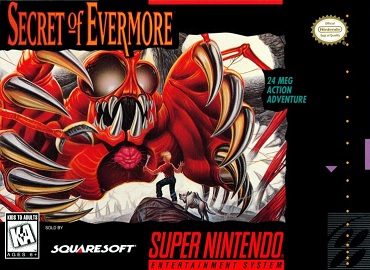
Secret of Evermore was awesome mostly due to the incredibly varied settings (you go from prehistoric, through an Ancient Greece/Egypt like area, to a Medieval-era area, back to sci-fi) that each change the dog, the currency, and the enemies. The game functions very similarly to Secret of Mana (only single player), but instead of magic, there is alchemy. You must find the right components to use your abilities now, but they level up with use, just like in Secret of Mana, so there's even more grinding (which I found enjoyable as a kid, not sure if I could handle it now). There is also a marketplace where I specifically remember having to trade the right items to the right shopkeepers in the right order to get very awesome and rare items. Figuring out that pattern was pretty fun (I think later I had help from Nintendo Power). I remember the bosses being pretty darn awesome, too (especially the one seen on the cover). Though the music wasn't as good as Secret of Mana or Chrono Trigger, it was still pretty awesome, as well. What I didn't know until today is just how bizarre and creepy the commercial for the game was. I'm pretty sure the dog never threw up the other versions of itself like in that commercial...
Friday, June 28, 2013
House Rules Rule!
A great aspect of tabletop games is the ease of adding house rules. Getting tired of playing the same game? Try using a deck of cards instead of dice for movement (a la Sorry) to add some more strategy. One player winning too often? Add some rule that handicaps him/her. Can't decide which game to play? Why not take a few rules from each game and play them all together!
In my church group on Fridays we often play Telestrations, Sour Apples to Apples, or Say Anything, which are all very similar games. Over the course of a number of weeks we started combining them into one (so far unnamed) glorious game. The current round's judge takes a Say Anything card and asks one of the five questions on it. The other player's answer the question as if they were playing Say Anything. The judge picks their favorite and least favorite cards. Least favorite spins the Sour Apples to Apples apple. If the apple says you can't talk, that means you have to draw your answer for the next round. If the apple says you play two red cards, then you write down two answers. If the apple says you answer before the green card is played, then you write down an "answer" before any question is asked (boy is this random!). If you need a winner, then the first player to be selected as the best answer five times wins! We typically don't care about winning the game in that group.
Fashioning your own house rules not only makes games more replayable, but it also helps you learn about game design. It'll help you understand some of the game's design decisions. It'll help you see how one small rule change can impact a game. It'll help you figure out why a choice between various game components is a very important choice when creating a game.
It's much harder to have house rules in video games because the various options have to be built into the game. It's not like you can easily take assets or mechanics from one game and use them in another. Options also add to the complexity of the game to the user and to the game balancer. The item options screen in Smash Bros. can look incredibly frightening at first and presumably every one of those item combinations had to be tested to make sure the game was playable with any option set. But putting that much work into the game to give the player options is the closest a game can get to having house rules. If you want a true test of skill, you can turn all the items off. If you want a sword battle, you can just turn on swords. Maybe you want a heavy hitting game, so explosives and baseball bats abound! Adding all of these options essentially lets the players create their own multiplayer modes. I can't think of many online multiplayer games that have a lot of options, but it could just be that negotiating those options/house rules are easier in person?
Wednesday, June 26, 2013
Games I Grew Up On: Secret of Mana
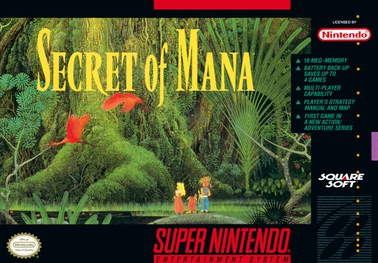
Unfortunately, we never beat the game. Even back when I was a kid, it was hard to really get the same group of friends over consistently, so when we did pick it up, we'd forget where we were supposed to go (back then games didn't really have maps or objective markers/compasses or anything that I expect in games nowadays) and were constantly starting over. Another problem was that the mage (my character) was pretty worthless against normal bad guys because MP (magic points) were limited, so I couldn't use spells that frequently, until a boss fight, at which point my friends really didn't get to play because I'd constantly be pausing the game trying to select spells to use. I would cast my spells so fast that I generally broke the animation system and either the enemies would freeze for a little bit, I would, or just damage numbers would all be delayed and then all appear at once. Hopefully, my friends don't resent my spell spamming that much (if they even remember it).
Despite that, this game is still in my top 5 games I've ever played because the setting and music are amazing and it really is a lot of fun to just run around with your friends killing baddies and leveling up. Maybe some day when my friends and I are all retired, I'll try to get us all around the SNES and finally conquer this game.
Subscribe to:
Posts (Atom)