Friday, June 28, 2013

House Rules Rule!

A great aspect of tabletop games is the ease of adding house rules.  Getting tired of playing the same game?  Try using a deck of cards instead of dice for movement (a la Sorry) to add some more strategy.  One player winning too often?  Add some rule that handicaps him/her.  Can't decide which game to play?  Why not take a few rules from each game and play them all together!

In my church group on Fridays we often play Telestrations, Sour Apples to Apples, or Say Anything, which are all very similar games.  Over the course of a number of weeks we started combining them into one (so far unnamed) glorious game.  The current round's judge takes a Say Anything card and asks one of the five questions on it.  The other player's answer the question as if they were playing Say Anything.  The judge picks their favorite and least favorite cards.  Least favorite spins the Sour Apples to Apples apple.  If the apple says you can't talk, that means you have to draw your answer for the next round.  If the apple says you play two red cards, then you write down two answers.  If the apple says you answer before the green card is played, then you write down an "answer" before any question is asked (boy is this random!).  If you need a winner, then the first player to be selected as the best answer five times wins!  We typically don't care about winning the game in that group.

Fashioning your own house rules not only makes games more replayable, but it also helps you learn about game design.  It'll help you understand some of the game's design decisions.  It'll help you see how one small rule change can impact a game.  It'll help you figure out why a choice between various game components is a very important choice when creating a game.

It's much harder to have house rules in video games because the various options have to be built into the game.  It's not like you can easily take assets or mechanics from one game and use them in another.  Options also add to the complexity of the game to the user and to the game balancer.  The item options screen in Smash Bros. can look incredibly frightening at first and presumably every one of those item combinations had to be tested to make sure the game was playable with any option set.  But putting that much work into the game to give the player options is the closest a game can get to having house rules.  If you want a true test of skill, you can turn all the items off.  If you want a sword battle, you can just turn on swords.  Maybe you want a heavy hitting game, so explosives and baseball bats abound!  Adding all of these options essentially lets the players create their own multiplayer modes.  I can't think of many online multiplayer games that have a lot of options, but it could just be that negotiating those options/house rules are easier in person?

Wednesday, June 26, 2013

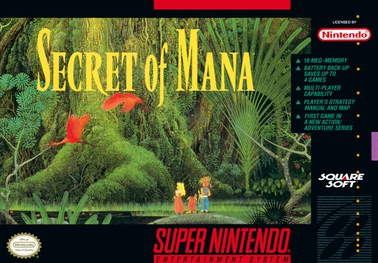
Games I Grew Up On: Secret of Mana

One of my favorite cooperative games growing up was Secret of Mana.  You and two of your friends could run around an amazing fantasy world trying to save it from destruction.  One of you would be the warrior (the guy), one the healer (the tall blonde), and the other the mage (the short...boy?  girl?  I never figured that out).  Not only did your characters level up when you killed enough monsters, but you could specifically level up your weapons and magic by constantly using that particular weapon or school of magic throughout the game.  What this generally meant is that my friends and I would run back and forth between a few areas, killing endless monsters until we were max level, then we'd go follow the path to the boss, which would fall easily to our overwhelming power.

Unfortunately, we never beat the game.  Even back when I was a kid, it was hard to really get the same group of friends over consistently, so when we did pick it up, we'd forget where we were supposed to go (back then games didn't really have maps or objective markers/compasses or anything that I expect in games nowadays) and were constantly starting over.  Another problem was that the mage (my character) was pretty worthless against normal bad guys because MP (magic points) were limited, so I couldn't use spells that frequently, until a boss fight, at which point my friends really didn't get to play because I'd constantly be pausing the game trying to select spells to use.  I would cast my spells so fast that I generally broke the animation system and either the enemies would freeze for a little bit, I would, or just damage numbers would all be delayed and then all appear at once.  Hopefully, my friends don't resent my spell spamming that much (if they even remember it).

Despite that, this game is still in my top 5 games I've ever played because the setting and music are amazing and it really is a lot of fun to just run around with your friends killing baddies and leveling up.  Maybe some day when my friends and I are all retired, I'll try to get us all around the SNES and finally conquer this game.

Monday, June 24, 2013

User Interface Intuitivity Test

In my recent quest to finish a bunch of half finished games, I discovered a new and interesting way to critique games.  Part of the problem of coming back to a game is that you've forgotten how to play the game and in some cases, getting back into it can be difficult.  This makes for an interesting way to see just how intuitive a game's interface and controls really are.  If you've already made it past all the tutorials, a good game won't keep reminding you how to play the game (I'm looking at you Skyward Sword and your insistence that I forgot everything every time I start a gaming session...).  However, a game should have some method for a player to refresh their memory about how to play.  Usually, this boils down to a controls/moves menu on the pause screen.  That should be the absolute bare minimum you should have in a game for returning players.

Beyond that, your interface should be clear enough that it's fairly easy to remember what everything represents.  If one little symbol lights up in a certain circumstance (e.g. the player has picked up the Hoobajoob of Greatness), it should be pretty obvious what that light stands for.  It's also really nice if the player can just pick up most of the controls without having to look at that menu.  One of the games in my backlog quest was Thor: God of Thunder from Liquid Entertainment (the company I used to work at).  One of the things I had the biggest difficulty remembering how to do it was also one of the game's most interesting aspects.  When you're fighting one of the big monsters (and there are a lot of them), you can grapple them to enter a special grapple mode: kind of like a mix between God of War's kill quick time events and Shadow of the Colossus boss fights.  Most of these have arrows appearing on the sides of the screen indicating if you can move to a different area on the monster.  However, for some reason I can't decipher, instead of just pushing that direction, you have to press B and the direction.

Setting aside whatever reasoning made this decision happen, a lot less of my time would be spent being confused and would be spent having fun if a small B in a red circle appeared next to the arrow.  If I just see an arrow as a player, I would think I could just push the joystick in that direction (a la Dragon's Lair).  It took a heck of a lot of trial and error (and death) before I realized the whole B button thing.  Therefore, this part of the gameplay fails the intuitive test.  I don't know how common it is for player's to come back to a game they never finished after months away from it, though, so this could all be moot.  For all I know, I'm the only person alive who tries to clear their backlog like this.

Friday, June 21, 2013

Tension Cycles in Games

I've spent a lot of my free time this past week working on clearing up my backlog of half finished games, games that for some reason or another I stopped part way through.  One of those games were Dead Space.  While playing, I noticed that I was super tense and on the edge of my seat the entire time.  This wasn't due to being excited or scared (although Dead Space is really good at building a terrifying atmosphere), but the game just builds a state of tension without really letting up.  You learn often and repeatedly that there isn't really any safe places.  Right when you think backtracking through previously cleared rooms or entering a room with a save station in it will be safe, the game tricks you.  This makes it much harder to play for long periods of time (the human body is not meant to be in a state of tension for so long.  Ultimately, for a game that is built for a joyride/intense experience, the moments of tension and excitement should be the punctuation marks between moments of safety/lulls so they can be more meaningful.

One game that did this cycle really well was Left 4 Dead.  The AI of the game was designed to come in waves when those lulls were getting too long and to let up when things were getting too tense.  There was also a little leeway on both ends to keep it from being predictable and there were also safe houses to go to (the whole point of most of the levels) where it was guaranteed to be safe once inside.  This was nice because during the tense moments, if you were near the safe house, you knew you could try to make a break for it if/when things got too bad.  If you weren't near a safe house, you knew you just had to survive long enough for things to calm down a little.  This same thought also tended to make me do brave/stupid/risky things since I knew I'd have a chance to try to recover if I could just last a little bit longer.  If the game is super tense the entire time, it's only going to make the player more careful and deliberate instead of giving them those fun moments where they can be bold.

Wednesday, June 19, 2013

Cartoons I Grew Up On: Superman The Animated Series

I'm not sure if I've said this before, but I didn't read many comics growing up.  The vast majority of my comic book knowledge comes from the cartoons in the 90's that I watched.  Most of these seem to be accurate enough portrayals of what happened in the comics that I can keep up with my comic geek friends fairly well.  One of those cartoons in a series of excellent cartoons was Superman The Animated Series.

This series was made by the same people who created the absolutely amazing Batman The Animated Series.  Unfortunately, the art style changed to be even less realistic (women with no waist, men with giant shoulders, etc.) than the Batman series first three seasons.  But they still tried to make Superman and his abilities more realistic.  The show also made other characters important and capable besides Superman.  This show is why I have such a respect for Dr. Hamilton from S.T.A.R. Labs.  This show and the aforementioned Batman cartoon built the basis for a world where the Justice League made sense (which is another amazing show, by the way).  This show is also the first time I've seen the most creative and artistic Green Lantern, Kyle Rayner.

I think it's really due to these three series of cartoons that I even care a little about DC characters.  They managed to give the characters a lot more depth than they had (in my mind) before that and had some very interesting plot twists here and there (more so in the Justice League series than the other two).  But my absolutely favorite moment of the series is when Bruce Wayne and Clark Kent meet.  Not because of any fanboy gushing or anything, but solely because for some reason the artists always drew Bruce Wayne's eyes as irises with no pupils and Clark Kent's eyes as pupils with no irises.  I don't know why that cracks me up so much, but it does.


Monday, June 17, 2013

Review: Man of Steel

This movie has me all sorts of conflicted and confused about what I really want out of a movie.  Nearly every opinion I formed than got contradicted later on in the movie.  For example, the movie starts with a very long sequence on Krypton explaining its end of days.  I both loved this sequence for showing so much bizarre alien-Krypton stuff (some Kryptonian creatures, some tech, some weapons and armor, etc.) and hated it because it was so long and I've seen Superman's origin so many times.  However, a friend of mine who I went with isn't as into comics as I am and really appreciated the rehashing of the origin story.  So I can just suck that up and move on.  The two things that I find a hard time moving on with are the odd camera quick-zooms and Superman's supposed care for human life that doesn't really manifest until it's convenient to the plot.

I'm not sure which modern day film technique I hate the most: unnecessary slow-motion (i.e. bullet time), purposefully shaky camera work when the action isn't being filmed by a character in the film, or these really bizarre quick zooms to something in the distance.  It doesn't really matter, though, because they're all super distracting and don't add a thing to the film.  This movie was the first instance I can recall so far that has done a double zoom both in and out in succession.  So a spaceship is off in the distance.  Start from a super wide useless shot, zoom to a normal medium shot of the spaceship, zoom again to a random section of the spaceship that I guess is important, but I can't tell because you zoomed WAY too much, zoom back out to the good shot, now zoom back to the original shot.  This happened multiple times in the movie.  Overall it made all the action very hard to track.  It definitely had a Hunger Games feel to it where I know there's action going on the screen, but heck if I can tell who is what or where and who just got punched or shot or thrown through a building...is Superman winning?  We won't know until they stop punching each other so they can get up and look menacing at each other for a second or two.  (More on this later).

They did a really good job of actually making Superman's big conflict (am I a man or a Kryptonian?) a big deal, through the flashbacks of his childhood growing up in Kansas.  Despite humanity's shortcomings, Superman decides to side with us.  However, this decision doesn't seem to come out during any of the fight scenes.  Not once does he try to pull the fight AWAY from people.  Instead, he keeps throwing bad guys into populated areas he hasn't destroyed yet.  He can't even keep the fight into one contained area.  So does he really care about humanity at all?  The only time it seems to matter is when the plot dictates he needs to watch people in trouble.  So does he just not like seeing people getting hurt, but once it's out of sight, it's out of mind?

Other random thoughts:

  • One of the other conflicts with my opinion I had was the first half of the movie I was wondering if there was going to be any action in the movie.  The second half of the movie, I wondered when the action sequence was going to end.  I guess that's what's called pacing?
  • Superman started the movie with a full beard, then went to a scruffy face, then clean shaven.  I really wish he would have kept one of the first two.  I'd totally root for Super Beard way more than Super Man.
  • I think secretly this movie is a live action Dragonball Z movie, but they couldn't call it that because they wanted people to see it.  You've got two aliens from another planet that ultimately they are meant to bring their species to.  One alien is a trained warrior who knows his destiny is to conquer, let's call him Vegeta.  The other alien grew up on this planet with no knowledge of where he came from and so only knows that he's different from everyone else, but he likes the planet and people he's with, I think we can call him Goku.  There's lots of fighting in the air, lots of quick dashes to fight from one spot to the next, and apparently these aliens can just will themselves to fly.  I'm pretty sure I saw Superman even go Kaioken x10 at least once...

Friday, June 14, 2013

Dreaming Up The Next Big Idea

Dreams are a very bizarre part of the recuperation process for human beings.  Whether you think they are your subconscious trying to relay something important to you, that they're just your brain trying to store and analyze the goings on of that day, or that they are your imagination trying to either mess with you or entertain you, you can't deny that dreams are just weird.  They also can affect your day to day by making you mad at someone for something they did to you during the dream.  But dreams can also be a wellspring of ideas that wouldn't come to you in your normal train of thought.

I personally like to use the more imaginative and fun dreams as a starting point for my games.  The original idea for Suspicion came from a dream, only with a vastly different setting.  I dreamt about a council of werewolves, vampires, and other monsters that had an agreement with a nearby village where the villagers would give them a few villagers every once in awhile for the monsters' purposes, but then the monsters would leave the rest alone.  However, one of the monsters secretly went to the village and started killing villagers on his own.  So it was up to the council to figure out who the traitor was and give him the angry mob approaching the castle before they reached it and killed all the monsters.  Being a dream, it wasn't as coherent as all that, but there was enough of an interesting setting and ideas there to start from.  Then I had to extract the crazy dream logic (you know, like when eating a sandwich can turn you into a dragon or something and that's perfectly normal in the dream) and extrapolate the ideas that I liked from there.

Sometimes the dream gives me a mechanic that I would love to see in a game.  Another time I had a dream where I was playing an RTS game, but I could build my species in a Spore-like editor.  I could make the creatures look however I wanted and then give them certain predefined abilities.  Like make a basic melee unit and design his building and an archer unit and his building.  But then the cool thing was I could take two units and combine them to start building a tech tree.  So if I had built the melee building and the archer building, now I could build a new building that made guys that had the abilities of both of the original units.  The building and unit were also a combination of the originals, which you could then edit if you didn't like how the computer combined the two things.  I'm probably never going to make this game, but I think it's a totally feasible idea for an RTS were the players could build their own species as long as the game functionality (how a unit attacks) and its price are separate from how it looks and all the game mechanics are balanced against each other.  You would also give the players a few premade species in case they didn't want to go to all this trouble.  So someone with more of an RTS background than mine, steal this idea (I give it up freely) and make this game and make it awesome!