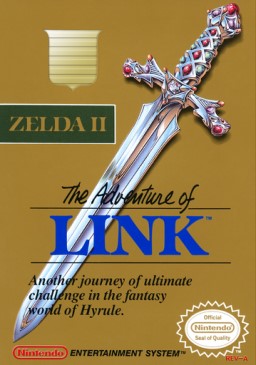
The majority of video games used to be unforgiving where a lost life could mean you have to replay many hours of gameplay. Zelda II: The Adventure of Link was a prime example of this. You have a set number of lives, losing all of them sends you back to the palace where Zelda is stuck in an eternal slumber and you'll have to make the trek back to wherever you lost that last life. If this was on the last boss, you'd have to fight your way back through the super difficult levels just to get to the super difficult dungeons to fight your way to the super difficult second to last boss and finally fight the final boss (which, fortunately, had a simple trick to defeat somewhat easily if you grew tired of making your way to him again).
Zelda II was one of those really rare sequels that has so little in common with the original that it's hard to see them as a series. I guess there's still an overworld map, but you don't fight anything there. Instead, if you touch an enemy in the overworld map, you get brought to a side scrolling view where you have to walk to either the left or right edge of the screen to get back to the overworld. The game also had a (in my opinion) really awesome RPG aspect to it where killing monsters garnered XP that would eventually give you more levels to put into your health, your sword, or your magic. All three of these were crucial and by the end of the game, you'll have maxed your level so you can't choose incorrectly, you just determine how hard/easy it is to make it through the game to the end. The map also held a number of secret locations that stored extra hearts, important items, and more monsters that you'd either need a guide to play along with or memorize where they all are because they are visually indistinguishable from the land around them.
I've managed to beat this game once and I had a friend who just celebrated his victory over the game. This is definitely a game where beating it is an accomplishment. This game also just came out for the Wii U virtual console and is also available on the Wii and 3DS virtual consoles, so if you're really itching for some true challenge and exploration, then I would recommend this game. I am Error.
Showing posts with label RPG. Show all posts
Wednesday, September 25, 2013
Wednesday, September 4, 2013
Games I Grew Up On: Gauntlet Legends
Gauntlet Legends was a game my friends and I would actually willingly replay over and over again just to get our characters to level 99. Essentially a revamp of the original Gauntlet, there are still monster generators, characters with different strengths and weaknesses, and magic potions and health items. But this game adds a 3D look, bosses, hidden collectibles, and the ability to level up your characters to make them even better. What I remember finding awesome is that you could actually see a visual difference between low level characters and high level characters, so it actually felt really satisfying to level up since you could see the difference.
Alongside the main four characters (Archer, Warrior, Valkyrie, and Wizard), players could unlock other characters like the Minotaur, Tigress, Jackal, Falconess, and the Sumner. It was a pretty mindless hack and slash game overall (except for trying to find the collectibles), but I think that may be a good thing with four players cooperating. A lot of times cooperative games that require actual thought (other than fight to fight strategy and communication) usually have one or two players strategizing and everyone else just doing what they're told or everyone starts fighting. The game also had a sequel called Gauntlet Dark Legacy. It pretty much just added more characters, but was otherwise the same game.
Monday, August 26, 2013
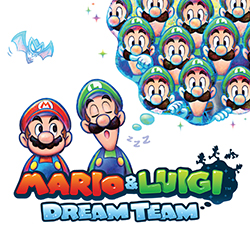
Review: Mario & Luigi: Dream Team
Unlike the Paper Mario series, the Mario & Luigi series seems to still be trying to follow Super Mario RPG in its gameplay and concepts. The latest in the series is Mario & Luigi: Dream Team and is not only focused more heavily on Luigi, which is always awesome, but doesn't portray him as a weak coward like the previous Mario & Luigi and Luigi's Mansions games always portray him. He's actually got quite a bit of courage this time around. I also really appreciated the fact that Bowser ended up being the main bad guy and he and his minions were more competent than they have been in past Mario games.
This is a fairly long game. Even though, I try to do everything in a game, I've always been fairly speedy at beating games and this took me a little less than 50 hours to beat. There's quite a lot to do and nearly all of it is quite enjoyable. Just like in Super Mario RPG, combat is a turn based system where correctly timed button presses can deal extra damage or avoid damage. Unlike Super Mario RPG, it's possible to completely avoid taking damage from enemy attacks and in most cases counterattack the enemy and deal damage to them instead during their attacks. The big difference between this game and other Mario & Luigi games is entering the Dream World through Luigi's dreams. In the overworld, Mario and Luigi are separate characters, Mario controlled with A and Luigi with B. In the Dream World, Dreamy Luigi combines with Mario to form one more powerful character. This is good since the enemies in the Dream World come in hordes of 10-20 at a time. It was actually pretty fun to have a mass of slightly weaker enemies to attack at once vs. the normal 3-5 enemies you normally face in these games.
Alongside the main quest, there are a plethora of side things to do. You can look for and rescue all the Pi'illo people that have been trapped throughout the island, you can find all the beans hidden in the ground throughout the island, you can replay harder versions of boss fights to try to win some coins, you can take on the expert challenges (generally just getting Excellent on attacks and avoiding all damage from enemies), and you can challenge yourself to a high score mode for the special attacks (basically repeat a special attack endlessly until you kill enough enemies or screw up performing the special attack). The item you get for completing all the expert challenges is well worth the time and effort it takes to get it, so I would recommend you try that, but the way the special attack challenges are done makes them not worth attempting. Each challenge requires you to get over 800 points even though some attacks are much slower or more challenging, so getting that score will take you much longer and many failed attempts. I personally did not find those fun in the slightest. Really my only complaint about the game.
Along with a leveling system that has the same choice and risk of Super Mario RPG (you get to pick the stat you're boosting, but you have a spinner deciding what you get), the game also has equipment that not only boosts your stats, but also gives you some interesting benefits, like doubling your defense when you have low health, possibly stunning enemies, or giving you back your Bros. Points (basically magic points, mana points, energy, etc. for using special attacks) if you score Excellent on the attack. By the end of the game I was just about invincible due to my combination of equipment. However, I still had to be fairly good at learning the enemy attacks so I could dodge them. So, I felt powerful, yet still challenged, which I think is how every good RPG should feel at the end.
So all in all, this is a quality game, very much worthy of following Super Mario RPG and trying to keep what that game did alive. I do still miss the hidden coin blocks in the overworld, but I guess I can't have everything...
This is a fairly long game. Even though, I try to do everything in a game, I've always been fairly speedy at beating games and this took me a little less than 50 hours to beat. There's quite a lot to do and nearly all of it is quite enjoyable. Just like in Super Mario RPG, combat is a turn based system where correctly timed button presses can deal extra damage or avoid damage. Unlike Super Mario RPG, it's possible to completely avoid taking damage from enemy attacks and in most cases counterattack the enemy and deal damage to them instead during their attacks. The big difference between this game and other Mario & Luigi games is entering the Dream World through Luigi's dreams. In the overworld, Mario and Luigi are separate characters, Mario controlled with A and Luigi with B. In the Dream World, Dreamy Luigi combines with Mario to form one more powerful character. This is good since the enemies in the Dream World come in hordes of 10-20 at a time. It was actually pretty fun to have a mass of slightly weaker enemies to attack at once vs. the normal 3-5 enemies you normally face in these games.
Alongside the main quest, there are a plethora of side things to do. You can look for and rescue all the Pi'illo people that have been trapped throughout the island, you can find all the beans hidden in the ground throughout the island, you can replay harder versions of boss fights to try to win some coins, you can take on the expert challenges (generally just getting Excellent on attacks and avoiding all damage from enemies), and you can challenge yourself to a high score mode for the special attacks (basically repeat a special attack endlessly until you kill enough enemies or screw up performing the special attack). The item you get for completing all the expert challenges is well worth the time and effort it takes to get it, so I would recommend you try that, but the way the special attack challenges are done makes them not worth attempting. Each challenge requires you to get over 800 points even though some attacks are much slower or more challenging, so getting that score will take you much longer and many failed attempts. I personally did not find those fun in the slightest. Really my only complaint about the game.
Along with a leveling system that has the same choice and risk of Super Mario RPG (you get to pick the stat you're boosting, but you have a spinner deciding what you get), the game also has equipment that not only boosts your stats, but also gives you some interesting benefits, like doubling your defense when you have low health, possibly stunning enemies, or giving you back your Bros. Points (basically magic points, mana points, energy, etc. for using special attacks) if you score Excellent on the attack. By the end of the game I was just about invincible due to my combination of equipment. However, I still had to be fairly good at learning the enemy attacks so I could dodge them. So, I felt powerful, yet still challenged, which I think is how every good RPG should feel at the end.
So all in all, this is a quality game, very much worthy of following Super Mario RPG and trying to keep what that game did alive. I do still miss the hidden coin blocks in the overworld, but I guess I can't have everything...
Wednesday, August 21, 2013
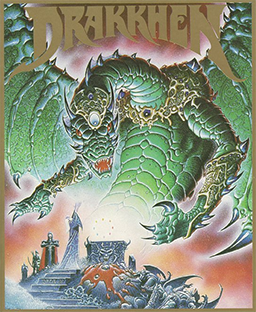
Games I Grew Up On: Drakkhen
Drakkhen was one of the weirdest, yet interesting RPGs I played for the Super Nintendo growing up. It's a "3D" "action" RPG where you create four characters, travel from castle to castle, carrying out quests for giant dragon princes/princesses, and fighting monsters. I never finished the game because there was always one point I got to where I had no idea where to go to next. I also don't know if I ever really understood any story there may or may not have been.
Traveling the overworld was along the XZ planes (no going up, only forward, backward, left, and right) and battles would take place in a brawler style view (you could travel around in all three dimensions in a fixed space). Battle consisted of your characters kind of randomly milling around enemies, occasionally attack enemies whenever they felt like it, with maybe some strategy that I couldn't really figure out.
You could equip your characters with armor and weapons you find (which changed character appearances). Generally, you'll find this equipment in the castles you can explore. Speaking of exploring, the game lets you explore pretty much wherever you want from the get go, so you can very quickly get overwhelmed by the giant black cat heads that shoot laser beams from their eyes or constellations that come down to destroy you. Like I said, a very weird game. It had a much more normal and super awesome sequel, Dragon View, that I was never able to finish because every ROM I found of it would freeze in the same spot. So basically, one series, two games, two games I was never able to beat. Sad day.
Wednesday, August 14, 2013
Games I Grew Up On: Super Mario RPG
Super Mario RPG is one of thee most memorable Super Nintendo experiences I had growing up. Not only was it one of Square's numerous amazing RPGs of the era (I miss those days), but it was the first time that Bowser was a playable character. It was also the rise of his occasional steps into being an antihero (usually only happens when someone else tries to take over the Mushroom Kingdom).
The basic premise of the game is Mario and crew trying to save the seven stars of Star Road that grant people's wishes from the evil Smithy and his gang. On the way to victory, there are a ton of mini-games, hidden secrets, and an incredibly difficult optional boss. While wandering around the world in an isometric view, Mario can jump around to climb platforms, hit ? blocks, and jump on enemies. Whenever Mario makes contact with an enemy, the characters enter a turn based battle like most JRPGs of the time. The difference (and the greatest thing this game added to the turn based RPG genre) was the ability to deal extra damage during attacks or dodge/lessen damage from incoming attacks with properly timed button presses. For example, pushing A right before landing a Jump on an enemy will make Mario jump an extra time (and with certain special jump attacks, you can keep doing this until you mistime the button press). This means that not only does the combat have strategy in it (the real purpose behind good turn based combat systems), but it also requires some dexterity to be fully effective.
This RPG spawned the Paper Mario series and the Mario & Luigi handheld RPG series. The Mario & Luigi series seems to be able to hold its own, but the Paper Mario series seems to be declining in quality, but all of them have been lacking some of the magic of the original. I'm not sure what exactly it is, probably the same magic that Square has lost since then. Or it could just be nostalgia won't let me like anything as much as the original...
Wednesday, July 3, 2013
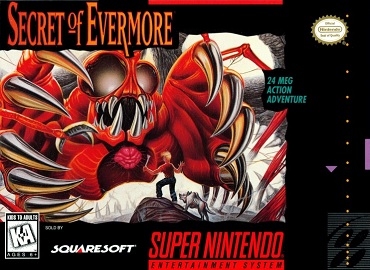
Games I Grew Up On: Secret of Evermore
A sequel to Secret of Mana in name and gameplay only, Secret of Evermore was a much more bizarre, but much more unique action RPG I played growing up. The game starts in Podunk, USA in 1995. A kid chases after his dog (who is chasing after a cat) and ends up in an abandoned mansion. Inside, they find a large and strange machine. The dog starts chewing on some wires, which causes the machinery to activate and send the pair into a strange space station where they are attacked by robots until they get in an escape pod that launches them down to the planet below. The area they land in looks a lot more prehistoric than the space station they were just on (including some raptors!) and the boy's dog has suddenly changed into a large wolf-beast. Thus begins their odd adventure to get back home.
Secret of Evermore was awesome mostly due to the incredibly varied settings (you go from prehistoric, through an Ancient Greece/Egypt like area, to a Medieval-era area, back to sci-fi) that each change the dog, the currency, and the enemies. The game functions very similarly to Secret of Mana (only single player), but instead of magic, there is alchemy. You must find the right components to use your abilities now, but they level up with use, just like in Secret of Mana, so there's even more grinding (which I found enjoyable as a kid, not sure if I could handle it now). There is also a marketplace where I specifically remember having to trade the right items to the right shopkeepers in the right order to get very awesome and rare items. Figuring out that pattern was pretty fun (I think later I had help from Nintendo Power). I remember the bosses being pretty darn awesome, too (especially the one seen on the cover). Though the music wasn't as good as Secret of Mana or Chrono Trigger, it was still pretty awesome, as well. What I didn't know until today is just how bizarre and creepy the commercial for the game was. I'm pretty sure the dog never threw up the other versions of itself like in that commercial...
Wednesday, June 26, 2013
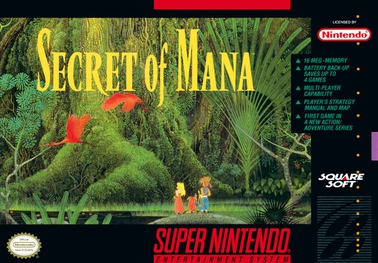
Games I Grew Up On: Secret of Mana
One of my favorite cooperative games growing up was Secret of Mana. You and two of your friends could run around an amazing fantasy world trying to save it from destruction. One of you would be the warrior (the guy), one the healer (the tall blonde), and the other the mage (the short...boy? girl? I never figured that out). Not only did your characters level up when you killed enough monsters, but you could specifically level up your weapons and magic by constantly using that particular weapon or school of magic throughout the game. What this generally meant is that my friends and I would run back and forth between a few areas, killing endless monsters until we were max level, then we'd go follow the path to the boss, which would fall easily to our overwhelming power.
Unfortunately, we never beat the game. Even back when I was a kid, it was hard to really get the same group of friends over consistently, so when we did pick it up, we'd forget where we were supposed to go (back then games didn't really have maps or objective markers/compasses or anything that I expect in games nowadays) and were constantly starting over. Another problem was that the mage (my character) was pretty worthless against normal bad guys because MP (magic points) were limited, so I couldn't use spells that frequently, until a boss fight, at which point my friends really didn't get to play because I'd constantly be pausing the game trying to select spells to use. I would cast my spells so fast that I generally broke the animation system and either the enemies would freeze for a little bit, I would, or just damage numbers would all be delayed and then all appear at once. Hopefully, my friends don't resent my spell spamming that much (if they even remember it).
Despite that, this game is still in my top 5 games I've ever played because the setting and music are amazing and it really is a lot of fun to just run around with your friends killing baddies and leveling up. Maybe some day when my friends and I are all retired, I'll try to get us all around the SNES and finally conquer this game.
Labels:
action,
Blank I Grew Up On,
multiplayer,
RPG,
video games
Friday, May 10, 2013
Review: The DeathSpank Series
There are three different games in the DeathSpank series, but there are so identical to each other that there's not much point in reviewing them separately. That sounds like a bad thing, but really, the games are so funny, the settings so bizarre and clever, and the gameplay is good enough that there's nothing wrong with that. The series is created by game designer, Ron Gibert - famous co-creator of the Monkey Island series and also eventually The Cave. Ron definitely has a certain style because the humor is consistently good in all of these games.
The games revolve around DeathSpank, a hero to the downtrodden, adorned with the Thong of Justice, his only objective is to vanquish evil. Although, he tends to easily get swayed about who is evil and who isn't. For example, he'll gladly help sentient Mind Barnacles (think Brain Slugs from Futurama) take over the local tribe population because they seem nice. What could go wrong there? Basically, the game is constantly poking fun at the typical adventure game trope that anyone who gives a hero a quest must be good. In fact, that's what the game does mostly, use, take advantage, and make fun of all sorts of typical adventure game tropes.
Gameplay is simple enough, you can equip a weapon to each of the four face buttons, consumable items to the four directions of the control pad, select one of three aspects to improve upon leveling up, and talk to people to start or resolve quests. You'll generally find equipment that matches your level as you go, so there's a constant feeling of progression. Dying will merely teleport you to the nearest Outhouse (which also function as fast travel points). Some quests involve some somewhat basic puzzles (a few riddles here and there, a few puzzles requiring finding, combining, and using items correctly). The game also allows a second player to join DeathSpank as his companion (different companion depending on which game), but I didn't get to see how this affects the game.
If you like light-hearted, simple action RPGs with loads of dark humor, stupid chickens, orphans, and bacon, then this series is probably for you. They are very well polished and there are definitely some very interesting twists and turns to more than just the story, but I don't want to say anymore lest I ruin things. I would suggest at the very least to try the demo and if you find the gameplay enjoyable, go through the first for a mere $15. You might find yourself hooked after that.
Friday, April 5, 2013
Review: Darksiders 2
Following the events off the original Darksiders (or at least some of the events? I'm still a little confused by this), Darksiders 2 has players take on the role of another horseman of the apocalypse, Death. Death is on a mission to redeem his brother, War, by trying to resurrect Mankind. Unfortunately, to fulfill this mission he has to follow a seemingly endless amount of people saying, "You should go here, but first help me!" Also, my post about a lack of collectible maps and the downsides of random loot drops were caused by this game.
It seems very strange that the first game did a good job with reminding you where collectibles were so you know where to go once you have the right items and this one failed so miserably at it. Also, the random loot drops made any special items you unlock through skill and hard work (like working through 25 waves of enemies in The Crucible or fighting a super hard optional boss) were really worthless, thus making it feel like a crappy accomplishment. This was only slightly mitigated by having Possessed weapons (that would randomly drop...) that you can "feed" other weapons to make them stronger. So you can craft an uber weapon to fit your play style. Of course, once you do that, you have little reason to care about any further weapon drops because they can't top your weapon.
Yet despite all the incredible gameplay failings this game had, I still want a Darksiders 3 to come out (which will prove difficult since THQ is no more...) because the art, character design, and universe they have built is still phenomenal. I want to play a third game as Strife (although I hope it doesn't become a console FPS since they've made him use guns as his weapons) and a fourth as whatever they've named the fourth Horseman (the only female of the group). I just hope that if someone gets the IP and they make another one, that it has more enjoyable gameplay.
Wednesday, April 3, 2013
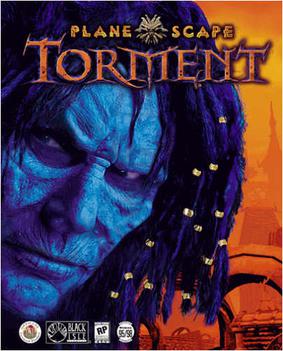
Games I Grew Up On: Planescape: Torment
One of my all time favorite games I have ever played is the game Planescape: Torment. Taking place in the D&D setting of Planescape, players play as The Nameless One, a man who not only can't seem to stay dead, but loses his memories every time he dies. The game starts in a mortuary where The Nameless One is just waking up from his last death when a floating skull comes up to explain what little is known (you're in a mortuary, you were just dead, and you have a back covered in tattoos instructing you to find a man named Pharod). It's then up to the player to discover how to escape the mortuary (there are many different ways to accomplish this), navigate the harsh city of Sigil, and find Pharod to explain...well...anything about The Nameless One.
This is one of the best games at giving the players choice and reacting well to player actions. The multiple ways to accomplish tasks last throughout the game even up to the very end where a skillful player can talk their way into getting the final villain to kill himself. You can switch classes throughout the game by talking to the right trainer. Your alignment switches throughout the game based on what you choose to do and react to given situations. Your teammates might turn on you based on your actions.
The one flaw of the game (and everyone including the developers seem to agree on this) is the combat system. It's definitely not forgiving and it almost always feels like a bit of a struggle (or maybe that's because my last playthrough was with a very non-combat-oriented Nameless One). Fortunately, there are plenty of companions to take with you to help cover your weak areas. Unfortunately, you can only have so many in your party and they are all incredibly well written, so to fully experience them all requires multiple playthroughs. Fortunately, the game is well worth multiple playthroughs. Unfortunately, the frogurt is also cursed.
<shamless plug>The best part is that most of the people who worked on this game (including my brother!) are making a spiritual successor and the Kickstarter ends in just a few days! </shameless plug>
Monday, March 11, 2013
Torment: Tides of Numenera Kickstarter
If you have not already heard of this, there is a Kickstarter to make a spiritual successor to the old Infinity Engine CRPG, Planescape: Torment. The people in charge of this are mostly people who worked on the original game, but due to licensing issues (and also in my mind because The Nameless One's story is already told), they are switching settings from Planescape to Numenera.
This Kickstarter has already broken a large number of records by achieving its goal in 6 hours, reaching $1 in under 8, and reaching $2 in two days. It seems to be majorly slowing down now (possibly due to the weekend), and I think that needs to stop. Both the original and this one have a focus on telling a deep story more than anything else, so all the extra money that goes in to the game will be spent towards making the story better and better. If gaming is ever going to have its Citizen Kane, I think it's going to be in a game like this. Also, on a more personal level, my brother, Adam, was a part of the original Torment game and they have gotten him involved in this one, too. So the better it does, the more steady a job my brother has.
Lastly, I think it's important to fund awesome video games like this through Kickstarter because it not only tells publishers that gamers do want games like this and that we'll pay good money for it, but also funding games through Kickstarter helps free the developer from the chains of a publisher so they can make the game they want more than what the publisher says is popular right now. The closer we can get to a video game business model with few publishers, the better. I'd say no publishers, but I think they have their place as well. I think there is room in this town for the the two of them. Anyway, so if you haven't backed the game already, please do so!
Friday, March 1, 2013
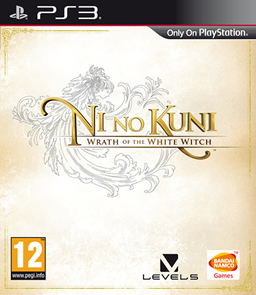
Review: Ni No Kuni
Ever since I heard Level 5 and Studio Ghibli were teaming up to make a game, Ni no Kuni, I got ready to dust off my PS3 and spend a good 60-80 hours in an incredibly beautiful world with plenty of quests, monsters, and adventure. I even got the Wizard's Edition that came with (among other things) a physical version of the Wizard's Companion found in the game and a Wizard's coin. The game certainly did not disappoint. As expected, the art of the game is beautiful - some cutscenes are hand drawn like any other Studio Ghibli movie, while most of them are in the cel shaded style of the gameplay. I will admit it would have been nice to have more hand drawn cutscenes, but that's probably because I want to watch another Miyazaki movie.
Gameplay-wise, there is plenty to do just like every other Level 5 game. If you focus on just the story, you may be introduced to all the types of optional aspects of the game after 5-10 hours. Between helping people on random errands, hunting bounties, capturing, training, and metamorphing familiars, crafting items with alchemy, finding hidden treasure chests, and competing in a tournament, there is certainly a lot to keep you occupied. Fortunately, the game does a good job of helping you keep track of these things. People with errands or things to offer you highlight on the map. Your journal is very clear about where to go next for every side quest. Your Creature Compendium lets you know what familiars are in what habitat (once you've fought them there), so it's easy to tell if you've caught all the familiars in a given place. There is also a progress report on most tasks to tell you how far through you are.
The game is not without its flaws, though. During your adventure, you will find other companions to travel and fight with you. Each person has three familiars to choose from at any time, but for some reason the other AI players never use all of their familiars. They also have a tendency to charge enemies with the familiars that are weak but strong with magic and use up all their mana by obliterating weak enemies with their most powerful spells. Sometimes I just could not understand why my teammates were as stupid as they were. Also, anytime anyone casts a spell that affects multiple targets (or a lot of times when I told my familiar to cast anything), it interrupts every spell your team is casting. So if you're trying to heal your nearly dead teammate and they decide to cast a mass target spell, chances are good they're going to die by the time you manage to pull that heal spell off. Also, my previous post about Instant Death was caused mostly due to this game. Not only do random normal enemies have instant death abilities (a lot of them in the last few areas of the game), but apparently some of them have that ability in a tournament where you're not allowed to use items. Since items are the only way to bring people back from the dead, that means there's a chance that you could instantly get killed in a tournament with no way to defend yourself. Other than that tournament example, though, it's not so bad because if you survive the combat, any previously dead teammates will be alive with 1 hit point so you can just revive them again.
Monday, January 28, 2013
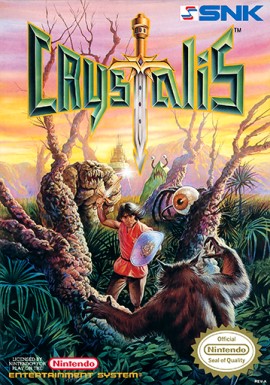
Games I Grew Up On: Crystalis
One of the very earliest action RPGs I ever played was Crystalis. The music was top notch, the gameplay was a good balance of intense (usually for boss fights) and pleasant (wandering around killing monsters for money/experience), and the setting is amazing (100 years after a nuclear war where magic has been rediscovered and is combined with science).
The player wakes up in a strange tower with no memory, but is guided by four different sages through the story to ultimately combine four different elemental swords into the Crystalis sword and defeat Emperor Draygon who is conquering the world. As cliche as that sounds now, it certainly wasn't when I was a little kid. Although I'm not sure how well this game stands up if you didn't grow up on it, it's definitely a game I go back to play every once in awhile.
Essentially, combat is like Secret of Mana. You run around in a mostly top-down view, stab at enemies with B, can cast some spells, can charge up your sword attacks to various levels by standing still (the character, not the player) and holding B (the player, not the character), use gold to buy upgraded armor and shields or useful items, talk to lots of people to figure out what to do next (eventually you get a Telepathy spell that lets you read people's minds, which is an interesting way to get information), and vanquish evil. I really want to go back and play this game again now just thinking about it...
Labels:
action,
Blank I Grew Up On,
NES,
RPG,
video games
Wednesday, December 5, 2012
Games I Grew Up On: TaskMaker
Most computer games I played when I was little were what was known as shareware. That is, they were either free to a point (essentially a demo or lite version for the game) or free with occasional pop ups for donations. One of those games that had a big impact on me was one my brother bought me for my birthday one year: TaskMaker. A lot of the games I played back then were top down, turn-based RPGs. What stood out for me with TaskMaker were two things: the open exploration of the game and the puzzles scattered around.
In the game, you play an adventurer who keeps going up to the TaskMaker (the leader of the land) to be told what to do. Really generic, honestly. But the tasks would lead you to the town you're supposed to be in and give you some idea of where you're supposed to go. However, you had complete freedom to go anywhere in the world you felt like. The only repercussions were that the monsters in areas you weren't ready for would smack you down quickly. But even within a town, it was fun to find all the nooks and crannies and unlock all the doors to collect the hidden goodies. I always found it funny when I found the town's trash dump and I would rummage around the trash pile and find some awesome piece of equipment (or just as likely, just find a bunch of trash). A lot of these buildings would have secret doors or passages that were unlocked with puzzles of some sort. Maybe stepping on a button would open a wall across town. The game had a nice map system, so it was easy to see where you have and haven't been.
Another amusing thing is that when you died in the game, instead of getting a game over screen, you would be sent to Hell where you must find the exit in a maze of flaming walls, fight a demon to open the exit, and then leave. However, any items that were on you when you died will be dropped, so usually loading an old save was a better way to go. Especially since whatever killed you will still be sitting around your corpse when you come back to reclaim your items.
Wednesday, November 14, 2012
Statistics (not the mathematic kind)
Nearly every video game has statistical models determining the outcome of any random event. Did your attack hit? How much damage did you do? Did they save against that spell? Games that display these statistical models to their players are typically what people mean when they label a game an RPG. Your character has this many health points, this much energy/mana/magic points, does this much damage, has this percent chance to hit, etc. These type of games are ideal for the min/maxers out there (like myself) because they know exactly how and what to put their emphasis in to maximize their effectiveness in their play style. This has gotten to the point for me where being able to put an extra point in one my stats is infinitely more rewarding than getting a new weapon that does extra damage or hits more frequently.
Many RPGs that let you create your character from scratch let you determine the starting stats of your character to help define how you are going to play from the beginning. They can determine these values in a few ways. Some games work like D&D where a number of dice are rolled to determine your starting stats, you may then swap those numbers around or take points from one stat to put into another, but you will never have more points than what you rolled. Another method is where you are given a set number of points and must distribute them all yourself. Some games will mix these two styles and make sure that (unlike the D&D method) you always have the same total number of points distributed, but the computer can randomly distribute them for you. I don't remember if I've played a game that does this, but another method I've thought of is having the player start as a blank slate and based on how they deal with the first few opening situations in the game, that determines their stats.
Each method has its pros and cons: the D&D method feels a lot like gambling, so when the player gets a bunch of high numbers, they feel like they win already. However, since the total number of points is determined by the numbers rolled, not every one of their characters will be as good as the others (which is more realistic). The point distribution system has a psychological con (at least for me) where I feel like I'm failing at something already since you can't make all your stats as good as possible (although I did learn years ago that making every stat slightly above average is no good either), but it gives you the most control over your stats letting you really maximize your play style. The game determined method completely takes away any control over your stats, but it means the game designers, who know what all those stats mean better than you do, can allocate the right amount of points so you will be as good as you can be at your play style as possible.
Friday, October 5, 2012
Leveling Systems
When a game is said to have RPG elements, 9 times out of 10 that means the game has some form of a leveling system. Using your weapon enough gives you rewards for using that weapon, killing a certain number of guys unlocks new abilities or skills, or your health increases the more punishment you take. Leveling systems come in a wide variety of forms and are ultimately a reward system to help feed that "just one more" feeling that most games have. You know something exciting should happen when that progress bar fills up fully.
Some games level you up at key points based on moving the story forward. This is great for the game designer because they know exactly how much power a player has at any given point in the game, which makes balancing easier. However, this is no fun for the player because it's incredibly predictable and does not reward the player for any skill they have or exploring they do, thus making the levels feel like part of the story rather than something the player earned.
Some games level up individual skills the more they are used. Depending on how opportunities to use the skill are given determines how hard it is to balance systems. If those opportunities are limited, then the game designer can calculate a player's minimum and maximum strength, but if opportunities are randomly generated and reoccur indefinitely, then a player can grind at one point and reach the highest levels early on in the game story-wise. This system is good for the player since it makes changing play styles possible (with some grinding) and makes it very clear what a player needs to do to be rewarded. However, players don't like to grind, so if it feels like they need to, which it usually does with this system, they will look for exploits to level up a skill super quickly.
Some games level up all the player's stats at once by rewarding a player for various things during the game (exploring sections of the map, unlocking a chest, killing enemies, etc.). This can make balancing a game very difficult since you have to account for min-maxing players who do everything to get as much experience as possible and for casual players who just go through the story. However, as long as it's consistent and clear what the rewards are for, this can be the most enjoyable for players. Players don't have to worry about playing a certain way to level up the skills they want, but get rewarded for the choices they make and actions they take.
One thing all these systems have in common is they all have progress bars that fill up. In my experience, all games except tactics games, the amount needed to level up goes up exponentially as the levels go up. Tactics games generally give a player a level every time they get 100 experience points (XP). The amount of XP you get for attacks/kills is based on the level of who you are attacking. Personally, I have never understood the exponential system because gaining levels becomes increasingly rare making your character's growth more and more stagnant. Instead with the tactics XP system, your character is constantly growing, you never get stagnant, and you can be rewarded for challenging yourself and completing tasks that are supposedly too hard for your current level. You also never have to guess when the next level is occurring.
I'm a big sucker for leveling systems and the more there are in the game, the more addicted I will get, but done poorly they can turn something fun and rewarding into a chore that needs to be done, thus turning a game into work. There should always be a balance between plentiful small rewards for a player and infrequent large rewards that players can work towards.
Monday, September 10, 2012
Dynamic History in Games
I have a friend who is currently on an MMO run, jumping from one to the next, looking for the next Everquest (his personal favorite from the sounds of it). Personally, I have only played two MMOs, World of Warcraft (thanks to a 7 day trial combined with a Christmas week off) and Star Wars the Old Republic (because it's Bioware and Star Wars). Posting my thoughts on those games are two whole other posts, but the reason I bring it up is because there was one experience I had early on in my WoW time that I think should be built off of that only MMOs really have a chance of achieving.
For those who don't know World of Warcraft, players play for one of two factions, The Alliance or the Horde. On a Player vs. Environment (PvE) server like I prefer, this really doesn't show itself in any way since players can't randomly attack each other. However, if you attack an NPC from the opposing faction, you are open to be attacked. Early on, players would organize raids on the enemy towns to try to wipe out all the NPCs. The alarm was usually raised fairly quickly and a defending force of players would be rallied to defend the low level players trying to quest through the area. There is no real benefit to this for the attacking players other than for funsies messing with the other team, but I think there should be.
One thing MMOs have going for them is the ability to emulate massive scale wars that players can take a part in. This only really works if there is any lasting effect of the war. So if attacking an enemy town will either wipe it out or take it over (thus increasing the size of your empire), the game can start to build a history. If you take this a step further and allow factions to be completely destroyed and new ones made, you can completely emulate the rise and fall of great empires. Obviously, this would have to be regulated in some way or another (for example, what happens if you were offline when your empire fell? Is your character from that empire able to start a rebellion of some sort or is it converted to the conquering empire?). Due to the persistence of MMOs, the NPCs would have to get involved in some way so that players can actually maintain lives outside of the MMO without worrying about their faction being lost while they were gone.
Adding in systems that allow a dynamic history like this would give a game the ability to have events with the impact of the The Cataclysm of WoW without having to spend developer time to manufacture it and let the game manufacture the massive events themselves. It also gives players a wonderful reason to work together on a global scale that makes the world feel even more massive than it already is.
Friday, September 7, 2012
Review: Dungeons and Dragons Adventure Board Games
Wizards of the Coast has released three different board games (well, really one game with three different settings) that are essentially D&D Lite - Castle Ravenloft, Legend of Drizzt, and Wrath of Ashardalon. These games have the same feel as Descent: Journeys in the Dark, but instead of one player versus the rest, these games are entirely cooperative. They split up control of the monsters/adventure between players so everyone is involved and the adventure is even more of a team event.
The game starts with players selecting an adventure to go on with its own setup, goals, and villains. Then they each select one of the five heroes to play. Each hero has a whole slew of abilities that they must trim down to their starting set. With the board and heroes all set up, any player can start the game (usually the fighter-type character should start). On every turn, players can either move and attack, attack and move, or move twice. If the players end their turn on an unexplored edge of a tile, they reveal another tile and a new monster (they might also have an encounter). If they did not explore, then they draw an encounter card (which are usually pretty rough for the players). That player then activates the monsters they control (such as they one they might have revealed on their turn) and play continues clockwise until the players achieve their victory condition or one character has no health left and there are no health surges (extra lives) left.
One of the first complaints most D&D players have with this game is that the monsters almost always get an attack off on the players before they can do anything. However, if players got to attack first, this game would be way too easy. As it is, they are perfectly challenging games. I have yet to play a game where a player has not had 0 health and had to use a health surge. There is a good balance between randomness and protection from losing/winning streaks on rolls.
My only problem with the game is that since everyone is working together, it's very easy to interpret rule ambiguities in the players favor, which sometimes felt like cheating to me. For example, monsters generally move from one tile to another, but on each tile are 16 squares that they can be placed on. I couldn't find any rule that says which square they should go on and having them adjacent to heroes will change what attack they do on subsequent turns, so deciding which square a monster should go on is up to the players and can drastically alter the difficulty of the game. (My friends and I have made a house ruling that monsters will go on the monster spawn points on each tile when they enter a tile from moving so it's always a set location.)
All in all, if you don't have time or a DM for a proper D&D romp, these are a nice alternative with quests taking a couple hours each and an option to play a campaign of multiple quests.
Friday, April 20, 2012
Review: Mass Effect 3
Mass Effect 3 is the finale to an epic sci-fi series made by Bioware. The purchase suggestion itself is pretty short: if you haven't played Mass Effect 1 or 2, don't get 3 (start with 1 if possible and work through all three); if you have beaten Mass Effect 1 and 2, you need 3. Unlike most video game trilogies, the Mass Effect trilogy really is a series. There is a grand sense of continuity and that your choices matter. Obviously, the major choices you make in 1 and 2 (did you kill this person or that person, who did you romance, etc.) will impact the third. But I noticed numerous times where even my more minor choices impacted the game or at least felt like they did. And that is the key here, player perception. If you can make the player feel like his choices mattered, then they mattered whether it actually changes any dialogue/events or not.
In the Mass Effect series, players take the role of Commander _____ Shepard. They can choose whether it's a female/male Shepard, what the first name is, and what they look like. The forced last name and title allow the main character to be mentioned by name in the voiceovers, which was a clever trick when Mass Effect first came out. The first two Mass Effect games have you fight a threat to the galaxy, while building suspense towards the much larger threat you fight in Mass Effect 3. Mass Effect 3 is essentially just one big set of cameos from all the characters you've come to know from the first two games. The really interesting thing that comes out of this is that if you talk to anyone else who has played Mass Effect 3, the stories can be very drastically different. The most obvious example being choice of gender - every time my friend talks about Shepard and says he, I get confused because I play as a FemShep (Female Shepard voiced by Jennifer Hale, my voice crush).
These choices and differences in story really help to solidify the Mass Effect story as a whole as a player story. I think because of this, the ending to Mass Effect 3 hit players much harder than a typical video game ending. Typically, video game endings are nothing to talk about (Rampage only gives you a single Congratulation. Teenage Mutant Ninja Turtles for the NES gives you a Game Over when you beat the game.). There are a few exceptions I can think of (first off, don't click those links if you don't want endings to Splosion Man, You Have to Burn the Rope, Portal 1, and Portal 2 spoiled, secondly, I think I see a pattern in the video game endings I enjoy...). Mass Effect 3's ending represents the culmination of 120+ hours of commitment to your particular Shepard's story. I think just like Lost's ending, there's no way to appease everyone. Maybe it's because I knew this ahead of time in both cases that I was able to enjoy both endings for what they were. Yes, that's right, I enjoyed Mass Effect 3's and Lost's ending. Not just "was okay with them", but was actually pleased by both of them. Obviously, I can't really discuss the endings here without spoilers, so if you want details, you'll have to talk to me personally, but I'd love to do that to see where our stories differed and what you thought.
Monday, March 9, 2009
If Life Were An RPG
- You would be able to cure any sickness by drinking a certain type of potion
- You can cure death by talking to a priest at a church
- Getting to work would take even longer due to having to randomly fight monsters
- Everyone would have a list of every skill they are capable of, how good they are at it, and how much more work they have to do to get better at it
- Switching jobs would be a matter of going to selecting a new job from a menu (possible requirements from other seemingly unrelated fields)
- Banks would only exist to protect your money in case of death at which point a friend can go to church to revive you (see above) and you can get your money back
- If you lived in a small village, there's a good chance you'd be called on to save the world from imminent danger (even more likely if you had spiky hair)
- Strangers wouldn't mind you barging in to their houses, rooting through their stuff, taking what you want, and leaving without saying a single word
- You'd probably start to notice that everything looks the same from one area to the next, just in different colors
Subscribe to:
Posts (Atom)