I've recently started listening to podcasts while I'm working. Usually I'll start listening to things when it's either getting too loud in the office to concentrate or if I feel myself starting to zone out or get distracted and I need to refocus on my work. Those seem like times where I totally wouldn't want to listen to a group of guys talking about video games, but it seems that most of the time, that helps me focus more than anything else I've found. One of my favorite podcasts I've been told about lately is the Giant Bombcast. I haven't listened enough to really get to know the guys individually, but it's a long (2-3 hour) podcast about what the guys have been doing lately, what games they've been playing, any recent gaming news and their thoughts on it, and responses to listener e-mails.
It reminds me of the morning show I listen to on the radio where they have a list of things to talk about, but get easily distracted or go into great depth about whatever they feel like, which makes it feel more personal than just a normal news thing, but it never feels like they're trying to force their opinions on anyone (well...maybe on each other), they just share what they feel about the given topic so it never really feels preachy or manipulative. They also seem to enjoy a variety of different games and systems, so it doesn't seem very biased overall. If you've got enough time to listen to podcasts and enjoy gaming, then I would recommend listening to the giant bombcast. It pops up every Tuesday, I think in the late afternoon roughly.
Friday, October 11, 2013

Wednesday, October 9, 2013
Games I Grew Up On: Batman The Video Game

I think the "plot" of the game is trying to follow the movie? It starts with you confronting Jack in the Axis Chemical Factory. Then you go through a museum. Then the batwing levels (which were pretty brutally difficult shoot 'em ups). Then into the cathedral to face the Joker once and for all. I guess it was short just like Super Mario Land, too. It's also pretty entertaining because the life counter is in hexadecimal and how the first and last boss fights are pretty much identical. If you have 30 minutes to kill, you can watch the entire game here. I remember really hating that auto scrolling level at the end...
Monday, October 7, 2013
Review: Curses!

Like most casual party games, the rules are incredibly simple. Every turn has you drawing a Challenge card, doing what it says (e.g. "Give a news report" or "Explain the difference between Coke and Pepsi") and then drawing a Curse card and giving it to someone else to do what it says (e.g. "Don't bend your elbows"). The Challenge cards are only for a single turn, but the Curse cards last until you get caught failing at it. If anyone else notices you not following a Curse, they can ring a bell and call you on it, at which point you will flip over the card and be free of that curse. A player is knocked out after three failed curses and the last player remaining wins the game.
This is one of those games where it's most fun if you don't play to win, but instead you play to make awesome/terrible Curse combinations. A lot of the Curses build off each other so you can get a Curse chain going around the table until someone fails. For example, there's a curse that makes say a pizza topping whenever someone stands up, another that makes you howl whenever someone says a food, and another that makes someone clap whenever someone makes an animal noise. Alternatively, you can give someone a theme of curses, so one person has to speak in a French-Irish Vampire-Pirate accent anytime they talk. Of course, as with most games that make people talk in certain ways, most people stop talking when those start appearing, which is precisely why the Challenge cards are so crucial and why the content of your response to a Challenge card is so meaningless. It's not about what you say, you just have to say things to activate all the curses on the table. Admittedly, this makes the first round kind of lame since there aren't very many curses on the table, but you could always fix that by just evenly distributing at least one curse card to every player.
The game is designed for 3-6 players and lasts between 60-90 minutes (in my experience). You could easily play with more players, but it will not only take longer since there are more players to eliminate, but it will also be much harder to keep track of what everyone is supposed to be doing, so it'll be easier to not get caught when you slip up doing a curse, which is only going to make the game last even longer, so just keep that in mind. This is definitely a great game if you want to laugh a lot during your game night.
Friday, October 4, 2013
Picross
Picross (a.k.a. Nonogram) are Japanese logic puzzles where a picture is revealed by filling out spots in a grid using numbers on the columns/rows. For example, if there is a 1 1 1 on the side, then there will be three individual spots filled out with at least one empty spot between each one. Usually Picross puzzles come in either 5x5, 10x10, or 15x15 configurations. It also helps to have grown up with pixel art to try to determine what the picture actually is (especially on the 5x5 ones).
I'm pretty addicted to these puzzles types (if Sudoku made pictures when complete, I'd probably be equally addicted to that) and have played through/bought pretty much every instance of it I've seen. Online versions like Armor Picross and Armor Picross 2, DS versions like Picross DS and Picross 3D, 3DS versions like Picross e, Picross e2, and soon Picross e3 (just came out yesterday), and Kindle Fire versions like the Flippix Art series, CrossMe Color, and Picranium Picross (of course I always wait for those to show up as Amazon's free app of the day).
If you play one Picross game, generally you play them all (unless it's a color version since that changes how the puzzles/number system actually work). There are minor differences in how the input works. For example, are mistakes pointed out immediately (usually with a time penalty or a limited number of allowed mistakes) or can you build the remainder of the puzzle based off of a mistake? Can you zoom into the 15x15 grid or do you have to be a little too accurate? When you're done, do they turn the pixel pictures into a real picture or color it so it's easier to see what they are saying it is? If you have never played a Picross game, I'd start with one of the free online ones to see what you think about it. The Armor Picross series is very well done, so I'd start there. Enjoy and don't spend too much of your day on it!
I'm pretty addicted to these puzzles types (if Sudoku made pictures when complete, I'd probably be equally addicted to that) and have played through/bought pretty much every instance of it I've seen. Online versions like Armor Picross and Armor Picross 2, DS versions like Picross DS and Picross 3D, 3DS versions like Picross e, Picross e2, and soon Picross e3 (just came out yesterday), and Kindle Fire versions like the Flippix Art series, CrossMe Color, and Picranium Picross (of course I always wait for those to show up as Amazon's free app of the day).
If you play one Picross game, generally you play them all (unless it's a color version since that changes how the puzzles/number system actually work). There are minor differences in how the input works. For example, are mistakes pointed out immediately (usually with a time penalty or a limited number of allowed mistakes) or can you build the remainder of the puzzle based off of a mistake? Can you zoom into the 15x15 grid or do you have to be a little too accurate? When you're done, do they turn the pixel pictures into a real picture or color it so it's easier to see what they are saying it is? If you have never played a Picross game, I'd start with one of the free online ones to see what you think about it. The Armor Picross series is very well done, so I'd start there. Enjoy and don't spend too much of your day on it!
Wednesday, October 2, 2013
Movies I Grew Up On: Strange Brew
.jpg)
Honestly, I really don't know what else to say about this movie...it's weird, it's silly, it's dumb, and you should watch it.
Monday, September 30, 2013
Review: Cloudy with a Chance of Meatballs 2
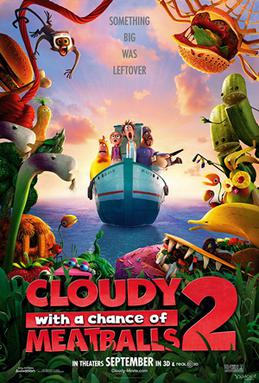
The plot is essentially Jurassic Park 2 and 3: the science that went wrong in the first one has gone ever further wrong creating an ecosystem of its own. Instead of dinosaurs, however, it's food animals (or foodimals). And even better than Jurassic Park 3, all the new types of creatures are actually well designed. Just about every foodimal is created solely to be a pun (Shrimpanzee, Peanut Butter and Jellyfish, Mosquitoast, etc.), but beyond the awesomeness of that, they are all really beautiful and well thought out.
The entire movie is also incredibly well animated with lots of little subtle (and some not so subtle) visual jokes going on almost all the time. There was one scene that totally reminded me of Joss Whedon's Much Ado About Nothing where the scene and dialogue were about one thing, but the entire time, there's something happening visually that was way more entertaining. There were also a couple characters who had me smiling pretty much the entire time they were on the screen just because of how their arms moved or the random stuff they were doing while they talked.
The following is a non-comprehensive list of who I think would like this movie:
- People with kids
- People who love puns
- People who love good animation
- People who love food
- People who love food puns
- People who love animated food puns
- People who love to laugh
- People looking for something lighthearted
- People who secretly (or not so secretly) wished they had a living Strawberry, Pickle, or Tacodile Supreme
- People who were told not to play with their food
- Probably you
Friday, September 27, 2013
When Collecting Goes Wrong
Sorry, I'm not talking about hoarding, although I guess collecting goes wrong there, too. I'm talking about collectibles in video games and how they can ruin certain types of games (or at least certain sections). As I'm sure you're aware by this point, I love collecting things in games. I love scouring every corner of a world to find all the hidden widgets and whatsits (especially if there's a tracker or some way to know if I've missed any), but I've come to the realization that collectibles lying on the ground can completely ruin any dramatic tension a game may have built up, not to mention any sense of sanity in the playable character.
Say your girlfriend just got kidnapped and you've chased the bad guys into some building. Being a video game, chances are pretty good that you could just stand at the entrance indefinitely and the bad guys will never leave the building or try to find some other way to ferret away your girlfriend because you were just standing there. Personally, I appreciate this bit of video game logic since it lets me move the story forward at my choice. But it definitely kills the mood of the game if it's an intense moment and I stop because there might be some hidden goody in an adjacent room and I have to stop chasing them to go find it.
This happened a bunch during Last of Us where I'd meet someone and they'd say, "Come follow me to safety" and they'd just walk off. Logically and cinematically, I should immediately follow them to make sure I'm safe. But I know I can comically just ignore them to wander into all the rooms they should have already cleaned out of useful items to see if I can find anything since the story won't trigger until I reach a certain place and I know enemies won't be coming from anywhere until that point. The problem I'm talking about is mostly with collectibles in games like Uncharted, Last of Us, and Remember Me. The fairly linear, cinematic type games where the pacing is very important to the overall experience.
I think collectibles can be done in those games, but it should only be in the sections where you have no immediate goal to rush somewhere. So, if the collectibles were only found in some kind of rest area, usually found right after a particularly intense part of the game, then it wouldn't really break the pacing much. If they were consistent about it, then it would also help me to not constantly be breaking the action to scour all the corners of a room to see if I missed anything. I could play the action sequences like action sequences and the collection sections like a crazy OCD packrat - essentially how I treat collecting in any open world game. I am either running around in collection mode or I'm moving the story along, but I get to choose when to do both. Of course, this is all because I can't stop myself from needing to collect everything and hating the feeling that I missed something, so as usual, maybe it's more a personal problem than a game design problem...
Say your girlfriend just got kidnapped and you've chased the bad guys into some building. Being a video game, chances are pretty good that you could just stand at the entrance indefinitely and the bad guys will never leave the building or try to find some other way to ferret away your girlfriend because you were just standing there. Personally, I appreciate this bit of video game logic since it lets me move the story forward at my choice. But it definitely kills the mood of the game if it's an intense moment and I stop because there might be some hidden goody in an adjacent room and I have to stop chasing them to go find it.
This happened a bunch during Last of Us where I'd meet someone and they'd say, "Come follow me to safety" and they'd just walk off. Logically and cinematically, I should immediately follow them to make sure I'm safe. But I know I can comically just ignore them to wander into all the rooms they should have already cleaned out of useful items to see if I can find anything since the story won't trigger until I reach a certain place and I know enemies won't be coming from anywhere until that point. The problem I'm talking about is mostly with collectibles in games like Uncharted, Last of Us, and Remember Me. The fairly linear, cinematic type games where the pacing is very important to the overall experience.
I think collectibles can be done in those games, but it should only be in the sections where you have no immediate goal to rush somewhere. So, if the collectibles were only found in some kind of rest area, usually found right after a particularly intense part of the game, then it wouldn't really break the pacing much. If they were consistent about it, then it would also help me to not constantly be breaking the action to scour all the corners of a room to see if I missed anything. I could play the action sequences like action sequences and the collection sections like a crazy OCD packrat - essentially how I treat collecting in any open world game. I am either running around in collection mode or I'm moving the story along, but I get to choose when to do both. Of course, this is all because I can't stop myself from needing to collect everything and hating the feeling that I missed something, so as usual, maybe it's more a personal problem than a game design problem...
Subscribe to:
Posts (Atom)