Picross (a.k.a. Nonogram) are Japanese logic puzzles where a picture is revealed by filling out spots in a grid using numbers on the columns/rows. For example, if there is a 1 1 1 on the side, then there will be three individual spots filled out with at least one empty spot between each one. Usually Picross puzzles come in either 5x5, 10x10, or 15x15 configurations. It also helps to have grown up with pixel art to try to determine what the picture actually is (especially on the 5x5 ones).
I'm pretty addicted to these puzzles types (if Sudoku made pictures when complete, I'd probably be equally addicted to that) and have played through/bought pretty much every instance of it I've seen. Online versions like Armor Picross and Armor Picross 2, DS versions like Picross DS and Picross 3D, 3DS versions like Picross e, Picross e2, and soon Picross e3 (just came out yesterday), and Kindle Fire versions like the Flippix Art series, CrossMe Color, and Picranium Picross (of course I always wait for those to show up as Amazon's free app of the day).
If you play one Picross game, generally you play them all (unless it's a color version since that changes how the puzzles/number system actually work). There are minor differences in how the input works. For example, are mistakes pointed out immediately (usually with a time penalty or a limited number of allowed mistakes) or can you build the remainder of the puzzle based off of a mistake? Can you zoom into the 15x15 grid or do you have to be a little too accurate? When you're done, do they turn the pixel pictures into a real picture or color it so it's easier to see what they are saying it is? If you have never played a Picross game, I'd start with one of the free online ones to see what you think about it. The Armor Picross series is very well done, so I'd start there. Enjoy and don't spend too much of your day on it!
Showing posts with label puzzles. Show all posts
Showing posts with label puzzles. Show all posts
Friday, October 4, 2013

Wednesday, September 18, 2013
Books I Grew Up On: Two Minute Mysteries

Since each mystery is so short, there really wasn't much time to set things up or have a denouement of any sort for each of the stories. It was mostly just a focus on that fun crucial part of mysteries where the detective catches someone making a mistake. At the end of each story, the book would pose a question like, "How did the detective know that person was the killer?" with an upside answer explaining the subtle mistakes. A lot of times the person mentioned something about the crime that the detective never told them (so they weren't supposed to know it).
I think this series was a good training tool for even deeper mystery solving and has prepared me well for the Phoenix Wright series. Now I know to scrutinize pronoun use and crime timelines among other things. The series has three books in all, but looking on Amazon, only the first one is still in print (and the others must be in huge demand since the new price is $150-200!). Fortunately, if you read one, the others are pretty just more of the same. If you're into mysteries, I'd give the main one a look since it's only $5.
Monday, July 15, 2013
Review: Whodunnit?

The premise of the show is one of those murder mystery parties/dinner theaters with a reality competition laid on top of it. Each episode, there is a murder. The contestants must try to piece together the murder. Each one can choose to investigate the crime scene, the morgue, or the last known location the person was before the murder. Since no contestant can be in all three places, some information must be shared, but the murderer is among them, so it's hard to tell who to trust. Not to mention that they are all competing to be the final contestant "left alive". After the investigation, everyone is given a riddle (a la Treasure Hunters), whose solution will lead to one more clue to how the murder occurred. Then in a confessional, the contestants lay out their theory of how the crime took place and who the murderer is. The two contestants whose theories were furthest from what happened become marked, with one of them becoming the murder victim for the next episode.
It's a really interesting premise for a show, but it definitely is pretty darn awkward. The deaths are so blatantly fake that the contestants even remotely acting like any of it is real is really just insulting to their (and our) intelligence. One contestant convulses on some wet ground as a cut, sparking wire lays on the ground kind of near her, but clearly not touching the water; one contestant on fire runs outside and jumps in a pool and somehow instantly drowns?; one contestant "conveniently" needs to go to the kitchen because their meal wasn't cooked like everyone else's and gets "attacked" by a mountain lion? I'm pretty sure everyone knows how murder mysteries are supposed to be, so acting like it's real when there's no real effort made to make it appear real is just strange. The confessionals where the contestants lay out their theory about the murder are just terribly acted (I'm sure the people had fun doing them, but over the top doesn't begin to describe it).
The other annoying part is that it's a lot like the Sherlock Holmes books, in that, as the viewer, there is no way for us to really play along or figure out anything ahead of time. The riddles are more like scavenger hunts and all the contestants seem pretty stupid, so it honestly could be any of them, but despite that, there is some part of me that wants to keep watching. Maybe part of me is hoping it'll turn out like the murder mystery episode of Saved by the Bell where there will be a twist of epic proportions part way through, but most likely this will just be a show that was much better in concept than in production. Really, it's just making me more upset that Treasure Hunters never got another season...
Wednesday, June 5, 2013
Games I Grew Up On: The Neverhood

The game starts with Klaymen (the player's character) waking up in a locked room with no knowledge of what he's doing there. There aren't very many other characters in the game and most of the story/world building is done by exploring and finding the giant wall of the world's creation story or various videotapes of Willie Trombone (awesome name) telling a bizarre fairy tale. I can't say too much about this game since the whole point is to explore and discover everything on your own (and it's well worth it if you can), but I will say this: it has one of the funniest scenes in a video game ever and some of the best music of any video game ever.
I guess I should also point out that what brought this game to mind is that the creators have a Kickstarter going for another game in a similar vein called Armikrog that you should very much support because it'll be awesome and if you had never heard of The Neverhood, maybe you have heard about Earthworm Jim, which was made by the same people.
Friday, May 3, 2013
Review: The Cave
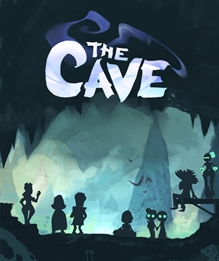
The whole game is beautifully narrated and almost every line is some joke or ominous foreshadowing (a lot like the story in the Deathspank series). The puzzles themselves are interesting the first time you solve them. Some require all three characters to work as a team, some require a character's special ability, some are just made easier with the special abilities. The downside of the game is that if you want to see everything, you have to beat the game at least six times with the majority of the game not changing and (I still don't understand how this happens nowadays) with unskippable cinematic bits. So the first time through The Cave is 100% fun and awesome. The second time through is roughly 42.9% awesome since you have already done the four major shared puzzles before. The third time through is 14.3% awesome since you are now only seeing one new area. For the remaining three playthroughs, the only difference is the ending you get based on the choice you make at the very very end. I've already mentioned how much I hate backtracking, so you can imagine that this doesn't go over so well with me. On the plus side, it did allow me to watch Netflix on my laptop while playing the game because I didn't have to pay attention that much, so at least I was getting two things on my mental checklist done at once...if you're not a completionist and the game is on sale for like $10 or so, I would highly recommend this. If you really like dark comedy and puzzles and don't mind a little backtracking, I would also recommend this. If you enjoy doing speed runs and trying to cut down the length of a playthrough to as short a time as possible, this would be a lot of fun, too. If none of those apply, I'd probably avoid it.
Wednesday, February 27, 2013
Games I Grew Up On: Adventures of Lolo
.jpg)
Adventures of Lolo is still one of the few true action puzzle games I've played to date. Portal and Portal 2 had moments here and there where timing was required, but not with enemies chasing you down (stupid Almas...). Most other action games with "puzzles" are mostly just block puzzles where you need to put Crate A into Slot A and Box B into Slot B. As a kid, I think I might have managed to get through maybe half of the game. In college with an emulator and save states, I was able to beat the whole game. Then, after college I managed to beat the game on the original system, but it's definitely a brain twister and a half.
Lolo got two more games after this and Lala was not only not captured in the third one, but you could play as her if you wanted. I think my favorite part about Lolo and Lala is that they were enemies in Kirby's Dreamland and later became staple Kirby enemies named Lololo and Lalala. Also, given their super simple geometric shapes, Lolo, Lala, Leeper, and Rocky were my first creations in a brief foray into sculpting I had a few years ago.
 |
| Kirby about to put the hurt on Lala |
Friday, November 2, 2012
Review: The Fool and his Money
So I previously mentioned a game I had pre-ordered for what I estimated was 5 years (turns out it was 7 years ago). It finally came out last Friday and long story short, it was well worth the wait. The Fool and his Money is a sequel to the game The Fool's Errand. I'm not sure if you have to play the original to understand the sequel, but it's free and it's awesome, so there's really no reason not to play the original, especially if you like puzzles.
The game is set up much like an Usborne Puzzle Adventure. There is a page of story text with an associated puzzle to solve. One difference is each page only shows a few sentences until the puzzle is solved. It's ideal to play the puzzles in order so you can understand the story, but it's not necessary. The game starts with around 10 puzzles unlocked with a new one unlocked for every puzzle solved. So if you get stuck on one puzzle, you can move on to another and come back when you're ready. Each puzzle solved unlocks a part of the Moon's Map. Once all the pieces are unlocked, they will have to be arranged appropriately to unlock the final set of puzzles.
All told there are well over 150 puzzles in this game that need solving. That's not counting the fact that you will have to figure out what the puzzle is in many cases. For example, there are 5 different card games whose rules you will have to learn through deduction and trial and error. Once you learn the rules, it's a whole other matter to defeat the other player. The best part of all the puzzles is that you can trust them to be fair. You don't have to worry about any trick questions, any hidden pixels, or any scattered information. Everything you need to solve a puzzle is on the page you find it or has a link to send you to where the information is. The clues are also subtle while still being obvious that there clues to be found. If you're really stuck on solving a puzzle, the main menu has a link to a very well crafted hint page that can guide you to a puzzle's solution without necessarily ruining the answer.
For $40, this brain buster is a grand bargain for anyone who loves having their smarts challenged. It's especially wonderful for fans of word play. However, be warned, you better really love anagrams.
The game is set up much like an Usborne Puzzle Adventure. There is a page of story text with an associated puzzle to solve. One difference is each page only shows a few sentences until the puzzle is solved. It's ideal to play the puzzles in order so you can understand the story, but it's not necessary. The game starts with around 10 puzzles unlocked with a new one unlocked for every puzzle solved. So if you get stuck on one puzzle, you can move on to another and come back when you're ready. Each puzzle solved unlocks a part of the Moon's Map. Once all the pieces are unlocked, they will have to be arranged appropriately to unlock the final set of puzzles.
All told there are well over 150 puzzles in this game that need solving. That's not counting the fact that you will have to figure out what the puzzle is in many cases. For example, there are 5 different card games whose rules you will have to learn through deduction and trial and error. Once you learn the rules, it's a whole other matter to defeat the other player. The best part of all the puzzles is that you can trust them to be fair. You don't have to worry about any trick questions, any hidden pixels, or any scattered information. Everything you need to solve a puzzle is on the page you find it or has a link to send you to where the information is. The clues are also subtle while still being obvious that there clues to be found. If you're really stuck on solving a puzzle, the main menu has a link to a very well crafted hint page that can guide you to a puzzle's solution without necessarily ruining the answer.
For $40, this brain buster is a grand bargain for anyone who loves having their smarts challenged. It's especially wonderful for fans of word play. However, be warned, you better really love anagrams.
Wednesday, September 12, 2012
Review: Bananagrams

I have only played this game once, so maybe I just don't quite understand things quite well, but it seems to me that there is no limit to the number of times you can dump tiles, so it seems like you can just repeatedly dump early on to have a much larger batch of tiles to work with. This game also has the same problem I have with Scrabble and its nonsense words (especially the two letter words like Qi, El, Za, etc.). But I guess this just means when I beat you with a whole board filled with real words, it will be that much more satisfying.
Friday, June 29, 2012
Puzzles in Board Games
To round out what has apparently become Puzzle Week, I wanted to talk about puzzles in another media type besides books and video games. I tried to think about puzzles in movies/television and the closest I can come up with is are shows like Psych or possibly Leverage (which come to think of it is probably one of the reasons why I like those shows so very much...) where there is some mystery to solve (who murdered that person or how are they going to steal that?) and in theory you are given just enough clues you might be able to guess it. The problem is that if they give too many clues, then it ruins any twists or surprises the writers have in store, but if they give too few, then it's like a Sherlock Holmes story where there is absolutely no way to guess the outcome because the clues Sherlock Holmes discover are never revealed until the end when he explains the answer. So ultimately, the episodes are designed so you can't solve it ahead of time, so they're not really puzzles.
So I decided to talk about puzzles in board games. I'm not talking about jigsaw puzzles or Mastermind, but something with a little more depth and variety in its puzzles. The only example I can really come up with is the game Mansions of Madness. I haven't actually been able to finish this game yet, let alone play it multiple times, so I can't do a proper review, but one of the things that made me buy the game was that it had in game puzzles that needed to be solved by players before they could achieve their goal. I was very curious how it was possible to make a repeatable puzzle in a game that both gave players time to think, but didn't completely stall the game for all the other players.
What they have come up are pipe and lock puzzles where you are given random pieces in a predetermined format and must swap and rotate them so that all the colors/shapes/whatever align. Not a very difficult puzzle, but these can definitely be tricky. The genius part is that you are only allowed to move and swap a set number of pieces each turn (determined by your player's Intelligence trait). So if you know how to solve the puzzle quickly, but your character is an idiot, it will take a long time to solve it or if you can't figure it out, you can think about your next few moves while other players are taking their turns. Again, I haven't played this enough to see how consistently awesome this is, but from what I saw it was pretty much exactly what I was hoping for when I bought the game.
I'm still trying to figure out a way to combine the Usborne puzzles and maybe some Cliff Johnson puzzles into a board game in such a way that it offers deep and clever puzzles that are replayable and not game-stalling. I'll let you know when I figure out how to do that...
So I decided to talk about puzzles in board games. I'm not talking about jigsaw puzzles or Mastermind, but something with a little more depth and variety in its puzzles. The only example I can really come up with is the game Mansions of Madness. I haven't actually been able to finish this game yet, let alone play it multiple times, so I can't do a proper review, but one of the things that made me buy the game was that it had in game puzzles that needed to be solved by players before they could achieve their goal. I was very curious how it was possible to make a repeatable puzzle in a game that both gave players time to think, but didn't completely stall the game for all the other players.
What they have come up are pipe and lock puzzles where you are given random pieces in a predetermined format and must swap and rotate them so that all the colors/shapes/whatever align. Not a very difficult puzzle, but these can definitely be tricky. The genius part is that you are only allowed to move and swap a set number of pieces each turn (determined by your player's Intelligence trait). So if you know how to solve the puzzle quickly, but your character is an idiot, it will take a long time to solve it or if you can't figure it out, you can think about your next few moves while other players are taking their turns. Again, I haven't played this enough to see how consistently awesome this is, but from what I saw it was pretty much exactly what I was hoping for when I bought the game.
I'm still trying to figure out a way to combine the Usborne puzzles and maybe some Cliff Johnson puzzles into a board game in such a way that it offers deep and clever puzzles that are replayable and not game-stalling. I'll let you know when I figure out how to do that...
Wednesday, June 27, 2012
Cliff Johnson
Alongside puzzles in book form, I also grew up playing many puzzle games on the computer. One of my favorite creators of these games was Cliff Johnson. I grew up playing Fool's Errand and 3 in Three (I think I've played through both of them at least three times each) and in college discovered At The Carnival. I still haven't played his other games because I haven't been able to get them to run on any machine I've tried them on yet. If anyone knows a free and legal way to run a Windows 98 program on a Windows 7 machine, I would greatly appreciate it.
In theory, at the end of September, Cliff will be releasing a new game called A Fool and His Money. I say in theory because I was immortalized in the Compendium of True Believers (i.e. pre-ordered the game) I think 5 years ago when I used to work at Liquid Entertainment. Each year the game was supposed to be coming out that year sometime, but kept getting pushed back due to a technical flaw or family emergency (it is only one guy making the game after all). I have hope this time will stick, though, because unlike the other times, Cliff has a weekly production schedule with clear goals and deadlines.
Of course, even if it doesn't, I'm all for supporting one of the men responsible for the games I was raised on. Heck, I'm even quoted on his page (although uncredited): "I grew up on Fool’s Errand and 3 in Three and cannot wait for their further adventures. You are a genius and you make me feel like one when I beat your games."
Monday, May 28, 2012
Review: Dismantlement Series

The goal of the game is fairly simple. You are given an object (ranging from a toaster to a radio to a lunch box) and you need to dismantle it with a screwdriver. Unfortunately, most of the screws will only be uncovered once you solve a puzzle. The clues for the puzzle are always found somewhere on the object and most of the time, you don't need to do any pixel hunting (warning TVTropes link) to find them.
The games are made in Japan (if you didn't catch that from the URL, the Dismantle Tea Canister, Dismantle Box Lunch 1 and 2, and Dismantle Mikoshi should give it away) and the earlier ones suffer a bit from Engrish, but you never really need to read anything of consequence anyway. There is no story here; there is rhyme or reason to what you're doing. Just dismantle things!
Subscribe to:
Posts (Atom)