Monday, July 15, 2013

Review: Whodunnit?

The summer is a strange period where there are more people with free time, but significantly lacking quality new media.  Movies seem to know how to take advantage of this, but for some reason, there's an incredible lull in new games and new television and generally what is released is pretty terrible (with a few notable exceptions).  The summer seems to be a good time for TV producers to test out their unique reality TV show ideas like The Mole, Pirate Master, and this season's show, Whodunnit.

The premise of the show is one of those murder mystery parties/dinner theaters with a reality competition laid on top of it.  Each episode, there is a murder.  The contestants must try to piece together the murder.  Each one can choose to investigate the crime scene, the morgue, or the last known location the person was before the murder.  Since no contestant can be in all three places, some information must be shared, but the murderer is among them, so it's hard to tell who to trust.  Not to mention that they are all competing to be the final contestant "left alive".  After the investigation, everyone is given a riddle (a la Treasure Hunters), whose solution will lead to one more clue to how the murder occurred.  Then in a confessional, the contestants lay out their theory of how the crime took place and who the murderer is.  The two contestants whose theories were furthest from what happened become marked, with one of them becoming the murder victim for the next episode.

It's a really interesting premise for a show, but it definitely is pretty darn awkward.  The deaths are so blatantly fake that the contestants even remotely acting like any of it is real is really just insulting to their (and our) intelligence.  One contestant convulses on some wet ground as a cut, sparking wire lays on the ground kind of near her, but clearly not touching the water; one contestant on fire runs outside and jumps in a pool and somehow instantly drowns?; one contestant "conveniently" needs to go to the kitchen because their meal wasn't cooked like everyone else's and gets "attacked" by a mountain lion?  I'm pretty sure everyone knows how murder mysteries are supposed to be, so acting like it's real when there's no real effort made to make it appear real is just strange.  The confessionals where the contestants lay out their theory about the murder are just terribly acted (I'm sure the people had fun doing them, but over the top doesn't begin to describe it).

The other annoying part is that it's a lot like the Sherlock Holmes books, in that, as the viewer, there is no way for us to really play along or figure out anything ahead of time.  The riddles are more like scavenger hunts and all the contestants seem pretty stupid, so it honestly could be any of them, but despite that, there is some part of me that wants to keep watching.  Maybe part of me is hoping it'll turn out like the murder mystery episode of Saved by the Bell where there will be a twist of epic proportions part way through, but most likely this will just be a show that was much better in concept than in production.  Really, it's just making me more upset that Treasure Hunters never got another season...

Friday, July 12, 2013

Review: The Perfect Heist

Yet another of the games I've backed on Kickstarter has arrived, this time it's The Perfect Heist.  On the surface, this is a heist movie flavored Munchkin, but after playing it, you'll realize that it's much more than just that.  Players cooperate or compete in various heists to earn Notoriety points.  The game ends when any player has been involved in a certain number of successful heists and at that point, the player with the most Notoriety points wins.  Each heist has a difficulty rating (that also determines how many Notoriety points it's worth).  Players build an Ability deck with a series of traits (Quick Thinking, Pyromaniac, Brute, etc.), weapons (brass knuckles, guns, flamethrowers, etc.), kit items (rope, ladders, high tech cameras, etc.), and a specialty (Driver, Gunman, Technician, etc.) to improve their ability to tackle the more difficult heists.  If a heist is too difficult for a player, they can recruit other players to join them on the heist by offering them a cut of the loot or Notoriety points the heist gives them or cards they already have.  Other players (even ones on the heist) can try to sabotage the heist to make them fail.  If a heist fails, the leader of the crew (the player who started the heist) has a chance to escape (by rolling a die) and if that fails, the player(s) with the least amount of Notoriety get to take some of their cards.

The part that makes The Perfect Heist so much more fun than Munchkin are the History cards.  History cards give you a special advantage targeted at one other player (e.g. your Sabotage cards are more effective against the targeted player), but the fun part is that you start to build a story between you and that other player.  Maybe that other player left you for dead.  Further twist, maybe that player was also your ex!  Further twist, you were family members with another player who was cuckolded by your ex who left you for dead!  As the game goes on and you play more and more of these History card, the story developed by them just gets more and more entertaining.  The game is for 3-6 players and technically you are supposed to only play History cards with the players sitting to your right and left, but if you can manage to keep track of how the various game rules affect you, there's no reason why you can't build an intricate web of ridiculous backstories with all the other players.

This game is easily worth the $35 it costs on their website, even if you don't care about your games building their own story, but for people like me who love it when a ridiculous story develops while you're out-negotiating and out-thinking your friends, this game is fantastic!

Wednesday, July 10, 2013

TV Shows I Grew Up On: MacGyver

One of my all-time favorite TV shows is MacGyver. For those of you who haven't seen the show (who should remedy that as soon as possible - let me know and I'll lend you the DVDs), the show is about this mulleted guy, MacGyver, who solves problems in creative ways.  For example, during a car chase, he realizes the brake line has been cut, so the person he's with takes the wheel, he gets on the hood of the car and uses a pen's spring and tube to fix the problem.  His fixes always have two things in common, they use whatever stuff he happens to find around him or bring with him (he's a live action point-and-click adventure game character!) and the solution is always very short term (usually just to escape the people chasing him or get out of the room he's been locked in).

In the first few seasons, MacGyver is a "problem solver" for the government.  Really, that's the job title he tells everyone.  So most episodes involve him going to different countries to try to stop some big conspiracy, save some third world country from itself, or do other Mission Impossible style hijinks.  Occasionally, his buddy, Jack, will get him into trouble with some new get rich quick scheme.  Sometimes, a world class assassin, Murdoc, will be either assigned to kill him or trying to get revenge for the last time he failed (these are always the best episodes!).  Eventually, MacGyver gets hired by the Phoenix Foundation, which is much more about saving the world through the environment, so he starts taking on the big, evil corporations.  By the end of the series, he's a huge environmentalist, health nut, hippie type character, which is especially funny because in the pilot he smokes some cigarettes to get past some lasers (of course) and there's no way the character at the end of the show would do that, so it's funny to see how much the character changed without any mention of these changes.  He's always represented as he always was how he currently appears.  So according to the end of the series MacGyver, he was always a health nut environmentalist.

Another funny change the show took is that the pilot clearly wanted to represent his clever solutions to things as more realistic and even very scientific.  He plugged up a leaking vat of sulfuric acid with a chocolate bar he had with him and while he was doing this, he was explaining the science behind why chocolate could be used this way.  As the show went on, the solutions and escapades became more and more ridiculous, from being transported back in time to King Arthur's days and basically having a Yankee in King Arthur's Court episode or to using a giant punch board computer from Atlantis (which was really just a giant tumbler lock and not a computer at all).  But it's still a great show, as long as you never ever take one minute of it seriously.

Monday, July 8, 2013

Scottish Games

I went to a Celtic festival this weekend and saw the caber toss, the sheaf toss, and the weight throw.  They all had the same thing in common, very simple game design.  Toss something heavy around better than other people can throw it around.  There's actually more complexity than that in the scoring of the caber toss, but I feel like that was developed over the years that caber tossing has been a thing.  For two of those games, it makes sense where the idea came from.  People bored on the job develop some strange competition to try to wile away the hours of mindless manual labor, so they bet on who can throw things farther.  But how the idea of throwing a giant log end over end came to be is beyond me.

Supposedly, people would toss logs over narrow chasms to cross them, but that doesn't really make any sense because that would require a lot more accuracy than caber toss does since you'd have to make sure it flipped on your side of the chasm or you'd lose your log.  Unless Scottish people were constantly needing new and interesting bridges across chasms, I don't see this happening often enough for anyone to really be as skilled as caber tossers are.  But what do I know?  I wasn't alive back then.  It is interesting that there doesn't seem to be a definitive answer to how this game came to be.  It also goes to show that random contests you have with your friends may last the ages and become a world-wide phenomenon!

Friday, July 5, 2013

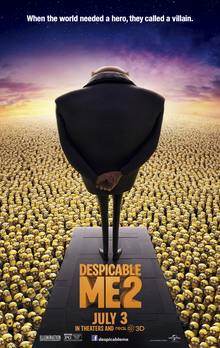
Review: Despicable Me 2

The world needs more minions.  Fortunately, Despicable Me 2 has them all over the place.  Admittedly, the movie is mostly about Gru and his quest to discover the identity of another villain threatening to destroy the world and stop them.  However, the movie does a great job of alternating between silly scenes involving the Minions, scenes that move the plot along, and scenes filled with zany supervillain antics.  The three girls that the plot revolved around the first Despicable Me are no longer the focus.

As well as trying to find and stop the mysterious other supervillain, Gru has to deal with both a neighbor and his daughters trying to set him up with single women, and trying to stop his eldest daughter, Margo, from seeing a boy.  It is a kid's movie, so the actual plot is fairly predictable, but the humor in the movie is top notch.  Even the obligatory fart joke is funny (someone gets a 21 fart-gun salute at one point).  But by far, the end of the movie is, in my opinion, the best movie ending ever.  I haven't laughed that hard and that long in a long, long time.  Because of this, I'm not too surprised that there's going to be a movie focused solely on The Minions.  I am curious how the dialogue in that movie is going to work, though...

Wednesday, July 3, 2013

Games I Grew Up On: Secret of Evermore

A sequel to Secret of Mana in name and gameplay only, Secret of Evermore was a much more bizarre, but much more unique action RPG I played growing up.  The game starts in Podunk, USA in 1995.  A kid chases after his dog (who is chasing after a cat) and ends up in an abandoned mansion.  Inside, they find a large and strange machine.  The dog starts chewing on some wires, which causes the machinery to activate and send the pair into a strange space station where they are attacked by robots until they get in an escape pod that launches them down to the planet below.  The area they land in looks a lot more prehistoric than the space station they were just on (including some raptors!) and the boy's dog has suddenly changed into a large wolf-beast.  Thus begins their odd adventure to get back home.

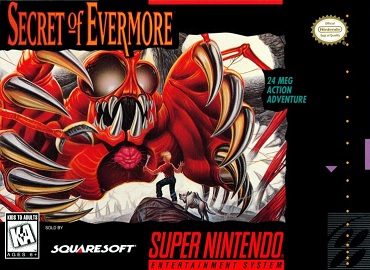
Secret of Evermore was awesome mostly due to the incredibly varied settings (you go from prehistoric, through an Ancient Greece/Egypt like area, to a Medieval-era area, back to sci-fi) that each change the dog, the currency, and the enemies.  The game functions very similarly to Secret of Mana (only single player), but instead of magic, there is alchemy.  You must find the right components to use your abilities now, but they level up with use, just like in Secret of Mana, so there's even more grinding (which I found enjoyable as a kid, not sure if I could handle it now).  There is also a marketplace where I specifically remember having to trade the right items to the right shopkeepers in the right order to get very awesome and rare items.  Figuring out that pattern was pretty fun (I think later I had help from Nintendo Power).  I remember the bosses being pretty darn awesome, too (especially the one seen on the cover).  Though the music wasn't as good as Secret of Mana or Chrono Trigger, it was still pretty awesome, as well.  What I didn't know until today is just how bizarre and creepy the commercial for the game was.  I'm pretty sure the dog never threw up the other versions of itself like in that commercial...

Monday, July 1, 2013

Review: Boss Monster

Some of the Kickstarter projects I backed have finally started getting their rewards fulfilled.  One of those projects is Boss Monster, a competitive dungeon crawler in reverse.  Players are monsters that compete to be The Boss Monster by building the attractive that both attracts and kills the most heroes from a nearby town.  Players can add rooms to their dungeon (up to 5 rooms max), build on top of existing rooms, or use spell cards that have an array of effects from killing monsters, to locking out a room in another player's dungeon.  Every turn new heroes arrive in town, then players can build on to their dungeon.  Then heroes will enter whichever dungeon is most interesting to them (each room has different treasure types that will attract different hero classes).  If the dungeon can deal enough damage to the hero, the player gets their soul (10 souls win the game).  If they can't kill the hero, the player gets a wound (5 wounds eliminates a player).

There's definitely a lot of strategy in this game that I'm still trying to master.  You don't want to attract heroes into your dungeon if you can't kill them, but a hero that's a wound for you isn't a point for another player.  Having a flexible dungeon that can change what hero type they are attracting can be useful to pull heroes away from another player, but that's not always easy to pull off.  Most games I played I somehow ended up with basically all the Mage related rooms so I ended up with lots of Spell cards, but could only really attract Mages.  But some of the Room and Spell card combinations can be a lot of fun to pull off regardless of how successful it is, like having one room deal a lot of damage and following it with the Minotaur's Lair that sends a hero back to that very room so even the most Epic of Heroes can't possibly survive.

If you can't tell from the box's art, this game is also chock full of retro gaming references from Double Dragon, to Ninja Gaiden, to Karnov.  Sadly, some of the most epic ones aren't available unless you backed the Kickstarter, like the golden Zelda cartridge style box sleeve.  But even without stuff like that, this is definitely a game worthy of getting for you and 1-3 other friends to compete against each other.