Showing posts with label books. Show all posts

Wednesday, September 18, 2013

Books I Grew Up On: Two Minute Mysteries

Ever since starting this whole Blank I Grew Up On series, I've been struggling to remember the names of the books I read as a kid.  Thanks to Monday's post, I now remember one set of books, the Two Minute Mysteries series of books.  This was a series of books containing a whole slew of 2-3 page mysteries that was more an exercise in reading comprehension and critical thinking than a story with a plot.

Since each mystery is so short, there really wasn't much time to set things up or have a denouement of any sort for each of the stories.  It was mostly just a focus on that fun crucial part of mysteries where the detective catches someone making a mistake.  At the end of each story, the book would pose a question like, "How did the detective know that person was the killer?" with an upside answer explaining the subtle mistakes.  A lot of times the person mentioned something about the crime that the detective never told them (so they weren't supposed to know it).

I think this series was a good training tool for even deeper mystery solving and has prepared me well for the Phoenix Wright series.  Now I know to scrutinize pronoun use and crime timelines among other things.  The series has three books in all, but looking on Amazon, only the first one is still in print (and the others must be in huge demand since the new price is $150-200!).  Fortunately, if you read one, the others are pretty just more of the same.  If you're into mysteries, I'd give the main one a look since it's only $5.

Monday, July 29, 2013

Video Game vs. Book Sizes

I forget where this thought came from, but I started thinking about how the various ways video games are released (full releases, expansions, DLC, etc.) are akin to how books are categorized by length (short story, novella, novels, etc.).  Some of them are pretty obvious, a full video game release is just like a novel: it can both build a new world, create grand adventures for a set of characters (generally recurring characters in future sequels), and has multiple ups and downs as well as conflicts (albeit one main one).  Expansions are like novellas: the are generally smaller adventures with the same characters that have already been setup in the full game/novel, only have time for one real conflict, and don't really have time to do much world building.

DLC, on the other hand, seems to come in two forms.  It's either like reading the same book, but with a different font (the main content is no different, but there's at least one minor difference to how that content is experienced).  In DLC forms, this is the new weapon/armor/skin.  The other type of DLC is more like a short story.  It is generally a new small adventure for the characters you know and love in an already established universe.  I haven't seen any DLCs that are the other form, where it's a whole new set of characters used to build the world/universe further, except for maybe Bioshock 2's Minerva's Den.  I can partly understand this because where a short story only needs to reference things from the world it comes from, DLC has to use the same technology (and generally art assets) made to use the game it's a part of.  So the easiest way to make DLC is just to make more of the same thing as the original game.

What I haven't quite figured out is what (if any) equivalent there is to smaller full games (i.e. PSN/XBLA games).  Would this be like a magazine article?  Just sort of a small way to amuse yourself for a bit of time, but generally no real substance to it?  Obviously there are exceptions on both ends of this analogy.  Not sure what else it could be.  I'm also curious what the visual media (movies, television, etc.) compare to these.

Wednesday, May 8, 2013

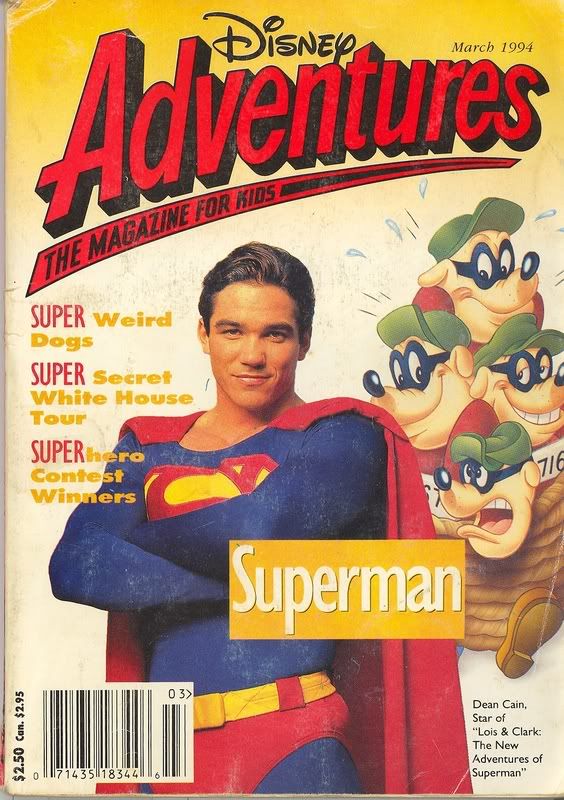
Books I Grew Up On: Disney Adventures

I guess every kid has at least one magazine they grow up with.  Or at least they used to, not sure what the equivalent for kids nowadays would be...anyway, the magazine that I subscribed to was Disney Adventures.  The magazine was filled with tidbits about the current movies, music, and television that was popular (obviously heavily focused on ABC, Disney, Touchstone Videos, etc.), random educational tidbits about whatever the current issue's theme was, and it had a bunch of comics from all sorts of Disney cartoon worlds.

One random thing I remember from my issues: the magician themed issue taught me that statistically, it takes 7 perfect shuffles to completely shuffle a deck of 52 cards.  I think this magazine also cultivated my love for everything Disney and helped solidify Walt Disney as one of my top role models.  I don't know about the later issues, but when I got it, it never felt like it was just a big advertisement for anything, but actually seemed like useful and worthwhile information.  I'm not sure how exactly to explain what I mean.  It felt Disney focused, but not blatantly biased "Disney is good, all else is bad".  I have the same feeling towards Nintendo Power and the opposite feel to Gamestop's magazine, Game Informer.  Of course, I'm probably the one that's super biased since I grew up with Nintendo systems and watching Disney movies...

Friday, April 26, 2013

Review: Quiet! The Power of Introverts in a World That Can't Stop Talking

I've always been an introvert.  I don't think I've ever tried to hide it, but it used to be something I struggled against.  I'm prone to purposefully spending weekends by myself at home because I find it infinitely more relaxing than going out to bars or parties or being overly social.  At some point I've learned to embrace my introversion, but also try to balance my life with some socialization since whether we're introverts or extroverts, humans are built to have relationships with other humans.  It wasn't until I read this book that I realized just many of my personality traits are tied to my introversion besides my aversion to large groups, loud noises, and small talk.

Susan Cain does a wonderful job of balancing anecdotal explanations and scientific studies to go into great detail about what it means to be an introvert, why it's awesome, the pros and cons between introversion and extroversion, and how to best structure your life to function best as an introvert.  For example, a developmental psychologist named Jerome Kagan did a long term study on a group of infants where they introduced the kids to a whole bunch of different stimuli and predicted which ones would be introverts and which would be extroverts.  He predicted that the kids who pumped their arms and legs in response to the new things were introverts and the ones who sat there unresponsive were the extroverts.  It turns out that introverts have amygdalas that react stronger to new and unknown situations.  As a kid, the response to this is to react to it.  As we grow older we tend to internalize those responses, but we feel much more aversion to new things then extroverts.

This explains why I've always been hesitant to try new foods, go new places by myself, interact with strangers, and so on.  I can get over these things, but I have a built in wall of aversion that I have to punch through first.  If I'm pressured to bust through this wall at a faster pace than I'm okay with, my reaction is to push back even stronger and refuse to do whatever it is.  This might be a separate trait from introversion, since this particular response never came up in this book.  I also am very opposed when someone tries to pressure someone else into doing something they don't want for a similar reason.  This empathy is a trait of introversion, since we generally pick up on other peoples' emotions and also apparently feel guilty really easily (which explains why I apologize much more often than I probably should).  But getting back to the book, if you think you're an introvert or know one and want to know how best to interact with them, I'd highly recommend this book.

Wednesday, January 2, 2013

Books I Grew Up On: Ed Emberley's Big Green/Orange Drawing Book


I've never been the artist in the family, but it was never due to a lack of resources.  Two of those resources were Ed Emberley's Big Green and Big Orange Drawing Books.  Ed Emberley's style of drawing style matched my doodling style.  Most everything was a combination of simple geometric shapes (circles, triangles, squares, and trapezoids).  The instructions are kind of like Lego instructions with each step having symbols representing what just got added to the drawing.  Each book (including the other two colors I don't remember us having - Red and Purple) has a theme that matches their colors.  The Green book is very Irish, St. Patrick's Day, Green Dragons, etc along with plenty of other things.  The Orange book is full of Halloween related objects.  Though these are not the most professional Learn How To Draw books, they are simple, well designed, fun, and my personal favorites.

Wednesday, October 17, 2012

Suspension of Disbelief

The crux of any story in any non-modern, real world setting, is suspension of disbelief.  If there is anything at all that isn't exactly how it is in real life, then at some point the viewer/reader/gamer needs to accept that that is the way that works in your world and things will continue to operate within the bounds set unless given some explanation to cause an exception.  If these bounds are ever broken with no explanation, then the viewer/reader/gamer's suspension of disbelief will be broken, the illusion will be shattered, and your content will be seen as the ridiculous nonsense that it is (or maybe I'm just really harsh about my SoD being broken...).

One example of where my SoD has been broken recently is the new J.J. Abrams show, The Revolution.  The premise is that for some reason unknown to everyone, all power has gone out in the world and no one can generate more.  That's pretty fantastical and unrealistic, so it gives the show fairly large bounds within which they can set up the world 15 years later.  I'm fine with not knowing why there's no power, I accept that as a fact, so it would make sense that the ability to manufacture much of what we have today would be difficult or impossible.  My suspension of disbelief is broken when some of the militia has working civil war-era musket ball style guns.  They would have had to manufacture those guns somehow, which begs the question what happened to all the other guns in the world?  Did they stop working?  Are modern bullets really THAT hard to make without electricity?  You still have fire, metal, and gunpowder...do I just not know how bullets are made?  Even if you accept that, I guarantee there will be some technological dissonance for every person.  Some technology that can still function or be adapted with modern knowledge.  It's not like humanity got stupider, just we have no access to electricity.  So in 15 years no one was able to adapt any of our current technology to a powerless world?

Another example is the movie Inception.  In the very beginning of the movie, Leonardo Decaprio explains the rules of the dream world to Ellen Page.  He has set in stone the bounds of the world, so I know what to expect.  Problem is that those rules are very quickly broken and tossed out.  So the world does not work at all how I was told it would, so my SoD is broken.  If they had said that they think the dream world works a certain way and it didn't, then I could have accepted that no one had dove that many layers down (which they established) so the rules changed from what was known.  However, they were very adamant that the world did work that way, so what am I supposed to think when it doesn't work the way it should?

One last example is the anime Samurai 7.  I touched on this in my review, but let me go into more detail.  Throughout the show, it was shown that the seven main Samurai could perform fairly ridiculous feats defying normal laws of physics (swords that could cut through buildings, being able to jump giant robots in a single bound, being able to catch arrows, slice bullets/missiles in half, etc.).  They were very consistent with these rules, so I gladly accepted them as how this world worked.   However, in the final two episodes, they were suddenly able to perform feats that made me wonder how the leader samurai had never won a war (as he claimed).  The engineer samurai converted one of the robot samurai's limbs into a flying ship (sure whatever, ridiculous, but I'll accept it).  The capital ship they are attacking shoots a giant laser beam at them through their own arm.  The enemy robots all blow up in this beam, but somehow this robot limb the samurai are flying can ride on top of the laser beam like a surfboard.  Ummm....what?  It's as if they project an aura of samurai-ness to whatever they touch.  Too ridiculous for me.

Monday, October 15, 2012

The Journey

I just finished reading The Wonderful Wizard of Oz (still going through classics thanks to the fact that they are all free on the Kindle) and it started me thinking about the journey characters take during epic quests.  I googled for tropes to see if I've once again inadvertently stumbled across one and the closest I can seem to find is The Hero's Journey - warning TVTropes link.  Whereas that trope is all about the events of the journey that the character goes through, my thought was more about the location.  In many stories - Wizard of Oz, Lord of the Rings, The Hobbit, and Kingdom Hearts to name a few - the characters start in an ideal world.  Actually, Wizard of Oz is slightly different because she starts in Kansas, which is described as incredibly grey and flat, so hardly ideal, but I'm thinking more about the Munchkin's land she really starts her journey on.

So they start in this super nice area they'd be crazy to leave, but they must for some reason (they're determined to get back to the land of the grey and flat, a tall man with a pointy beard and even pointier hat told them to, they fall into a black hole and end up in a different place, etc.).  The next step is always safe with the illusion of danger (like a Disneyland ride) - a forest with the feeling of danger, but either no real danger or some guardian to keep the character safe, a strange town full of strangers, but no one really threatening and usually there's a guide to help the character out.  As the journey continues, the locations get darker, scarier, and more dangerous directly proportional to the character's growth level.  The journey ends somewhere either completely gothic, demonic, or void.  Basically, there will be lots of spike and/or fire or there will be lots of nothing.

My favorite part is that once the quest is completed, the characters usually just appear back at the beginning.  Story-wise it makes sense, the climax has happened, another climax is not what a reader really wants, but if the characters were struggling to reach their destination (running low on food, sneaking past armies, etc.) then that should still be an issue on the way back, right?  And if they do get magically apparated or taken home by giant eagles, then why didn't those take them to their destination in the first place?  Definitely food for thought when coming up with the ending of the journey.

This transition from idyllic settings to terror can be something really interesting to play with when designing games, especially if you make the transition slow and subtle so the player doesn't even realize it's happening. I'd especially love to see this concept played with in a board game.  Somehow the board itself changes as the game continues on and gets darker and more twisted (mostly just the art, not so much the components).

Friday, August 31, 2012

Jules Verne

I blame high school for my fear of the word "classic".  Nearly every English class forced me to read really boring classic books and then analyze them to death probably reading in all sorts of meaning the original authors never intended.  Thanks to that practice, I gained the incorrect assumption that all classic books were just as boring and hard to read.  It wasn't until after League of Extraordinary Gentlemen came out that I started to break that assumption.  I wanted to know the backstories to all (or at least most of) the characters to see the source material.  This led to some very hilarious discoveries like Mr. Hyde is actually smaller than Dr. Jekyll, not a big hulking brute, Mina was not a vampire, and (unfortunately) that 20,000 Leagues Under the Sea is the most boring book I have ever read.

There is one single action scene in that book that lasts all of a single page.  The rest of the entire book is just long descriptions of various fishes and how horrible civilization is and thus Captain Nemo must destroy it (which makes him better, how?).  But, as with most media, I decided to give Jules Verne three chances to get me interested.  So I read Journey to the Center of the Earth, which was slightly better, but still just a lot of nothing happening with long descriptions of geology this time.  The one action scene in that didn't even really involve the humans, they just watched it happen.

But a few nights ago I finished The Mysterious Island.  I don't know if I just love castaway stories or something, but this book was much more enjoyable.  There are still long descriptions of science-y things, but this time it was on how things like gunpowder, telegraph wire, hydraulic lifts, and other scientific innovations were created.  There also was more than one action scene and the main characters actually were involved in them.  They still magically get saved (twice) in no part thanks to them, which is kind of lame, but at least they did something this time.

So Jules Verne has had his three chances and thanks to The Mysterious Island, he has slightly redeemed himself in my eyes, but I doubt I'll be reading any more books of his in the future.  It's not that he's a bad writer by any means, but his books are not my style.  Just like character movies - Napoleon Dynamite, Best in Show, A Mighty Wind, etc - his stories are all about a journey with no real goal in mind.  I have nothing to look forward to, I don't know what anyone's motivation is.  People are just kind of doing a bunch of stuff just because.  I have never liked stories like that.  At the same time, I'm glad I gave Mr. Verne two more chances.  Now I have more ideas for board game premises.  :)

Friday, August 3, 2012

Grudges and Archenemies

If you have never seen the cartoon Gargoyles, I would highly recommend you watch it (even if you're an adult).  Not only is it made by some pretty amazing people, but it has incredibly well done continuity and character building.  One of the aspects I loved the most is that each one of the main gargoyles had a grudge against a different one of their villains that persisted throughout the show and heavily influenced their interactions with those characters.  Goliath and Xanatos, Brooklyn and Demona, Lexington and The Pack, Broadway and criminals with guns, and Hudson and the Archmage.  Any time one of these villains showed up, the appropriate gargoyle would start acting very different.  Goliath was always quick to mistrust David Xanatos.  Lexington was always eager to go out and fight if The Pack was involved.  Broadway would go in a rage to destroy the firearms because of a bad experience he had with one in the past.  These recurring attitudes really helped to give a strong depth to the gargoyle's characters because you would slowly see them overcome the grudge to win the day.  Goliath kept being forced to team up with Xanatos.  Lexington kept getting caught when he stupidly rushed out to fight The Pack, so he eventually learned to fight smarter (which made sense since he was the smartest of the gargoyles).

Star Trek: The Next Generation had a similar thing going on, but not so tangible.  Almost every time a character had an episode revolve around them, they would have to struggle with the same issue.  Geordi would time and again have episodes about bad relationships.  Riker kept dealing with problems caused by his career (either focusing too much on it in his past or refusing to advance to Captain).  Crusher dealt with being alone.  Picard kept dealing with opening up and not being such a stoic Captain.


I want to say I'm just illustrating some examples of a foil, but with Star Trek, they were situations and not characters and with Gargoyles, they weren't the opposite of the character, they were just an archenemy developed from the gargoyle's first experience with them.  I guess this is much harder to do if your story just has a single protagonist since he'll just seem really bitter if he has a strong grudge against all of his villains.

Monday, July 9, 2012

Spirit Flyer Series

Another book series I grew up with that impacted me greatly as a child was the Spirit Flyer series of books by John Bibee.  I remember getting to church early sometimes since my parents were in the orchestra/choir and wandering around the church library looking for something interesting to read.  They had a fairly decent kids section, but generally I would just be on the lookout for these eight books.

Yes, that's right, these are Christian kid's books.   The analogies they have for Christianity may not be as subtle as C.S. Lewis or J.R.R. Tolkien, but they're also not super preachy books either.

In the Spirit Flyer series, there are a group of people who have Spirit Flyer bicycles.  Old, ugly bicycles with big balloon tires that the other kids mock.  However, the Spirit Flyer bicycles (and the associated accessories), when properly used give kids strange powers like the ability to fly on their bike E.T. style or to get an early warning horn like Spider-Man's spidey-sense.  The trick is that the kids have to learn to trust the bikes and as they do, they start to learn more about the bike's creators (The Three Kings) and the Deeper war between the Three Kings and Goliath Toys (who aren't who they seem to be).

Each book follows a similar formula: the main character of that particular book gets a Spirit Flyer.  The kid starts learning about the bike's amazing powers.  The kid gets in trouble due to the Spirit Flyer (either they misuse its powers or are made fun of for having it).  They ignore the bike and start following Goliath's Toy's current evil plan.  They get into incredible trouble.  Their bike, the Kingson, or other Spirit Flyer owners come rescue them.  They learn their lesson.  They help stop Goliath Toy's evil plan.

Yet, even knowing that formula and that it holds true pretty consistently, it doesn't really matter.  There is plenty of action, real-life issues kids deal with, and the quotes from The Kingson are so memorable that I still use them to encourage myself to this day.  Sure, they may not be direct quotes from Jesus, but I feel like they are things he would've said.  "What I call worthy is worthy.  What I love  is lovable."

Monday, July 2, 2012

Crossovers

I rewatched the Spiderman 90's cartoon recently thanks to Netflix and realized just how many crossovers there are throughout that show.  For those who don't know, a crossover is when two different IPs in the same universe intersect.  So when Spiderman and Daredevil team up to take down the Kingpin, that is a crossover.  Crossovers help to broaden the scope of a universe you've built and help make it feel much bigger than just the single entry point the consumer is enjoying.  On a business side of things, it also helps introduce people to another IP that they might start buying into now.  Maybe Daredevil seemed intriguing so they'll find out if there's a Daredevil cartoon or buy the comic.

To be done well, crossovers have to make sense (the two IPs have to exist in the same universe and time, so Naruto meeting Edward Elric is probably not going to happen believably any time soon) and they should be more than just a cameo (although that can be hilarious if done well).  So when Spiderman's mutant genes start going out of control and changing him, he goes to Charles Xavier for a cure because he has heard that's what he does.  He knows nothing about the X-Men because they are not common knowledge at that time.  So obviously when he invades the mansion, the X-Men protect him and BAM!  Crossover.  Tony Stark is showing off some amazing new technology, of course Peter Parker would be there because he's both a scientist and a news photographer.  So when someone tries to steal the technology, Iron Man and Spiderman both happen to show up?  BAM!  Crossover.

Crossovers don't necessarily need to be characters either.  An event in one IP that affects the entire universe should be brought up from time to time in the other ones because it was a big deal.  So when Deep Space 9 starts during the battle of Wolf 359 or when Voyager encounters the Borg who have some drones from the same battle, that is a well placed crossover from another series.  Of course, Voyager has its share of awesome character crossovers as well.

Crossovers are understandably hard to pull off unless one IP is a spin-off of another because both IPs have to make sense in each other's universe (Dr. Horrible will probably never be visiting McClaren's Pub since super heroes and super villains would make no sense in modern day New York).  The tones of the two shows have to mesh well together as well (the members of Sacred Heart Hospital would probably never have a murder to solve..well...actually maybe they could...).  It's a shame crossovers aren't done more frequently, but it is fairly hard to set up.  What's your favorite crossover moment?

Monday, June 25, 2012

Review: Usborne Puzzle Adventures

I've said it before and I'll say it again, I love puzzles.  This series of books is one of the reasons of that.  I remember finding these books in the most random little bookstores when my parents took us camping and never when I actively looked for them.  Even nowadays, the only place I can find them cheap and new is directly from the publisher.

Each book follows the same formula with a different story: an opening page explaining how the book works, a puzzle to solve on most pages, one page of hints in case the puzzles confound you, and then pages of answers for each puzzle.  These puzzles aren't just random puzzles, but help immerse you even more into the story.  Sometimes the characters receive a coded message that you must decipher to understand what the characters know.  Sometimes you have to go back to previous pages looking for something the characters just remembered.  You are not supposed to read ahead in the story until you solve each puzzle.

Most of the books in the series are meant for children, so the puzzles aren't super hard, but harder than you'd expect.  A few of the books are the "advanced series", which even give my puzzle-solving brain a run for its money.  Much like choose your own adventure stories, the interactivity really helps you feel more a part of the story and at the same time, the puzzles are a good exercise for your observation skills and logic.

If you have any kids, I highly recommend this series for them, I guarantee at least one story will intrigue them and then they'll be hooked.  Even if you don't have kids, I'd recommend this series to anyone who enjoys good puzzles.  Just keep in mind that if you do buy from the publisher, don't be confused by the occasional British term (I got confused for a bit when the text said some kids were running around with torches and the pictures showed flashlights).

Monday, April 9, 2012

Taking Inventory

After recently watching an episode of The Office where they had to take inventory, I thought it would be an interesting idea to take inventory of what media I am currently consuming, what I've recently finished, and what is next up in various queues.  Now would also be a good time to request reviews of any of these if you want.
  • TV shows
    • Currently watching
      • On Netflix
        • Star Trek: The Next Generation
        • Fullmetal Alchemist Brotherhood
        • Bleach
        • Naruto
        • The Incredible Hulk
      • On live TV
        • Survivor
        • The Amazing Race
        • Revenge
        • Ringer
        • New Girl
        • Big Bang Theory
        • How I Met Your Mother
        • The Office
    • In my Netflix queue to start
      • Star Trek: DS9
      • Star Trek: Voyager
      • Battlestar Galactica (the new one)
      • Stargate SG-1
      • Dr. Who
  • Movies
    • Watched in the past 6 months
      • The Muppets
      • Sherlock Holmes: A Game Of Shadows
      • The Three Musketeers
      • Puss In Boots
      • Real Steel
      • Rise of the Planet of the Apes
      • Harry Potter: Deathly Hallows Part 2
      • Cowboys and Aliens
      • The Hunger Games
    • Looking forward to
      • Avengers
  • Video Games
    • Started in the past 6 months, but may never finish
      • Thor
      • Red Dead Redemption
      • Wario Land 4
      • Kirby and the Amazing Mirror
      • Fire Emblem
      • Legend of Zelda Skyward Sword
    • Finished in the past 6 months
      • Professor Layton and the Last Specter
      • Batman: Arkham City
      • Dungeon Defenders
      • Uncharted 3
      • Dead Island
    • Still working through
      • Mass Effect 3
      • Star Wars: The Old Republic
      • Skyrim
      • Dead Space
    • Backlog
      • Super Mario Land 3D
      • Assassin's Creed 2
      • Assassin's Creed Brotherhood
      • Assassin's Creed Revelations
      • Lego Harry Potter Years 5-7
      • Lego Star Wars 3
      • Syndicate
      • Sly Cooper Collection
      • Kingdoms Of Amalur: Reckoning
      • Binary Domain
      • Journey
  • Books
    • Finished in the past 6 months
      • The Legend of Sleepy Hollow
      • Gulliver's Travels
      • Treasure Island
      • The Time Machine
      • Frankenstein
      • Holes
      • The Count of Monte Cristo
      • A Princess of Mars
    • Currently reading
      • Journey To The Center of the Earth
    • In my Kindle queue
      • The Gods of Mars
      • Warlord of Mars
      • Thuuvia, Maid of Mars
      • The Chessmen of Mars
      • The War of the Worlds
      • Alice's Adventures in Wonderland
      • The Legends of King Arthur
      • The Mysterious Island
    • Eventually need to read
      • Game of Thrones series

Friday, April 6, 2012

Review: Hunger Games

The Hunger Games movie was adequate at what it does. It got across the main points of the Hunger Games story without really messing anything up. However, I think the only reason the movie was good at all was because the Hunger Games book was so fantastic.

For me, until the Hunger Games started, the movie was incredibly boring and I don't remember the book being that way. I think a lot of that is that the book can and does devote time to explain and detail the history of this world they've set up and the backstory of some of the characters, so you get a better feel for the characters' motivations and struggles. In the movie, you get a wall of blah text at the beginning, you see Katniss go under a fence with a sign you briefly see that says "Do Not Enter" or something, but you have no idea why she can't enter that or that hunting is forbidden. The movie just doesn't have time to go in to the whys of the world so when Katniss and Gale are in the forest and a ship drops down on them, you don't know why they run and hide from it.

I went with a friend who hadn't read the books before watching the movie. It apparently was clear enough for him to understand mostly what was going on, but at the end he said, "I need to read the books now." That's probably what the book authors are hoping for, but personally I feel if you haven't watched the movies or read the books, save your money and just read the books. You're just going to get a fuller, richer experience than you do with the movie.

The one thing the movie did wrong in my opinion is a trend among movies nowadays and that's that blasted shaky cam. The first half of the movie when Katniss is in the forest, the camera is shaking like there are earthquakes everywhere. Does this add anything to the movie other than nauseated customers? Whenever there is a fight, just like most movies now, the camera gets right up in the action so you can't actually see what is going at all, you just see lots of movement. I understand that this is supposed to make the fight feel action-packed, but you know what they used to do that worked better? Have fight scenes with good choreography with a camera pulled back so you could actually see what the heck is happening. I don't need to be manipulated to feel action on the screen. In fact, the more I see that, the more I realize I'm being manipulated and immediately get pulled out of the movie and start entering critique mode.

Wednesday, April 4, 2012

Nonfiction in Fiction

No matter what setting a story is in, there are always elements of nonfiction in them. There need to be in order for people to understand what's going on. Lord of the Rings may have orcs, dwarves, and elves (which are all still humanoid sentient beings), but it also has swords, bows and arrows, castles, horses, boats, and most importantly, second breakfast.

What I find interesting are stories that take some existing concept/technology and take it to its next logical advancement (Michael Crichton), place it in the context of a completely different setting (Terry Pratchett), or have a story take place during monumental historical events (Count of Monte Cristo). Each of these raise different questions for me that I enjoy trying to answer. What would happen if cloning became cheap and freely available? How did people decide what signal meant what using semaphores? Did history actually take place like that (History was my least favorite class in school...)?

I think the sign of a good author is one who does his research and makes the uninformed or semi-informed people doubt what they know or think things could happen the way they do in the story. This should also apply to other forms of media, but I can't really think of any movies, TV shows, or video games that made me really ask these questions. Some even make it very clear they don't understand anything about what they are portraying.

So what are your favorite extrapolations of existing technology? What is your favorite story that takes place in history (but doesn't necessarily affect/alter that history)?

Friday, March 30, 2012

Retro Review: Count of Monte Cristo

Ever since getting the Kindle, I've been reading a bunch of classics since anything written before 1920 is free. I figured a good place to start would be with the book that was the basis for my second favorite movie of all time, Count of Monte Cristo.

If you don't know the plot, I'll try to summarize it without ruining anything. Edmond Dantes is a sailor just about to marry the woman of his dreams and become captain of the ship he's been sailing on for years when he is betrayed by men jealous of his good fortunes. He is sent to a prison where he meets a fellow prisoner who tells him of a fortune hidden on the island of Monte Cristo. Eventually Edmond escapes, retrieves the fortune, and uses it to give himself a new name and identity and get revenge on the people who ruined his life.

The book, movie, and anime (Gankutsuou: The Count of Monte Cristo) all share this general story. What's really interesting is all the differences between the three versions. The book is easily the most complex of all three. There are four men on whom Edmond wants revenge and one man who Edmond needs to repay for trying to help him while he was imprisoned. Edmond uses each man's interests to get revenge (he bankrupts the banker, tarnishes the name of the politician, etc). He also uses their children against their parents, which becomes really interesting when the son of the man he tries to help falls in love with the daughter of one of the men he has declared revenge on.

The movie is understandably simplified in many ways. One of the conspirators that got Edmond sent to prison in the book is not in the movie. The methods of revenge are very simplified. There are significantly less children and wives in the movie, so less people to complicate the plot. I truly respect everyone involved in making this movie since despite so much simplification, the plot is very clear and nothing is ruined by what isn't in the movie. It remains my second favorite movie of all time.

The anime is very interesting because the main plot stays much truer to the book, but the setting is a heck of a lot more sci-fi. The Count of Monte Cristo is a space vampire, his cohorts are aliens, there are spaceships (obviously), and yet there are horses, stage coaches, and sword fights. Oh, the sword fights take place in giant robotic suits of armor.

The thing I find the most interesting about all of them is a recurring theme that is different in each one. In the book, Edmond sees himself as an avenger of God's. So everything he does is righteous in his eyes (which of course gets challenged a few times). In the movie, Edmond feels God has abandoned him and so has no problem with getting revenge by any means. In the anime, (it's hard to explain without spoiling something crucial, so bear with me) Edmond seeks revenge because he must feel strong emotions (like hate) or he will die.

I highly recommend the book or movie. The anime is interesting and worth watching, but it's a little too weird and there are some animation styles that bothered me a little too much. It does have giant robot suits of armor, though...I'd also recommend the TV show Revenge, which is the closest to a modern day equivalent that we have.