Monday, June 17, 2013

Review: Man of Steel

This movie has me all sorts of conflicted and confused about what I really want out of a movie.  Nearly every opinion I formed than got contradicted later on in the movie.  For example, the movie starts with a very long sequence on Krypton explaining its end of days.  I both loved this sequence for showing so much bizarre alien-Krypton stuff (some Kryptonian creatures, some tech, some weapons and armor, etc.) and hated it because it was so long and I've seen Superman's origin so many times.  However, a friend of mine who I went with isn't as into comics as I am and really appreciated the rehashing of the origin story.  So I can just suck that up and move on.  The two things that I find a hard time moving on with are the odd camera quick-zooms and Superman's supposed care for human life that doesn't really manifest until it's convenient to the plot.

I'm not sure which modern day film technique I hate the most: unnecessary slow-motion (i.e. bullet time), purposefully shaky camera work when the action isn't being filmed by a character in the film, or these really bizarre quick zooms to something in the distance.  It doesn't really matter, though, because they're all super distracting and don't add a thing to the film.  This movie was the first instance I can recall so far that has done a double zoom both in and out in succession.  So a spaceship is off in the distance.  Start from a super wide useless shot, zoom to a normal medium shot of the spaceship, zoom again to a random section of the spaceship that I guess is important, but I can't tell because you zoomed WAY too much, zoom back out to the good shot, now zoom back to the original shot.  This happened multiple times in the movie.  Overall it made all the action very hard to track.  It definitely had a Hunger Games feel to it where I know there's action going on the screen, but heck if I can tell who is what or where and who just got punched or shot or thrown through a building...is Superman winning?  We won't know until they stop punching each other so they can get up and look menacing at each other for a second or two.  (More on this later).

They did a really good job of actually making Superman's big conflict (am I a man or a Kryptonian?) a big deal, through the flashbacks of his childhood growing up in Kansas.  Despite humanity's shortcomings, Superman decides to side with us.  However, this decision doesn't seem to come out during any of the fight scenes.  Not once does he try to pull the fight AWAY from people.  Instead, he keeps throwing bad guys into populated areas he hasn't destroyed yet.  He can't even keep the fight into one contained area.  So does he really care about humanity at all?  The only time it seems to matter is when the plot dictates he needs to watch people in trouble.  So does he just not like seeing people getting hurt, but once it's out of sight, it's out of mind?

Other random thoughts:

  • One of the other conflicts with my opinion I had was the first half of the movie I was wondering if there was going to be any action in the movie.  The second half of the movie, I wondered when the action sequence was going to end.  I guess that's what's called pacing?
  • Superman started the movie with a full beard, then went to a scruffy face, then clean shaven.  I really wish he would have kept one of the first two.  I'd totally root for Super Beard way more than Super Man.
  • I think secretly this movie is a live action Dragonball Z movie, but they couldn't call it that because they wanted people to see it.  You've got two aliens from another planet that ultimately they are meant to bring their species to.  One alien is a trained warrior who knows his destiny is to conquer, let's call him Vegeta.  The other alien grew up on this planet with no knowledge of where he came from and so only knows that he's different from everyone else, but he likes the planet and people he's with, I think we can call him Goku.  There's lots of fighting in the air, lots of quick dashes to fight from one spot to the next, and apparently these aliens can just will themselves to fly.  I'm pretty sure I saw Superman even go Kaioken x10 at least once...

Friday, June 14, 2013

Dreaming Up The Next Big Idea

Dreams are a very bizarre part of the recuperation process for human beings.  Whether you think they are your subconscious trying to relay something important to you, that they're just your brain trying to store and analyze the goings on of that day, or that they are your imagination trying to either mess with you or entertain you, you can't deny that dreams are just weird.  They also can affect your day to day by making you mad at someone for something they did to you during the dream.  But dreams can also be a wellspring of ideas that wouldn't come to you in your normal train of thought.

I personally like to use the more imaginative and fun dreams as a starting point for my games.  The original idea for Suspicion came from a dream, only with a vastly different setting.  I dreamt about a council of werewolves, vampires, and other monsters that had an agreement with a nearby village where the villagers would give them a few villagers every once in awhile for the monsters' purposes, but then the monsters would leave the rest alone.  However, one of the monsters secretly went to the village and started killing villagers on his own.  So it was up to the council to figure out who the traitor was and give him the angry mob approaching the castle before they reached it and killed all the monsters.  Being a dream, it wasn't as coherent as all that, but there was enough of an interesting setting and ideas there to start from.  Then I had to extract the crazy dream logic (you know, like when eating a sandwich can turn you into a dragon or something and that's perfectly normal in the dream) and extrapolate the ideas that I liked from there.

Sometimes the dream gives me a mechanic that I would love to see in a game.  Another time I had a dream where I was playing an RTS game, but I could build my species in a Spore-like editor.  I could make the creatures look however I wanted and then give them certain predefined abilities.  Like make a basic melee unit and design his building and an archer unit and his building.  But then the cool thing was I could take two units and combine them to start building a tech tree.  So if I had built the melee building and the archer building, now I could build a new building that made guys that had the abilities of both of the original units.  The building and unit were also a combination of the originals, which you could then edit if you didn't like how the computer combined the two things.  I'm probably never going to make this game, but I think it's a totally feasible idea for an RTS were the players could build their own species as long as the game functionality (how a unit attacks) and its price are separate from how it looks and all the game mechanics are balanced against each other.  You would also give the players a few premade species in case they didn't want to go to all this trouble.  So someone with more of an RTS background than mine, steal this idea (I give it up freely) and make this game and make it awesome!

Wednesday, June 12, 2013

TV Shows I Grew Up On: Finders Keepers

After a break pause, I'm back to my Nickelodeon theme for these Blank I Grew Up On posts.  This time, I'll be talking about the game show, Finders Keepers.  I didn't watch much of this show, so I'm going to have to rely heavily on that wiki page to remember how it works, but it essentially boils down to two teams of two kids would race to find hidden objects in a picture and then find items hidden inside rooms in a house that are just as messy and ridiculous as any hidden object game.  I'm guessing what drew me to this show were those old Highlights magazines found in doctor and dentist offices that always had a couple hidden object activities in them.

As stated, the first part of the game had the teams searching for hidden items on a giant picture.  Doing so would give the team some money and a chance to search a specific room of the house (sometimes normal house rooms like the living room or kitchen, other times ridiculous themed rooms like Frankenstein's Laboratory) for a specific object.  The rooms were filled with all sorts of junk and had traps that would go off to try to distract the kids (confetti cannons, falling shelves, etc.).  If the team found the correct item and showed it to the host before their time was up, they'd earn more money.  Sometimes the object would garner and instant prize awarded with the money.

After repeating this whole process with two giant pictures and the associated attempts at finding items in the house, the team with the most money would go on to search the house for more prizes.  The teams would be shown six rooms they were going to search and given one clue to the first item.  Each item found would give them a prize and a clue to the next item.  The prizes got better as more items were found.  Apparently, the creators of this show managed to film 260 episodes total and the show ran for two years, which means 5 new episodes must have been on every week.  Now I'm curious how I didn't watch more of this show...

Monday, June 10, 2013

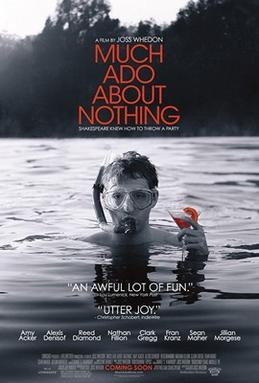
Review: Much Ado About Nothing (the Joss Whedon version)

Much Ado About Nothing is a modern retelling of the Shakespearean play by Joss Whedon and his crew coming out as a limited release (one theater in San Francisco, two in LA, and two in NY) for a couple weeks until June 21st.  I was fortunate enough to have a group of friends to go with to watch a viewing in San Francisco.  All of the dialogue in the movie is the exact dialogue from the original play.  So if you've already read/watched the play or seen the 1993 version then you know the plot.  If not, it's mostly about two different couples: a pair of people jaded and cynical of love whose friends conspire to get them to love each (Beatrice and Benedick) other and a pair whose love is put to the test by a villain spewing a string of lies to tear them apart (Claudio and Hero).

So, the reason to watch this movie is because the actors are all top notch and the modifications to the scenes outside of the dialog are great.  For example, when Benedick starts to try to woo Beatrice, during the entire conversation he's just doing super awkward workout exercises/poses to try to show off.  And of course, there's Nathan Fillion, who plays the not so intelligent policeman, Dogberry.  I really don't want to describe much because words can't express the humor of how good Nathan's comedic timing and delivery of the lines works.

I was definitely surprised by how much I ended up liking Alexis Denisof (the actor who plays Benedick here, Sandy Rivers on How I Met Your Mother, and Wesley in Buffy/Angel).  His performance is spectacular and even further makes me want to actually watch Angel.  This is surprising because Wesley was one of my least favorite characters on Buffy.  But other than Dogberry, Benedick was my favorite character in this movie and as much as that can be attributed to the dialog written by William Shakespeare, I would be remiss to not give much of the credit to Alexis himself.

Friday, June 7, 2013

Gaming Pet Peeve: Poor User Input Responsiveness

I've noticed a common trend in a lot of the games I've played and been frustrated by recently.  In many games, a button prompt will appear when you can interact with some object in the world.  This is good and basic user interface design.  Where it goes wrong is when the display appears, but pressing the button does nothing.  Even if that prompt appears for a split second, if the user has been spamming the button, the button should do something when that prompt is visible.  This is especially annoying if the interaction button is the same as, say, the jump button.  So instead of interacting with something you end up jumping over it and since you were holding forward, you went past it.  If that object happened to be on a cliff edge...well...that sucks.

This is one of those game design things to cater to the impatient gamer.  I've opened tons of chests before already in this game, I know what button to push, so the prompt is an indicator that I'm in the right spot to interact with the chest.  If the prompt appears and pressing the button doesn't open the chest, the prompt has failed its job.  The simplest way to do this is for the prompt visibility radius to be smaller than the actual interaction radius.  That way if the user is spamming the button, they'll interact with the chest before the prompt appears rather than the other way around.

Wednesday, June 5, 2013

Games I Grew Up On: The Neverhood

I've always been a big fan of claymation things.  I can probably thank Nickelodeon showing Aardman Animation's Creature Comforts.  So when I saw a claymation PC game growing up, I grabbed it immediately.  It helped that it was a point and click adventure game as was popular back in the day.  The game in question was called The Neverhood.

The game starts with Klaymen (the player's character) waking up in a locked room with no knowledge of what he's doing there.  There aren't very many other characters in the game and most of the story/world building is done by exploring and finding the giant wall of the world's creation story or various videotapes of Willie Trombone (awesome name) telling a bizarre fairy tale.  I can't say too much about this game since the whole point is to explore and discover everything on your own (and it's well worth it if you can), but I will say this: it has one of the funniest scenes in a video game ever and some of the best music of any video game ever.

I guess I should also point out that what brought this game to mind is that the creators have a Kickstarter going for another game in a similar vein called Armikrog that you should very much support because it'll be awesome and if you had never heard of The Neverhood, maybe you have heard about Earthworm Jim, which was made by the same people.

Monday, June 3, 2013

Compulsion Review System

Back in the early 2000's, there was a game review website Old Man Murray that was all about snarky reviews on games that got strong reviews elsewhere - sort of like Zero Punctuation.  One of the very novel things that came out of it was the Crate Review System, where a game would be judged by how long it took to get to the first crate because after that point, "the designer has run out of ideas" according to the article.  This review system is a joke (but still something interesting to think about when playing games), but I've just developed my own review system that works along similar lines.  I'm now going to start judging games based on how long I play until my need to finish a game overrides my need to do everything in a game.  I call it, the Compulsion Review System.

In a perfectly designed game, I should still be having fun when I finish completing all the side quests/gathering all the collectibles so that I can finish the game and have both compulsions happy at the end.  When doing all the side things in a games starts being work and stops being fun or when parts of the game start frustrating me enough that my need to finish the game gets stronger, the game has over stayed its welcome.  Now, my need to gotta catch 'em all is pretty darn strong, so I don't know the conversion rate between happy Erics and happy *insert name here*s.  Meaning, this review system doesn't work that well for me to tell other people how good a game is.  That is, unless the game is so bad that the compulsion is overridden near the beginning of the game.  That means that the collecting is so boring, the mechanics are so broken, or the difficulty level is so high that I just don't care anymore.

It's also possible for the need to finish the game compulsion to get ignored, but that takes a truly terrible game.  Either that or I just got distracted by a game I had been looking forward to for a long time.  But even then, the game will be sitting on my shelf mocking me for having not beaten it, so that's an extremely rare thing.  And this is how you use your own personal crazy to work for you instead of against you.  The more you know....