Everyone has pet peeves while gaming. These can range from game components not being lined up right (see #4), other players not following the rules exactly, game phases being skipped, discard piles not being face up, people not paying attention, people not strategizing during other player's turns so their turns take much longer than they should, or any other number of issues. I've noticed each of those pet peeves in enough other people to realize it's not just me, but one pet peeve of mine that I seem to always get odd looks for is that I hate people shuffling a discard pile back into the deck before the game tells us to or the draw deck is empty.
I understand that in most cases, people are trying to save time by shuffling the discard deck into the draw deck when there are only a few cards left, but I don't think people realize how that affects the probability of getting cards and how much that can affect the game. With a full deck, each card has a completely even chance of being drawn. When the deck is empty, each card will have been drawn once. When you shuffle the discard pile to form a new draw deck, all cards have either been used or are in someone's hand waiting to be used. If you shuffle that discard deck early, the cards that were in the draw deck had no chance to be used, which means they will show up less frequently. This means that the more powerful or popular cards will show up much more frequently since they will go into this discard pile and back into the deck much more frequently. This sounds good, but there is a reason the game came with more cards than just the popular/powerful ones. The balance of the game is being destroyed with this early shuffle.
Let's take it to the extreme and say that every time a card gets used, instead of putting it in a discard pile, we randomly place it somewhere in the draw deck. If we place it above any other card in that deck, we will see the used card more often than those cards below it. If we place it at the bottom of the deck (and repeat this every time to make sure all cards can potentially appear the same number of times) then once we hit the end of the deck, we will be playing the same game we were at the beginning since all the cards will be in the same order. The whole purpose of the discard deck is to have a separate place to store cards that have been used from those that haven't had a chance to be used yet. So give every card an equal chance at serving its purpose. Don't shuffle early.
Showing posts with label rambling. Show all posts
Showing posts with label rambling. Show all posts
Monday, December 10, 2012

Monday, October 15, 2012
The Journey
I just finished reading The Wonderful Wizard of Oz (still going through classics thanks to the fact that they are all free on the Kindle) and it started me thinking about the journey characters take during epic quests. I googled for tropes to see if I've once again inadvertently stumbled across one and the closest I can seem to find is The Hero's Journey - warning TVTropes link. Whereas that trope is all about the events of the journey that the character goes through, my thought was more about the location. In many stories - Wizard of Oz, Lord of the Rings, The Hobbit, and Kingdom Hearts to name a few - the characters start in an ideal world. Actually, Wizard of Oz is slightly different because she starts in Kansas, which is described as incredibly grey and flat, so hardly ideal, but I'm thinking more about the Munchkin's land she really starts her journey on.
So they start in this super nice area they'd be crazy to leave, but they must for some reason (they're determined to get back to the land of the grey and flat, a tall man with a pointy beard and even pointier hat told them to, they fall into a black hole and end up in a different place, etc.). The next step is always safe with the illusion of danger (like a Disneyland ride) - a forest with the feeling of danger, but either no real danger or some guardian to keep the character safe, a strange town full of strangers, but no one really threatening and usually there's a guide to help the character out. As the journey continues, the locations get darker, scarier, and more dangerous directly proportional to the character's growth level. The journey ends somewhere either completely gothic, demonic, or void. Basically, there will be lots of spike and/or fire or there will be lots of nothing.
My favorite part is that once the quest is completed, the characters usually just appear back at the beginning. Story-wise it makes sense, the climax has happened, another climax is not what a reader really wants, but if the characters were struggling to reach their destination (running low on food, sneaking past armies, etc.) then that should still be an issue on the way back, right? And if they do get magically apparated or taken home by giant eagles, then why didn't those take them to their destination in the first place? Definitely food for thought when coming up with the ending of the journey.
This transition from idyllic settings to terror can be something really interesting to play with when designing games, especially if you make the transition slow and subtle so the player doesn't even realize it's happening. I'd especially love to see this concept played with in a board game. Somehow the board itself changes as the game continues on and gets darker and more twisted (mostly just the art, not so much the components).
So they start in this super nice area they'd be crazy to leave, but they must for some reason (they're determined to get back to the land of the grey and flat, a tall man with a pointy beard and even pointier hat told them to, they fall into a black hole and end up in a different place, etc.). The next step is always safe with the illusion of danger (like a Disneyland ride) - a forest with the feeling of danger, but either no real danger or some guardian to keep the character safe, a strange town full of strangers, but no one really threatening and usually there's a guide to help the character out. As the journey continues, the locations get darker, scarier, and more dangerous directly proportional to the character's growth level. The journey ends somewhere either completely gothic, demonic, or void. Basically, there will be lots of spike and/or fire or there will be lots of nothing.
My favorite part is that once the quest is completed, the characters usually just appear back at the beginning. Story-wise it makes sense, the climax has happened, another climax is not what a reader really wants, but if the characters were struggling to reach their destination (running low on food, sneaking past armies, etc.) then that should still be an issue on the way back, right? And if they do get magically apparated or taken home by giant eagles, then why didn't those take them to their destination in the first place? Definitely food for thought when coming up with the ending of the journey.
This transition from idyllic settings to terror can be something really interesting to play with when designing games, especially if you make the transition slow and subtle so the player doesn't even realize it's happening. I'd especially love to see this concept played with in a board game. Somehow the board itself changes as the game continues on and gets darker and more twisted (mostly just the art, not so much the components).
Wednesday, October 10, 2012
Indie Games
My friend sent me a link to a website listing every independently made game from the year 2012. Looking through the list I was just trying to recognize some names when I saw Legend of Grimrock followed by Fez. My first comment to my friend upon seeing that was, "I didn't know Legend of Grimrock was an indie game" to which he replied, "Who funded it?" What made me stop and think is that the funding source isn't what makes a game an indie game to me even though the definition of an indie game is a game made by a developer independent of any other company.
I started musing over what it is that makes a game an indie game in my mind. I think to me, an indie game developer is like a hipster of the gaming community. They use retro graphics and music not for any actually valid or game mechanic reason, but because it's cool and retro. They make games where the message and/or being artsy is so much more important than actually making something fun - which is the difference to me between an interactive experience and a game.

Clearly, this is a ridiculous definition, but I think it's because to me those are the type of developers that embrace the label indie game developer whereas most independent game developers are just game developers. They focus more on making enjoyable experiences for people or making money doing something they enjoy. This is what being an indie game developer should be about. I would love it if one day I never have to hear that term again and can just talk about various game developers. Thanks to things like Kickstarter and Gambitious changing the way games are funded, this may be possible someday.
I started musing over what it is that makes a game an indie game in my mind. I think to me, an indie game developer is like a hipster of the gaming community. They use retro graphics and music not for any actually valid or game mechanic reason, but because it's cool and retro. They make games where the message and/or being artsy is so much more important than actually making something fun - which is the difference to me between an interactive experience and a game.
Clearly, this is a ridiculous definition, but I think it's because to me those are the type of developers that embrace the label indie game developer whereas most independent game developers are just game developers. They focus more on making enjoyable experiences for people or making money doing something they enjoy. This is what being an indie game developer should be about. I would love it if one day I never have to hear that term again and can just talk about various game developers. Thanks to things like Kickstarter and Gambitious changing the way games are funded, this may be possible someday.
Wednesday, October 3, 2012
Kickstarter Is Dangerous
Growing up I always saw commercials about getting out of credit card debt and TV show episodes where people got in trouble due to credit cards, so I always was smart with them and didn't understand how people could get into trouble with them. Then I started backing Kickstarter projects and I started to see how it's possible. No money is actually taken out until the end of the deadline and that's only if the project is fully funded. Although, unlike credit cards, your reward is very much not immediate. With the projects I back, it seems to take 3-6 months before I'll see any results from my money if they ever actually pan out (the first project I backed isn't going to have any product to ship until March of next year). Once you're set up, it's also really easy to back any project because you just click a button and you're done. Dangerous.
But in case anyone is interested, here is what I have backed so far:
But in case anyone is interested, here is what I have backed so far:
- Brawl In The Family: Volume One - A physical book version of the first 200+ comics from the webcomic series, Brawl In The Family. I just love the webcomic and what this guy to succeed in everything he does. 5x their goal achieved and funding is closed.
- Reaper Miniatures Bones - A new line of miniatures from Reaper Miniatures. I love miniatures and games that come with them, but don't actually have any myself outside of the games they come with, so this was a cheap way of getting lots of miniatures (I think it ended up being like $1 per miniature or something) of all sorts of types. This should be great for prototyping in the future or a D&D game or something. 114x their goal achieved and funding is closed.
- Project Eternity - Isometric RPG in the vein of the Baldur's Gate and Icewind Dales series. I have always had a love of Black Isle Studios and Obsidian Entertainment is where most of those guys now work, so I support them in all they do. Plus, my brother was a part of making Planescape: Torment and this is its spiritual successor, so I really want it to succeed (and I also want to get my brother involved somehow...). Over 2x their goal achieved and rising.
- Lost Valley - A board game about the Klondike rush in the North. A lot of the mechanics in this game sound similar to another game I'm designing, so I'm curious to see how the game works. Plus, it looks like a pretty fun game. 1.5x their goal achieved and rising.
- The Perfect Heist - A card game about being the best thief out of your band of thieves. I have always had a weakness for thief protagonists - Oceans Eleven, Thief (the PC game), etc. This game looks like it really captures that feeling wonderfully and the gameplay mechanics sound similar to Munchkin, so it should be loads of fun! Over 3x their goal achieved and rising.
- Mr. Card Game - A deck building adventure card game based on the Kingdom of Loathing. The game itself sounds fun (from the few details we've really gotten), but I was a big fan of Kingdom of Loathing years ago, so I'm a fan of something that comes from that universe. Who doesn't want to be a Disco Bandit or a Pastamancer? Over 6x their goal achieved and rising.
Monday, August 27, 2012
Superhero TV shows
Since it seems like Hollywood has figured out how to make quality comic book movies, I think it's about time some TV exec gets on the trend and makes some quality television series. Looking back over the last 50 years at superhero TV series, there is a surprisingly small amount of them. The 60s gave us campy (but awesome) Batman, 70s gave us Wonder Woman and The Incredible Hulk, 90s gave us The Flash, Swamp Thing, and Lois & Clark, 2001 brought us The Tick, Mutant X, and Smallville, 2002 gave us Birds of Prey, and 2011 gave us an attempt at a new superhero, The Cape (which I would highly recommend and am sad it only saw one season).
I think part of the problem is that media seems to have decided people don't want over-the-top ridiculous and/or campy anymore. Everything needs to be super real and gritty and to me, superheroes just don't work in that world. Being over-the-top and embracing how ridiculous most superheroes are what make movies like The Phantom, Darkman, and dare I say it, Green Lantern incredibly entertaining (to me at least). Superheroes are all about being more than human, being more fantastic than reality. Although, I haven't seen Mutant X or Birds of Prey, every other series on that list did a great job of embracing the ridiculous and taking the audience on an adventure.
After making the list, it did seem strange to me that these shows seem to come in waves. 1966, 1975, 1977, 1990, 1990, 1993, 2001, 2001, 2001, 2002, and 2011. This means if the trend continues, we will get another superhero show next year and then we won't get any until the early 2020's. I'm not sure why there seems to be a roughly 10 year gap between these waves. Maybe a new decade gives executives hopes in a clean slate on previous attempts at things?
Thanks to IHC's Ultimate Live-Action Comic Book Movie and TV Database for helping me verify my list.
Thanks to IHC's Ultimate Live-Action Comic Book Movie and TV Database for helping me verify my list.
Friday, August 10, 2012
Board Games: Story or Contest?
During a recent game night with the board game Descent: Journeys in the Dark, I realized an interesting dichotomy between why my friends play board games. Some friends want to play the games to have an adventure/live the story, while others want to just beat their friends in a competition. (Well actually, it's more of a trichotomy because one of my friends comes mostly to socialize and plays the games because that's what we're all doing). After realizing this, I thought about how I play and I think that I switch between the two depending on the game. To me, Descent is D&D Lite, so I like to play that more as an adventure. Other games, I kind of just want to win despite the interesting story of the game.
Before I go on, I have to define a few things. Theme is not the same as the story. A game's theme is the setting and style. The who are you and what are you doing of the game. Every single game has this. The story is the why of the game. Why are you trying to achieve your objective? Not every game has this. Apples to Apples theme is comparison and modern day pop culture. Settlers of Catan's setting is the island of Catan. If it has any story it's that you are competing to settle the island better than everyone else because I guess something magical happens once you settle it enough? Typically, the games with stories are the ones where you have characters and are playing a role. The Mansion of Madness, the Betrayal at House on the Hill, the aforementioned Descent and Adventurers games, Tales of the Arabian Nights, etc.
So, obviously if a game has no story or a weak story, people are playing to win (unless they have a fantasy world in their head even more elaborate than my own...). But what I've discovered personally is that when I play for a story, the game is more fulfilling than just playing to win (unless I've been on a really long losing streak...). Some of my favorite game nights are ones where a story came out of it. Like the time my friends were playing Tales of the Arabian Nights and my friends spent the entire game in prison, ensorcelled, insane, and enchanted, finally escapes by grabbing on to a rope of an evil visier's magic carpet, and then falls to his death because he can't hang on. (That was not such a great night for him and he won't play the game anymore, but I still find it funny.) I think part of the reason why playing for story is more fulfilling is that I tend to play nicer. I'll hint about strategies other players could employ against me because it will make things more interesting. I might try riskier strategies because if it succeeds, it's going to be an awesome story and if it fails I can go down in a blaze of glory. Also, when I play for story and don't play to win, there's less chance of me pouting if I reach the point in a game where it's impossible to win and I have to keep playing (being trapped and unable to build in Settlers is so depressing).
What I'm kind of curious about, is when designing a game do the designers have a story in mind? I know for every game I've come up with there is always a definite story in mind for the players to experience. The game always takes precedent over the story when it comes time to design it or make choices, but it's always there in the back of my mind. I guess that's what the rule book is for...
Before I go on, I have to define a few things. Theme is not the same as the story. A game's theme is the setting and style. The who are you and what are you doing of the game. Every single game has this. The story is the why of the game. Why are you trying to achieve your objective? Not every game has this. Apples to Apples theme is comparison and modern day pop culture. Settlers of Catan's setting is the island of Catan. If it has any story it's that you are competing to settle the island better than everyone else because I guess something magical happens once you settle it enough? Typically, the games with stories are the ones where you have characters and are playing a role. The Mansion of Madness, the Betrayal at House on the Hill, the aforementioned Descent and Adventurers games, Tales of the Arabian Nights, etc.
So, obviously if a game has no story or a weak story, people are playing to win (unless they have a fantasy world in their head even more elaborate than my own...). But what I've discovered personally is that when I play for a story, the game is more fulfilling than just playing to win (unless I've been on a really long losing streak...). Some of my favorite game nights are ones where a story came out of it. Like the time my friends were playing Tales of the Arabian Nights and my friends spent the entire game in prison, ensorcelled, insane, and enchanted, finally escapes by grabbing on to a rope of an evil visier's magic carpet, and then falls to his death because he can't hang on. (That was not such a great night for him and he won't play the game anymore, but I still find it funny.) I think part of the reason why playing for story is more fulfilling is that I tend to play nicer. I'll hint about strategies other players could employ against me because it will make things more interesting. I might try riskier strategies because if it succeeds, it's going to be an awesome story and if it fails I can go down in a blaze of glory. Also, when I play for story and don't play to win, there's less chance of me pouting if I reach the point in a game where it's impossible to win and I have to keep playing (being trapped and unable to build in Settlers is so depressing).
What I'm kind of curious about, is when designing a game do the designers have a story in mind? I know for every game I've come up with there is always a definite story in mind for the players to experience. The game always takes precedent over the story when it comes time to design it or make choices, but it's always there in the back of my mind. I guess that's what the rule book is for...
Wednesday, August 8, 2012
Why Are Video Games Based on Movies SO BAD?
It's a fairly well-known fact that movies that are based on video games are terrible. I was going to write on how the conversion going the other way is equally terrible, but after doing some research, I'm not quite sure that's true. I already knew a bunch of examples of games based on licenses (but no particular movie) that were successes (Transformers: War for Cybertron, Batman: Arkham Asylum, Batman: Arkham City, Ghostbusters, and countless Star Wars and Indiana Jones based games). So I figured I'd narrow it down to tie-in movies - video games that are required to come out at the same time as a movie that are known for being rushed and given too many publisher requirements to be a fun and creative experience. But after looking into that, I found out there are more decent to good movie tie-ins than I thought.
I knew from personal experience that I enjoyed a few myself. But since the critics didn't always agree with me (I liked the Iron Man game personally), I did a search that was less biased (or rather the bias is based on multiple peoples' opinions and not just my own). The following games received 75+ Metacritic scores: Scott Pilgrim vs. The World, Spider-Man, Spider-Man 2, Toy Story 3, Kung Fu Panda, Lord of the Rings: The Two Towers, Lord of the Rings: The Return of the King, Harry Potter: Chamber of Secrets, X-Men Origins: Wolverine. So what this tells me is that it is possible to have a video game based on a movie and release at the same time with the chance that it's not terrible, but I think that unless the IP is something for typically nerdy people (comic book fans and high fantasy fans) or for their children, you're going to have a rough time of it. And even that isn't a guarantee of quality. I think just like the movies themselves, the creativity required to make a truly amazing gaming experience cannot be stifled by the movie's deadlines or limiting the game to the movie's content.
I was glad to find in my search that movie tie-ins seem to be few and far between recently (the only ones released I could find this summer have been Battleship, Brave, and The Amazing Spider-Man), so maybe someone is getting the message that rushed games just aren't worth it? I am all for bringing movies into the video game realm, but the source needs to be treated with respect just like any other translation. Also, unless the movie feels like a video game (e.g. you can distinguish levels, bosses, action sequences that would be fun to play, etc), the video game adaptation should expand on the movie, not just rehash it.
Also, during my research, I was very intrigued to discover that one of my favorite movies growing up, Darkman, had an apparently successful tie-in game associated with it.
I knew from personal experience that I enjoyed a few myself. But since the critics didn't always agree with me (I liked the Iron Man game personally), I did a search that was less biased (or rather the bias is based on multiple peoples' opinions and not just my own). The following games received 75+ Metacritic scores: Scott Pilgrim vs. The World, Spider-Man, Spider-Man 2, Toy Story 3, Kung Fu Panda, Lord of the Rings: The Two Towers, Lord of the Rings: The Return of the King, Harry Potter: Chamber of Secrets, X-Men Origins: Wolverine. So what this tells me is that it is possible to have a video game based on a movie and release at the same time with the chance that it's not terrible, but I think that unless the IP is something for typically nerdy people (comic book fans and high fantasy fans) or for their children, you're going to have a rough time of it. And even that isn't a guarantee of quality. I think just like the movies themselves, the creativity required to make a truly amazing gaming experience cannot be stifled by the movie's deadlines or limiting the game to the movie's content.
I was glad to find in my search that movie tie-ins seem to be few and far between recently (the only ones released I could find this summer have been Battleship, Brave, and The Amazing Spider-Man), so maybe someone is getting the message that rushed games just aren't worth it? I am all for bringing movies into the video game realm, but the source needs to be treated with respect just like any other translation. Also, unless the movie feels like a video game (e.g. you can distinguish levels, bosses, action sequences that would be fun to play, etc), the video game adaptation should expand on the movie, not just rehash it.
Also, during my research, I was very intrigued to discover that one of my favorite movies growing up, Darkman, had an apparently successful tie-in game associated with it.
Wednesday, July 18, 2012
Self-Imposed Objectives
Oftentimes when playing a game I find myself adding on my own objectives: make a figure eight with my roads in Settlers of Catan, kill players as Donkey Kong by falling off a cliff while holding them and throwing them at the last second, etc. Consciously, I'll do this if a game is getting unbalanced or is losing its fun. If I'm winning too much and my friends aren't having fun, I'll secretly start adding in extra challenges I have to accomplish to handicap myself. If I'm losing and there's no hope of winning, I'll ignore the main objective of the game and start working towards my secondary one so I can feel accomplished (and so I don't pout and wreck the fun for everyone else). If a game is starting to get old, I'll come up with new game modes for my friends and I to play (like racing backwards in Mario Kart so last place is first and gets the best items).
I've realized recently that sometimes these objectives get imposed on me subconsciously as well. Whenever I'm playing a sneaking game like Thief, Alpha Protocol, or Deus Ex, I will ensure my playthrough is flawless and that no one ever sees me or I'll restart the level. Generally, I also have to knock every enemy out stealthily, too. When playing a game like Pikmin or Overlord, I refuse to lose any of my little minions and will reset if any of them get taken out. Sometimes this makes things more fun, but more often than not it just ends up with me being very frustrated and taking 5x longer to finish a level. Unfortunately, I find these compulsive needs hard to ignore. It usually takes me losing multiple times or finding some way to circumvent the compulsion to get through the area. Apparently I'm more okay with losing Red Pikmin versus Purple or White Pikmin (not a color thing, just Reds are easier to replenish) so if a boss is taking too many tries, then I will eventually just go in with an army of Reds and be able to handle losing a few here or there. Of course, then the daily report shows up showing how many Pikmin I've lost in the entire game so far and I get super sad for all the poor Pikmin that died for my cause.
I've realized recently that sometimes these objectives get imposed on me subconsciously as well. Whenever I'm playing a sneaking game like Thief, Alpha Protocol, or Deus Ex, I will ensure my playthrough is flawless and that no one ever sees me or I'll restart the level. Generally, I also have to knock every enemy out stealthily, too. When playing a game like Pikmin or Overlord, I refuse to lose any of my little minions and will reset if any of them get taken out. Sometimes this makes things more fun, but more often than not it just ends up with me being very frustrated and taking 5x longer to finish a level. Unfortunately, I find these compulsive needs hard to ignore. It usually takes me losing multiple times or finding some way to circumvent the compulsion to get through the area. Apparently I'm more okay with losing Red Pikmin versus Purple or White Pikmin (not a color thing, just Reds are easier to replenish) so if a boss is taking too many tries, then I will eventually just go in with an army of Reds and be able to handle losing a few here or there. Of course, then the daily report shows up showing how many Pikmin I've lost in the entire game so far and I get super sad for all the poor Pikmin that died for my cause.
Friday, June 22, 2012
The Magic of 3
Three has always been my favorite number. I've never been able to explain, it just has been for all time. So maybe this is why I notice the abundance of threes in my world. The Trinity of God that I believe in (Father, Son, and Holy Spirit), the three seasons of Monterey (foggy, rainy, and sunny), three meals a day, the third season of TV shows tend to be where they start to get awesome (The Office, Buffy, Star Trek: The Next Generation, etc.), you must count to 3 when using holy implements, it helps you avoid time loops, trilogies tend to be better overall than just two movies in a series or four, you start with 3 lives, it takes 3 hits to kill a boss, there are 3 related items to find, there are 3 enemy categories (grunt, miniboss, boss), ninjas run around in 3s, primary colors come in threes (blue, red, yellow or red, green, blue), final bosses have three forms, at least three items are required to determine a pattern, and at least three items are needed to form a proper list.
I don't really have a point, I just like seeing the 3 in Three.
I don't really have a point, I just like seeing the 3 in Three.
Friday, June 8, 2012
E3 2012 Thoughts
One thing I really love about my job is that I'm not only allowed to have the big E3 press conferences streaming while I'm working, but my boss asks for the URL I'm using so he can watch, too. For those who don't know, E3 (Electronic Entertainment Expo) is the time every year that the game industry shows off what is coming up to customers around the world. Each of the three big companies (Microsoft, Sony, and Nintendo) has a press conference where they not only announce games, but also the upcoming technology they are making that we should be excited about.
For Microsoft, this year's only really new thing (the rest were all sequels of their exclusive IPs and Assassin's Creed 3) was Microsoft Glass. Microsoft Glass is an attempt to connect all of your gadgets together so that while watching a movie, you can see the cast automatically on your phone or tablet or to easily switch what media you're enjoying on your phone or tablet on to your Xbox. The only interesting thing I can see is if doing something on your phone/tablet affects something in your game (like what Mass Effect 3 had with its iPhone app to improve Galactic Readiness), but I'd rather have a machine built for that specific purpose (see the Wii U below). Not to mention I don't have a smartphone or tablet, so really I'm just not the target for this thing anyway, but it does give me more potential incentive to pick up a Kindle Fire at some point.
For Sony, the only thing they showed that I cared at all about was their version of Smash Brothers with Sony characters (oh and they showed Assassin's Creed 3). Basically you take Sony exclusive characters (Kratos, Ratchet and Clank, Sweet Tooth, Cole McGrath, etc.), which I am happy to see they have a good amount of, have up to four players fight each other as them building up charge bars, and unleash super attacks once the charge bars are full that kill the other players. My initial reaction is that that system seems a little too simple, but I guess I'll just keep my eye on it for now.
For Nintendo, they focused heavily on the Wii U and made me excited I own a 3DS (and they also showed Assassin's Creed 3). The Wii U is coming out sometime Holiday 2012. I'm still not excited enough to be a day one buyer of it, but there is so much potential in the Wii U that I can't help but get excited. Essentially, the Wii U's big thing is its controller, the WiiPad. It's a large controller with a touch screen in the middle that can either display extra information to the player that doesn't get displayed on the TV or can get sent the audio/video meant for the TV in case someone else is using it. This is exciting not only because of the asymmetric gameplay that secret information leads to with the former, but it means I can have Netflix or something else on my TV while playing a Wii U game. I know it's probably terrible for my attention span, but I do love to multi-task. :)
I understand that it's important for the console developers to show they have third party support (especially for Nintendo), but when all three conferences show us the same game, it's not at all special or unique, so why waste time doing it? Especially when Ubisoft (makers of Assassin's Creed 3) had their own press conference where they (you guessed it) showed off Assassin's Creed 3. It seems to me, the press conferences should be about showing customers what is unique and special about that particular company, not about showing off what everyone else has as well.
For Microsoft, this year's only really new thing (the rest were all sequels of their exclusive IPs and Assassin's Creed 3) was Microsoft Glass. Microsoft Glass is an attempt to connect all of your gadgets together so that while watching a movie, you can see the cast automatically on your phone or tablet or to easily switch what media you're enjoying on your phone or tablet on to your Xbox. The only interesting thing I can see is if doing something on your phone/tablet affects something in your game (like what Mass Effect 3 had with its iPhone app to improve Galactic Readiness), but I'd rather have a machine built for that specific purpose (see the Wii U below). Not to mention I don't have a smartphone or tablet, so really I'm just not the target for this thing anyway, but it does give me more potential incentive to pick up a Kindle Fire at some point.
For Sony, the only thing they showed that I cared at all about was their version of Smash Brothers with Sony characters (oh and they showed Assassin's Creed 3). Basically you take Sony exclusive characters (Kratos, Ratchet and Clank, Sweet Tooth, Cole McGrath, etc.), which I am happy to see they have a good amount of, have up to four players fight each other as them building up charge bars, and unleash super attacks once the charge bars are full that kill the other players. My initial reaction is that that system seems a little too simple, but I guess I'll just keep my eye on it for now.
For Nintendo, they focused heavily on the Wii U and made me excited I own a 3DS (and they also showed Assassin's Creed 3). The Wii U is coming out sometime Holiday 2012. I'm still not excited enough to be a day one buyer of it, but there is so much potential in the Wii U that I can't help but get excited. Essentially, the Wii U's big thing is its controller, the WiiPad. It's a large controller with a touch screen in the middle that can either display extra information to the player that doesn't get displayed on the TV or can get sent the audio/video meant for the TV in case someone else is using it. This is exciting not only because of the asymmetric gameplay that secret information leads to with the former, but it means I can have Netflix or something else on my TV while playing a Wii U game. I know it's probably terrible for my attention span, but I do love to multi-task. :)
I understand that it's important for the console developers to show they have third party support (especially for Nintendo), but when all three conferences show us the same game, it's not at all special or unique, so why waste time doing it? Especially when Ubisoft (makers of Assassin's Creed 3) had their own press conference where they (you guessed it) showed off Assassin's Creed 3. It seems to me, the press conferences should be about showing customers what is unique and special about that particular company, not about showing off what everyone else has as well.
Monday, June 4, 2012
Gotta Catch 'Em All Syndrome
As stated before, collecting things is part of my nature. This doesn't just apply to video games, but it definitely affects how I play games pretty heavily. I not only have a compulsive need to find all hidden collectibles in a game, unlock all upgrades of things, and check off every item on any list possible in a game, but I also have to get the highest ranking/medal, finish any side objectives, and kill all optional bosses. Normally this isn't that big a deal, but this need has repeatedly marred my experience with a game. Super Mario 64, Fez, Assassin's Creed, and Assassin's Creed: Brotherhood are all memorable (or recent) experiences where the need to collect everything ruined or severely marred my experience with the game. It seems pretty strange to have such a strong compulsion to collect things that it will turn a game from something to entertain me to something to punish me or make me work.
I can come up with reasons to try to explain the need (finding game design flaws so I won't make the same mistakes, bragging rights, getting the best ending, etc.), but honestly none of that comes into play while I'm under the effect of Gotta Catch 'Em All Syndrome (GCEAS). If you give me an in-game to do list or list of unlockables, I will do everything I can to finish them all off. The trick to overcoming GCEAS is learning when to override that. I've apparently been able to override it universally for Achievements (unless the game is all about unlocking achievements). I can override it if I see no hope of ever completing it or it's WAY too time consuming (Final Fantasy optional bosses, I'm looking at you and your 50 health bars...). I can override it if I realize I've already missed something that I can't go back and get anymore (which is a HUGE design flaw in my opinion).
What I'm really curious about is other people suffer from GCEAS and to what extent. Are there some things they have to collect/complete and others they don't?
I can come up with reasons to try to explain the need (finding game design flaws so I won't make the same mistakes, bragging rights, getting the best ending, etc.), but honestly none of that comes into play while I'm under the effect of Gotta Catch 'Em All Syndrome (GCEAS). If you give me an in-game to do list or list of unlockables, I will do everything I can to finish them all off. The trick to overcoming GCEAS is learning when to override that. I've apparently been able to override it universally for Achievements (unless the game is all about unlocking achievements). I can override it if I see no hope of ever completing it or it's WAY too time consuming (Final Fantasy optional bosses, I'm looking at you and your 50 health bars...). I can override it if I realize I've already missed something that I can't go back and get anymore (which is a HUGE design flaw in my opinion).
What I'm really curious about is other people suffer from GCEAS and to what extent. Are there some things they have to collect/complete and others they don't?
Friday, May 25, 2012
Difficulty
Balancing is a part of game design I've never been terribly good at. Difficulty is the core result of balancing. Difficulty is how easy or hard it is to achieve a winning situation in a game at any point. In video games, this tends to adjust the number of enemies, health levels, amount of ammo/resources available to the player, deadliness of enemies (how much damage they do and how often they hit successfully), etc. In board games, this tends to affect how possible it is to come back an win from an underdog situation. On the one hand, you don't want players to ever feel like they can't win. On the other hand, you don't want a player in the lead to feel like taking another player down a notch is completely meaningless. Poorly balanced games can suffer from either being too easy or too hard and from what I'm calling "rubberbanding".
It may seem like it would be fun to play a game that takes no skill to win. And for a little bit, it actually can be a nice little diversion, but if a game never becomes a challenge at all, then it will get very boring. At some point, the player will realize they aren't really needed to play the game, if something else pressed the inputs or moved the pieces, the game would play itself. Some examples of this are Candy Land (is there ANY thought or choice in that game?) , Chutes and Ladders, and most Kirby games (the difficulty is when you try to find all the game's secrets, otherwise the game is painfully easy).
Too Easy
It may seem like it would be fun to play a game that takes no skill to win. And for a little bit, it actually can be a nice little diversion, but if a game never becomes a challenge at all, then it will get very boring. At some point, the player will realize they aren't really needed to play the game, if something else pressed the inputs or moved the pieces, the game would play itself. Some examples of this are Candy Land (is there ANY thought or choice in that game?) , Chutes and Ladders, and most Kirby games (the difficulty is when you try to find all the game's secrets, otherwise the game is painfully easy).
Too Hard
When a game becomes too hard, the player feels they cannot win. Sometimes they know this going in, in which case it's okay (arcade games or games with high scores tend to be this way). If they reach this point too often, however, the player will start to feel incompetent and get very frustrated at the game. This is generally when controllers end up inside of televisions or smashed to a thousand pieces on the ground. There does seem to be a niche for games intentionally built this way. Personally, I can't stand games that frustrating. One tricky thing I've noticed is trying to distinguish between a game being super difficult and me just not getting used to the controls/game actions. If I'm stuck due to the latter, that means I can get better and overcome the fight, which gives me the rewarding feeling that designers want players to feel when playing their games.
I think an ideal game has a mix of areas that border on Too Easy and Too Hard so that you can have a roller coaster ride effect while playing the game. For example, immediately after a tough boss battle, you should get some piece of equipment that makes taking down normal enemies a piece of cake.
Rubberbanding
Rubberbanding is when a player in dead last can very easily recover and win the game despite any setbacks that have occurred previously. Although, this feels great for that player, it makes the rest of the players feel like everything they did in the game was pointless. The most frequent instance of this is in the Mario Kart series. I've always felt the computer cheats in that game and recovers too easily, but it's gotten more and more ridiculous as new Mario Kart games come out. Especially since the accursed blue shell made its appearance. Carcassone can feel like it has this problem, too, if someone's strategy is putting Meeples on all the big fields since it looks like they have no points until the end of the game.
Wednesday, May 2, 2012
Happy Characters
Maybe it's because I've noticed that Joss Whedon seems to hate happy characters, but I've noticed a trend that in most TV series, characters aren't allowed to be happy for more than an episode. I know there has to be some drama to inspire conflict because otherwise the show would be very boring. What I mean is almost any time two characters start a romantic relationship in a show, they have roughly 2-3 episodes before something happens and they break up. Even the shows I can think of with exceptions only have one long lasting couple. Scrubs had Turk and Carla. How I Met Your Mother has Lily and Marshal. The Office has Jim and Pam. Friends (eventually) had Monica and Chandler. Lost had Sun and Jin. But none of the other characters seem to be able to maintain a consistent relationship for very long.
This pattern makes it hard for me to ever really care at all about whoever the other main characters are dating, especially if it's not a main character. But I guess in most cases it just fizzles with no or very little repercussions. When Joss Whedon takes out a happy couple, things get really really ugly. I'd put links to various examples, but I don't want to spoil anything in case you haven't watched Buffy, Firefly/Serenity, Angel, Dollhouse, or Dr. Horrible's Sing-along Blog. And if you haven't watched any/all of those, go do it! Do it now!

I don't know why I love Joss Whedon making me so sad...but I do...
This pattern makes it hard for me to ever really care at all about whoever the other main characters are dating, especially if it's not a main character. But I guess in most cases it just fizzles with no or very little repercussions. When Joss Whedon takes out a happy couple, things get really really ugly. I'd put links to various examples, but I don't want to spoil anything in case you haven't watched Buffy, Firefly/Serenity, Angel, Dollhouse, or Dr. Horrible's Sing-along Blog. And if you haven't watched any/all of those, go do it! Do it now!
I don't know why I love Joss Whedon making me so sad...but I do...
Friday, April 27, 2012
Character Movement
Moving your character around is essential to any first or third person video game, so much so that most modern games insist on teaching you how to move within the first few minutes of the game. In some games, it's very methodical. For example, Robotron, players move from one space on a grid to another in one of 8 directions. In Super Mario Bros., players move left or right with the ability to jump up and "gravity" pulls them down.
Most of the time while playing a game, I don't really think much about character movement, but every once in awhile, a game will make some poor decisions in regards to player movement. I have classified three consistent design flaws that can happen with movement - backtracking, slowing a character down, and speeding a character up.
Most of the time while playing a game, I don't really think much about character movement, but every once in awhile, a game will make some poor decisions in regards to player movement. I have classified three consistent design flaws that can happen with movement - backtracking, slowing a character down, and speeding a character up.
Backtracking
Backtracking is when a player is forced to walk through an area they have already been through before. In most single player games, once a player has gone through an area, there won't be any more events in there and they have already seen the location, so walking back through it is incredibly boring.Event/Enemy Respawns
One solution to this is to have enemies respawn in an area once the player has left. Dead Island does this throughout the game - even though there are no people left to zombify, zombies keep reappearing after you clear an area out. Although this does make backtracking more eventful, it also makes it even more tedious since not only is the player not experiencing anything new, but they're being forced to experience something they have already experienced before. Traveling to the same village/hub again and again also adds additional design flaws such as the repetitive NPC who is spouting out some dialogue to try to make the world feel alive, but when he says the same thing for the hundredth time you passed him while revisiting the town, it gets a little ridiculous.One-Way Levels
Another solution is to make levels one-way so there is no chance of backtracking a la Mass Effect 3. This can be a major problem for the Collection gamer because if he thinks he missed something, he won't be able to go back to it later and it will be a constant irritation that will affect his outlook on the game. If this happens enough times, the player may stop playing altogether. The player should always be able to backtrack if they choose to do so. If it's the player's choice to backtrack, then they cannot (or at least should not) blame the game.Fast Travel Maps
My personal favorite solution is the fast travel map like in Skyrim. Once you have visited an important location, it appears on a map and at any time you can select that location an instantly travel there via Load Screen rather than walking. This is the closest solution I've seen to eliminating backtracking, but what happens if you want to go somewhere that doesn't have a quick travel point? When I played Legend of Zelda Wind Waker, I hated the sailing. I would point my ship to the next destination, set the wind to take me there faster, and then just get up and do something else. There was at least one time I had enough time to go to the bathroom and make myself a sandwich before I reached my destination. At one point you get a song that lets you teleport to specific quadrants on the map. At that point, I thought, "Finally! Now I can enjoy this game!" Much to my dismay, I discovered it only took you to certain arbitrary quadrants on the map, not any of them. What's the point of quick travel if it doesn't take me where I want to go?Slow Down
Generally, the player speed is calculated out so the player can reach their goal in a good amount of time, but not so fast that they miss the view on the way. Generally, players are pretty impatient if they feel like they have nothing to do where they are and want to move the game along (or maybe that's just me). So when a character is forcibly slowed down, it is incredibly frustrating. In both Uncharted 3 and Mass Effect 3, there were sequences where the player was chasing something and was either badly hurt or had been drugged, so they understandably walked slower. That part makes sense to me. What doesn't make sense to me is why these parts are interactive. The character is moving slow (not fun) and there is nowhere to go but forward (no hidden goodies around). The end result is that the player is just holding the joystick forward during what essentially is a cutscene. So why not just make this a cutscene?
I stopped playing Red Dead Redemption for this very reason. Every mission started the same way: meet a character in a town and hold A to follow him on a horse while you two talk. You know what'd be more fun than sitting there holding the A button? Making it a cutscene or locking my movement to auto-follow him unless I press a button so that I can put the controller down and enjoy the dialogue someone worked hard on writing and voicing.
Now if slowing the character down was caused by some action the player took and gives them some risk/reward situations (doing a power move, which uses up all my stamina, which causes me to move slower while the fight is still happening), then that is fine. But even then, the slow down should only last a few seconds at the longest.
I stopped playing Red Dead Redemption for this very reason. Every mission started the same way: meet a character in a town and hold A to follow him on a horse while you two talk. You know what'd be more fun than sitting there holding the A button? Making it a cutscene or locking my movement to auto-follow him unless I press a button so that I can put the controller down and enjoy the dialogue someone worked hard on writing and voicing.
Now if slowing the character down was caused by some action the player took and gives them some risk/reward situations (doing a power move, which uses up all my stamina, which causes me to move slower while the fight is still happening), then that is fine. But even then, the slow down should only last a few seconds at the longest.
Speed up
Eric, I thought you said gamers (or just you) are impatient! Why would speeding the character up be bad? That's a good question! This is only a problem if you ever expect your player to replay your game from the beginning. Once they get used to moving quickly, starting over and moving at the original speed is going to feel like the character is walking through molasses. So really, this is the same problem as the previous one, but indirectly. I generally don't play games more than once (at least not since high school), so usually this is not a problem for me. It has become a problem for me with Star Wars: The Old Republic. In that game, there are 8 different classes, each with their own story. Since it is from Bioware, I know I will enjoy the stories, so I want to experience them all. At level 14, you get an ability called Sprint that lets you run faster when not in combat (you can turn it off, but why in the world would you want to do that since it costs nothing to have active?). Then at level 25, you get the ability to ride a personal speeder around in most open areas. However, once you have a character that far, if you start a new character, guess what? It feels like torture getting around for those first 25 levels! What's the harm in eliminating Sprint and making that the default run speed and letting players have speeders from the beginning of the game?
Wednesday, April 25, 2012
What Is Your Video Game Nature?
I've always had a great fascination with personality tests. I haven't figured out why, but I love to classify myself and see what I am/where I belong. I even love the silly "Which Harry Potter character are you?" quizzes that used to be all over Facebook (at least if they're well made and especially if there are more outcomes than Ron, Hermione, and Harry). So I guess it's no surprise that I love to try to classify my video game play style to try to figure myself out even more. I've come up with six ways to describe my gaming nature: Collector, Explorer, Strategist, Button Masher, Problem Solver, and Problem Maker.
Collector
There has always been an inherent need in my game style to collect everything and see every bit of content a game has to offer me. Sometimes this need is so overwhelming that I will push through a game I'm not enjoying because I need to check it off my mental to do list. Sometimes I know I won't be able to find everything by myself, so I resort to cheating (I played Assassin's Creed with a map of all flag locations up so I could get them all). I never feel good about that, but it means I won't be bothered at the end of the game when I have 99/100 of something and there's no way to know where it is. The lack of free time that comes with being an adult has gotten me to be able to override the Collector. If I start losing interest in a game, I may be able to ignore side quests and just finish the game because unfinished games are an even bigger problem to me than a beaten, but not completed game. The Collector loves any game with unlockables.
Explorer
I like to go into every nook and cranny of a game and see what hidden goodies I can find. Partly this goes hand in hand with the Collector, but it doesn't always. The Explorer in me likes to get to places I'm not supposed to get to just because I want to see where I can go. This need to explore is precisely why open world games like Skyrim and Dead Island are so dangerous to me. Those worlds are so gigantic that it would take hundreds of hours to explore everywhere, but not exploring somewhere means not seeing an interesting view or getting a bonus item of some sort. The Explorer is also why I never beat Baldur's Gate. I fully explored every single area in the outside world in that game, finally got to Baldur's Gate, and found out it was yet another giant grid of areas to explore...The Explorer loves non-linear games and secret areas.
Strategist
I love being able to take time to assess a situation and figure out the optimal way through this. Min-Maxing (making choices in a game in order to maximize strengths and minimize weaknesses) is a crucial part of strategizing. This is another reason I have to do all side quests before I complete any main quests in a game. By the time I get to the main game, I am so powerful that nothing can stop me. In the game, Blue Dragon, the final boss didn't even get to attack my players a single time before I killed him. The Strategist loves turned based RPGs and tactics games most, but strategy can be found many action games as well (do I kill the large, powerful enemy first or all the little weak ones? Which attack works best in this situation?).
Button Masher
I've never been any good at fighting games because when I start to panic (like when my brother has me trapped in a corner in Street Fighter II), I start to wildly push buttons and hope something happens. I also love to just push buttons to see what happens (which is why I think explaining what buttons do in a game is pointless). The Button Masher WILL ALWAYS push the red button that says Do Not Push. The Button Masher works best when the Strategist has had time to analyze the situation because he can direct the Button Masher towards the correct buttons. For example, with nearly any third person action game like God of War or X-Men Origins: Wolverine there are heavy and light attack buttons. The Button Masher will begin mashing these buttons arbitrarily when he sees his first enemy. After a few fights, the Strategist will be able to see patterns of button presses achieve what result and will direct the Button Masher to repeat that button combination in the future. The Button Masher loves any game with combos or interactables.
Problem Solver
I have always had a huge fondness for puzzles. One of the reasons I love programming is the deductive part of code debugging. Trying to figure out what caused a crash, following the trail, and analyzing the data is amazingly fun. The Problem Solver combines with the other parts in interesting ways. Seeing a floating object to collect, the Problem Solver goes in to action to figure out how to get the item so the Collector is appeased. When the aforementioned button combo stops being effective, the Problem Solver goes into action to figure out why this enemy is different from the others and figure out how to stop him. The Problem Solver loves puzzle games and any game situation that makes him stop and think.
Problem Maker
I've always been good at breaking programs. I love doing things that I shouldn't in them to see how it deals with that. The Problem Maker is precisely why I was so good at being a tester for Atari and it's why at work, my co-worker will ask me to break his new system he implemented once he thinks it's complete. The Strategist likes the Problem Maker because he'll find exploits that give the Strategist a bigger advantage. Much like the Explorer, the Problem Maker likes to go places he shouldn't, but mostly because he wants to fall through the world. The Problem Solver and Problem Maker go hand in hand when coding since the Problem Maker gives the Problem Solver something to solve. The Problem Maker is the game designer's worst enemy and his happiness is usually mutually exclusive to the game designer.
I'm sure there are many other categories of gamers (i.e. reasons you play games and you play them how you do) and as noted, these categories tend to go together, so this exercise isn't about pigeonholing your players (a.k.a. customers), but more about assessing their motivations so that you can include something to appease all the different aspects in your games. For me, the ideal combination would be an item that let me jump extra high so I could get to weird locations, hidden down a side path, blocked by a door that has a puzzle involving buttons to solve, followed by a wave of enemies of different types (support, combat, etc.).
Friday, April 13, 2012
Player Driven Story Part 2
Frequently while playing video games, I like to imagine how people would react to my character's actions/choices if it were real life or even a movie. I have been trained to completely ignore any warnings about imminent danger or impending doom if I feel that is part of the main story. Unless a timer appears on screen, I know that nothing will happen until I get to the designated spot to trigger the event. So, I like to take my time, make sure I don't miss any hidden goodies, talk to everyone until their dialogue repeats, etc. This breaks the excitement and drama of the scene, but feeling like I missed something bothers me far more than not feeling as rushed as I'm supposed to. A few times I've managed to specifically ignore my need to "catch 'em all" and just rush through things to keep the feeling of the story going (generally this happens while playing any Uncharted game).
I was actually surprised when doing this impacted the story in the very beginning of Deus Ex: Human Revolutions. When you first reach your headquarters, your boss says you must get to the helicopter immediately, so I automatically go, "Screw you, I want to explore my office and talk to people first." A few minutes later you receive a message, "Where the [heck] are you? Get down to the helipad now!" I'm used to insistent warnings like that to try to get the story going, so I again ignore it. What I didn't expect was the next message, "Thanks to your screwing around, all the hostages have just been killed." Wait, what? You mean you ACTUALLY wanted me to listen to your urgent warnings? Huh, that's novel. Since it was the beginning of the game, I just restarted and actually rushed through to save the hostages. I was actually impressed they did this. I figured since they did it as part of the first mission, it was the game's way of teaching you that timing matters. Unfortunately, that's the only time in the entire game where timing really matters, which is a design flaw I'll talk about in a future post.
So here is where designer story and player story collide: In the original Mass Effect, Command Shepard is charged with finding a rogue Spectre before he can hurt any more people. "Uhhh...Commander, why are you driving the Mako around this planet when we know Saren is in a completely different system? What do you mean you're looking for other threats to the galaxy? Your mission is to stop Saren!" In Mass Effect 2, Shepard is tasked with stopping a strange threat known only as the Collectors. "Commander, shouldn't we be looking for the Collectors and not scanning this planet for Platinum? This seems like someone else's job. If we really need Platinum, can't you use your Cerberus resources to get some sent to you?" In Mass Effect 3, Shepard is trying to get as many forces as possible to stop the Reaper invasion currently happening on Earth. "Commander, I'm getting complaints from citizens on the Citadel that you keep walking up to them and just standing there staring at them while they are talking to someone else. No one will trust you if you don't stop being such a creeper."
Or take Adam Jensen (Deus Ex: Human Revolutions): "I just have to infiltrate this base, stealthily take out all the guards, save all the hostages, and then...OH MY GOODNESS! There are cardboard boxes in the corner of the room! Who knows what could be under them! I better start throwing them all around the room just to make sure there's nothing there."
Of course, I'm not the only one to notice these descrepancies between designer story and player story...
I was actually surprised when doing this impacted the story in the very beginning of Deus Ex: Human Revolutions. When you first reach your headquarters, your boss says you must get to the helicopter immediately, so I automatically go, "Screw you, I want to explore my office and talk to people first." A few minutes later you receive a message, "Where the [heck] are you? Get down to the helipad now!" I'm used to insistent warnings like that to try to get the story going, so I again ignore it. What I didn't expect was the next message, "Thanks to your screwing around, all the hostages have just been killed." Wait, what? You mean you ACTUALLY wanted me to listen to your urgent warnings? Huh, that's novel. Since it was the beginning of the game, I just restarted and actually rushed through to save the hostages. I was actually impressed they did this. I figured since they did it as part of the first mission, it was the game's way of teaching you that timing matters. Unfortunately, that's the only time in the entire game where timing really matters, which is a design flaw I'll talk about in a future post.
So here is where designer story and player story collide: In the original Mass Effect, Command Shepard is charged with finding a rogue Spectre before he can hurt any more people. "Uhhh...Commander, why are you driving the Mako around this planet when we know Saren is in a completely different system? What do you mean you're looking for other threats to the galaxy? Your mission is to stop Saren!" In Mass Effect 2, Shepard is tasked with stopping a strange threat known only as the Collectors. "Commander, shouldn't we be looking for the Collectors and not scanning this planet for Platinum? This seems like someone else's job. If we really need Platinum, can't you use your Cerberus resources to get some sent to you?" In Mass Effect 3, Shepard is trying to get as many forces as possible to stop the Reaper invasion currently happening on Earth. "Commander, I'm getting complaints from citizens on the Citadel that you keep walking up to them and just standing there staring at them while they are talking to someone else. No one will trust you if you don't stop being such a creeper."
Or take Adam Jensen (Deus Ex: Human Revolutions): "I just have to infiltrate this base, stealthily take out all the guards, save all the hostages, and then...OH MY GOODNESS! There are cardboard boxes in the corner of the room! Who knows what could be under them! I better start throwing them all around the room just to make sure there's nothing there."
Of course, I'm not the only one to notice these descrepancies between designer story and player story...
Wednesday, April 4, 2012
Nonfiction in Fiction
No matter what setting a story is in, there are always elements of nonfiction in them. There need to be in order for people to understand what's going on. Lord of the Rings may have orcs, dwarves, and elves (which are all still humanoid sentient beings), but it also has swords, bows and arrows, castles, horses, boats, and most importantly, second breakfast.
What I find interesting are stories that take some existing concept/technology and take it to its next logical advancement (Michael Crichton), place it in the context of a completely different setting (Terry Pratchett), or have a story take place during monumental historical events (Count of Monte Cristo). Each of these raise different questions for me that I enjoy trying to answer. What would happen if cloning became cheap and freely available? How did people decide what signal meant what using semaphores? Did history actually take place like that (History was my least favorite class in school...)?
I think the sign of a good author is one who does his research and makes the uninformed or semi-informed people doubt what they know or think things could happen the way they do in the story. This should also apply to other forms of media, but I can't really think of any movies, TV shows, or video games that made me really ask these questions. Some even make it very clear they don't understand anything about what they are portraying.
So what are your favorite extrapolations of existing technology? What is your favorite story that takes place in history (but doesn't necessarily affect/alter that history)?
Wednesday, March 28, 2012
Viewing Life Through Alignment Grids
I don't know if it's because I just started playing my very first D&D game a few weeks ago or if I saw a bunch of versions of alignment charts posted on Facebook, but I have started to view many shows and movies lately trying to figure out what D&D alignment grid characters belong to.
If you don't know what a D&D alignment grid is, it is a 3x3 grid that classifies characters' behavior and attitudes. Essentially, it dictates how a character will react in any given situation. The table looks like this:
| Lawful Good | Neutral Good | Chaotic Good |
| Lawful Neutral | Neutral | Chaotic Neutral |
| Lawful Evil | Neutral Evil | Chaotic Evil |
Growing up with D&D computer games, I got used to these terms, but never really understood them in great detail. Although, the first one I remember where it really affected anything was Planescape Torment because your alignment could change based on your actions. The more I play games with moral choices, the more I notice patterns of mine. I almost always play as a character that will save as many lives as possible, but then rob everyone blind if they let me. I'm still not really sure where that puts me. Other than the robbing, I definitely play Neutral Good because I won't blindly obey the law if it means harming innocents. But if I'm robbing you blind so I can buy better equipment to fight larger monsters and save more towns, that's still Good...right?
But besides the introspection, I've also noticed I've been making similar observations while watching Star Trek: The Next Generation and Bleach. I haven't tried to classify everyone, but there are definitely some characters that I keep focusing on. For example, I argue Captain Picard is Lawful Neutral. There have been a number of episodes where he chooses not to aid people because it would break the Prime Directive. Dr. Pulaski is Chaotic Good since aiding people comes above all else. I'm still trying to figure out what Kenpachi would be. All he cares about is fighting the strongest person, nothing else matters. I feel like that's some form of evil, but I'm not sure if it's Lawful or Neutral...
What alignments are your characters? What alignment are you?
Just for fun, here are some alignment charts:

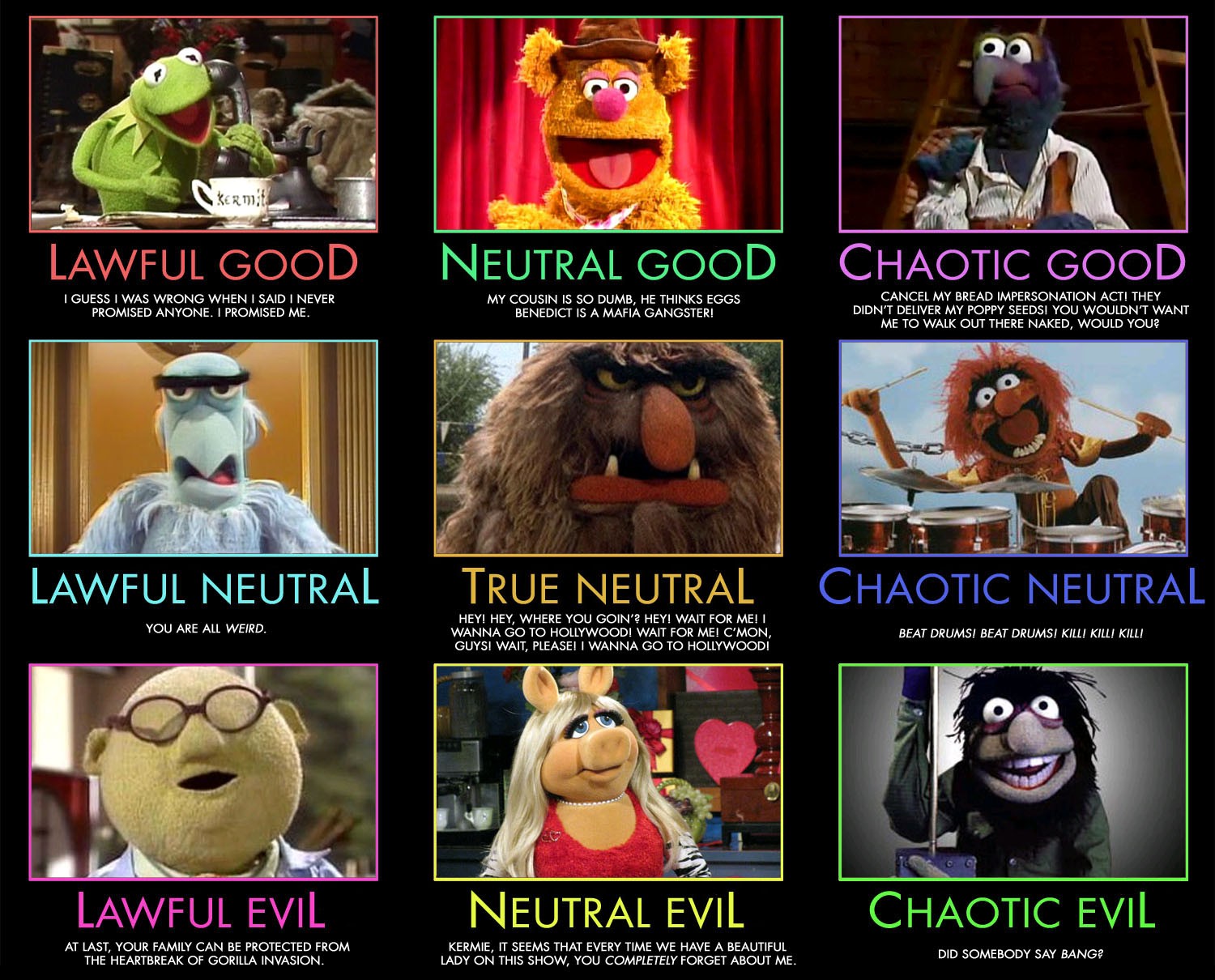
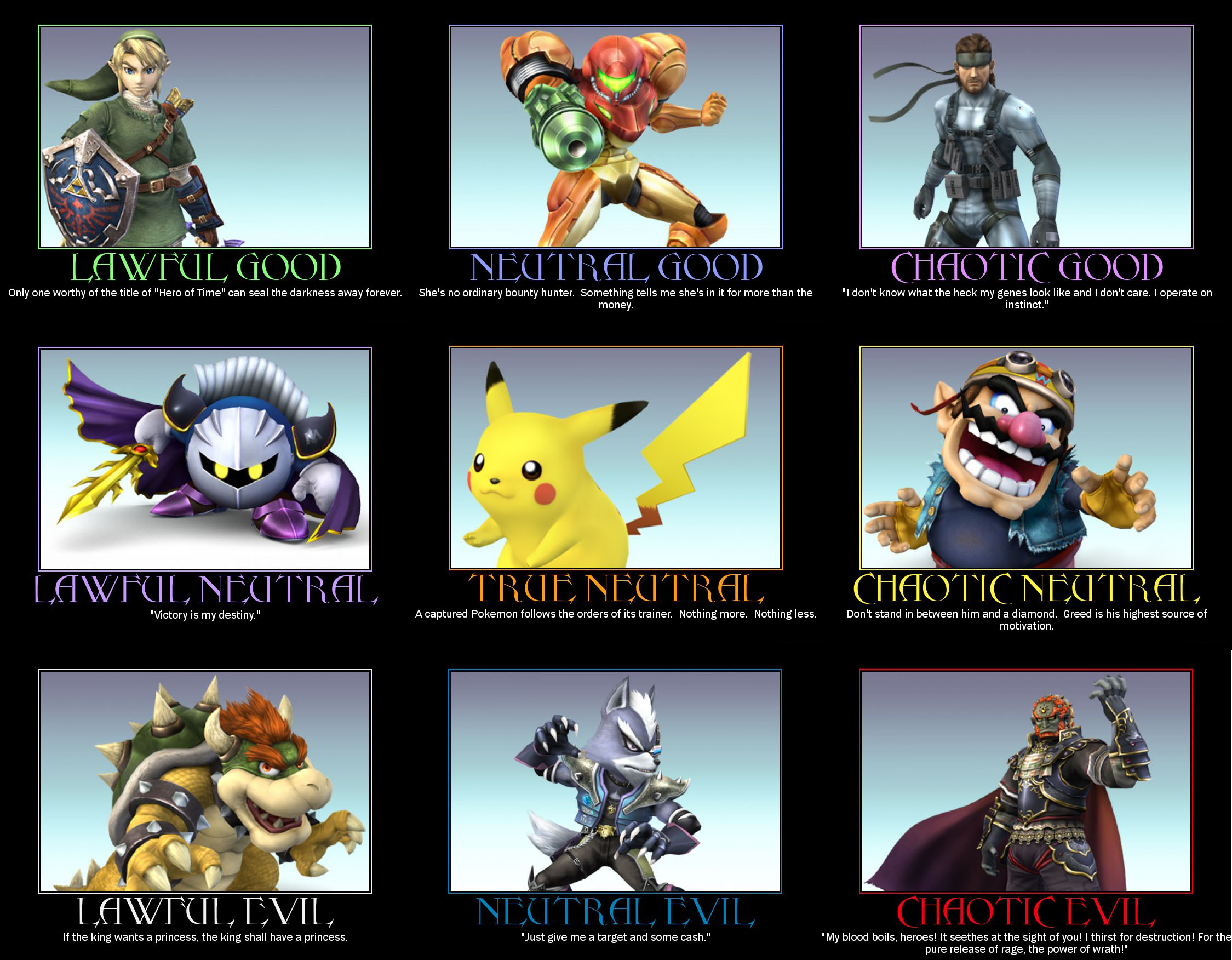
Friday, July 24, 2009
Beards
The following are pros and cons of growing a beard:
- Pro - You get called boss and sir far more often when shopping for things
- Con - You get asked "Are you buying these for your kids?" when buying cartoons or family movies (only really a con if you don't have kids or aren't buying said cartoons/movies for your kids)
- Pro - You can save parts of meals for snacks for later
- Con - Other people can see you saving parts of meals for snacks for later
- Pro - Men respect you more (see Chuck Norris)
- Con - Women are less likely to find you attractive
- Pro - You're one step closer to becoming a wizard, mighty pirate, first mate of a starship, lumberjack, computer programmer, etc.
- Pro - You can really emphasize how hard you are thinking at any given moment
- Con - People will know when you're plotting evil schemes (no no I wasn't twirling my moustache!)
- Pro or Con - People are highly unlikely to kiss your cheek
- Pro - A good, thick beard successfully hides zits underneath it
- Con - An improperly cared for beard may cause zits
- Pro - At any moment (assuming the beard is long enough) you can shave off the beard and gain back 10 years of your life
- Con (possibly) - You look 10 years older with a beard
- Pro - You have an excuse to get a moustache comb
- Con - You have to buy beard trimming equipment (unless you want the gross, unkempt beard look)
- Pro - You get asked one less question when getting a haircut (ie "Do you want sideburns?")
- Con - Wearing fake beards will no longer work as a disguise


Friday, June 12, 2009
Motion/voice controlled gaming
Ever since the Wii was announced, there's been a trend of motion control technologies released. Two of these were just announced at this year's E3 and the technology isn't finished, so I'll try not to judge them on how glitchy they may look. My big concern with this trend is that a lot of games do not work with motion controls. At least not without losing precision or feeling gimmicky. Project Natal specifically has this video of a family very happily playing a bunch of really dumb looking mini-games together. Let's assume for a second that anything shown in that video is possible (a big assumption in my opinion), sure that's great for like a 10 minute gameplay session with a bunch of people, but I don't see how that entertainment would last at all or be any fun when I'm playing a game by myself.
You've got a racing game where three people sit there and watch one person play for a very very rare moment of "Now I get to play!" If I were that dad, I'd tell my daughter to go to the pit stop every lap just so I could get to play. You've got a Godzilla game that looks like a glorified EyeToy game, which had the same problem of no games for it besides lame mini-games. You've got a game show game where the motion is hitting the buzzer. Didn't they sell that game only with an actual buzzer so you can't complain about it not registering your hand movement in time?
Maybe I'm just jaded because of the Wii's waggle-rificly inaccurate motion controls and constant stream of shovelware mini-games. Speaking of the Wii, they've released some new technology to make their motion sensing more accurate. If that works then that helps one problem, but developers still have the problem of slapping in motion controls in games just because. Like Wario Land: Shake It!, which would have been a fantastic old-school platforming game save for the fact that every half a minute or so you'd have to violently shake your controller to get money out of bags or get enemies out of their armor. This completely broke me out of the enjoyment I was having playing the game every time I had to do it. That's not the goal in my opinion.
Some games did manage to do the motion controls incredibly well without feeling gimmicky. Mostly because it wasn't shaking or waggling the controller to do things. It was pointing the controller like a gun to fire my in-game gun at people or making a motion like I was tossing a garrote around someone's neck to choke them (violent I know, but it is a game based on the Godfather).
So I guess my problem is two-fold. I really don't trust Project Natal for most games because I think it's important to have the feel of something in your hands while playing a game. Imagine playing Rock Band with no instruments. Air Rock Band Hero. Closets around the world would love that because they wouldn't have to hold so many plastic peripherals, but the controls would have to be so dumbed down to feel at all accurate, which would just ruin the experience.
The other problem I have is that for most games, I play at home to relax sitting on the couch. I can't do that if you're making me stand up and punch the air or run in place to get across the land of Azeroth or some such thing. If I had to run around as much as I make my virtual counterparts run around in games, I'd be the world's fittest marathon runner in existence. I don't see that being fun.
On the other hand, I do see Project Natal being great for workout games or line dancing or something related. My biggest complaint about working out is that it's mind-numbingly boring. I'm sitting there doing a repetitive motion staring at nothing, trying to get my mind wandering so it can be happy, but at the same time trying not to lose count of how many sit ups or push ups I've done. If I could be running on a treadmill while my TV is in front of me displaying a hiking trail I'm "running" on, that would be awesome! Or having a virtual personal trainer. Or even if I just had a simple progress bar above a virtual me that counted my reps for me and kept track of my stats so I could level up (ie turn working out into an RPG) then I'd buy that no questions asked.
So I'm wary of the future. If developers just cram in motion controls everywhere just to try and make a quick buck with "casual gamers", then I fear for the future of gaming. If developers are smart and use motion controls as a clever tool for more interactive gaming that makes sense and isn't a lot of work for the player, then I'm all for it.
Subscribe to:
Posts (Atom)